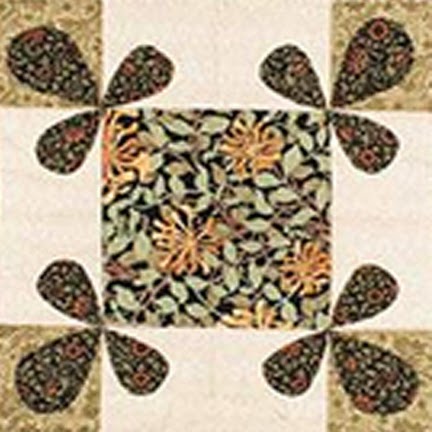
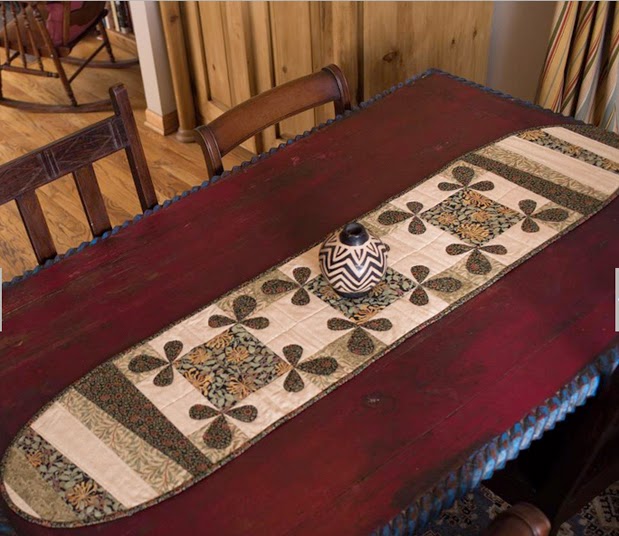
12" block in the Best of Morris Table Runner Kit
Here's a kit made from my latest William Morris repro fabrics.
Moda is offering a kit on Craftsy.
12" x 58"
Click here to see the Best of Morris Table Runner kit:
http://www.craftsy.com/supplies/moda-best-of-morris-table-runner-kit/10296
"Bring timeless style to your dinner table with Moda's Morris Table Runner Kit! You'll receive a pattern and fabric to sew this elegant, 12" x 58" runner. Featuring classic prints and an easy-to-piece design, this project comes together quickly -- and makes a lasting impression!"

I loved the look and did a little digital sketching to see what the 12" blocks would look like if you made 16 of them and added a little border (maybe 3") for a 56" square quilt.
The block pattern is an old one dating back at least to the 1840s.
You find it in various classic color schemes like indigo on white. The basic structure is a square in the center of the block with 3 leaves on each corner. All can be appliqued but occasionally you find a vintage example in which the square background is pieced and the leaves are appliqued over the seams.
I've been doing a little pattern tracking on the block, trying to figure out the date of the design and the influences. In my book Encyclopedia of Applique it's got a number (#5.32) but no name. You can barely read my fuzzy snapshot of page 64 above.
It says:
"5.32
T (for traditional pattern)
Unnamed---from a quilt ca. 1840"
I have found several variations in mid-19th century quilts,
with the variety in the shapes of the leaves.
These are from samplers and from single-pattern repeat block quilts.
A different green, typical of the early 1840s
when Sarah Ann Smith of Swarthmore, Pennsylvania
signed and dated this chintz-bordered version in 1844.
Here's a graceful example--mid-19th-century.
Are those seams extending from the edges into the leaves?
I guess you could piece this whole thing.
You---not me.
A block from an album/sampler. The corners look like cacti.
During the 20th century a change occurred.
The center square became a nine-patch.
#5.33
Here I labeled it T for Traditional applique and indexed two names:
- Honey Bee from Nancy Cabot's quilt column in the Chicago Tribune in 1933.
- Birds in the Air from the Coats and Clark Thread Company in 1942.
Maybe it isn't so T for traditional, but rather a D for designer-drawn.
Ruby Short McKim is probably the first designer to show this pattern with a nine-patch in 1929.
McKim's pattern published in the Kansas City Star in 1929.
Carrie Hall called it Blue Blazes too in her 1935 book Romance of the Patchwork Quilt.
Here's the actual block from the Hall collection at the Spencer Museum at the University of Kansas.
(An aside: I bet that tan color was once darker than the blue, but it has faded to khaki.)
To see it at Spencer's online collection site click here and scroll down:
Hall in her book included a photo of a finished quilt with the nine-patch center. It's tough to tell how old it is from the black and white photo but the border is a weak clue to after 1870 or so. Hall, who was always on the side of romance --- as in fiction---captioned this quilt "Honey Bee: A beautiful specimen of this lovely old colonial pattern." Colonial technically means before 1776 but in the 1930s that word implied "old." It's certainly not a colonial pattern, much more an 1840s design, which of course is "old."
Because the block with the nine-patch is mostly pieced I included it in my BlockBase for pieced designs.
The block with the nine patch has a number in BlockBase #2217 and an applique number #5.33.
In either format---with or without the nine-patch--- it's a good beginner's block because it's simple piecing and simple applique.
The Table Runner kit is an excellent format for basic patchwork, a good teaching tool, or a project to improve your skills.
Another vintage variation---no name, no number, one of a kind?