QUILTS & FABRIC: PAST & PRESENT


Thursday, August 11, 2016

Books For Sale

Auguste Reading to Her Daughter
by Mary Cassatt

Reading women were a favorite subject matter for painter Mary Cassatt.
All the paintings on this page are by her.

I've spent a little time inventorying the books in my basement.

Young Lady Reading

As Henry Thoreau once said:
"I have now a library of nearly 900 volumes over 700 of which I wrote myself--"

I imagine he meant he had 700 unsold copies of one of his own books and a few by some other authors. I am in a similar position.

I've also checked on which of my books are still available to purchase from other places.

The Reader

If you are looking at this page on a computer you can see a column over on the right with links to books I've written. I've recently updated that so most of the links should work.

There are a few places you can buy the books.

One good source is my Etsy Shop. I have copies from the original print runs that I will be glad to sign and send you.
Click here to see the book store:

Francoise

The other is C&T Publishing's search page about MOI

Last time I looked they have 14 books available. Some were originally published by the Kansas City Star Quilt Division and are from the original print runs.Others that C&T published over the years are print-on-demand (meaning they print a darn good edition when you order it.)

Reading Le Figaro

Some of the books like Clues in the Calico are completely out of print
 (can't find a POD or an eBook edition)
but it's not that outrageously priced as a used book online.

Mary Cassatt in old age with a book.
From the Smithsonian.

See more paintings of women reading:

https://thesleeplessreader.com/about/fellow-readers-favorite-paintings-of-women-reading/

Tuesday, August 9, 2016

Past Perfect: Hamilton: The Quilt

Georgann Eglinski: Hamilton: The Quilt (top)


 It's the year of Alexander Hamilton. We saved his bacon on the ten dollar bill. Hamilton: An American Musical is a Broadway mega-hit.

Lin Manuel Miranda 
as Alexander Hamilton

The central panel copied from a circa 1800 print done
by the Hewson print works in Philadelphia.
Georgann added more butterflies and flowers.

And Georgann has been listening to the music as she sewed on her medallion featuring the reproduction panel from John Hewson. She read the Ron Chernow biography of Hamilton and as far as she's concerned it's 1803.

With one concession to the present.

The Winterthur-Hewson prints designed by Kathy Hall came out in 2011.
I'm still working on my version.
(or maybe the phrase is---mine is still in the waiting for border inspiration box)

Georgann's chintz scrapbag is fairly monumental.
Much of it is from lines that Terry Thompson and
I have done for Moda over the past twenty years.

See some more Hewson quilts at this Pinterest page:

Saturday, August 6, 2016

Morris Hexathon 14: Canterbury

Morris Hexathon 14: Canterbury by Becky Brown

Morris Hexathon 14: Canterbury
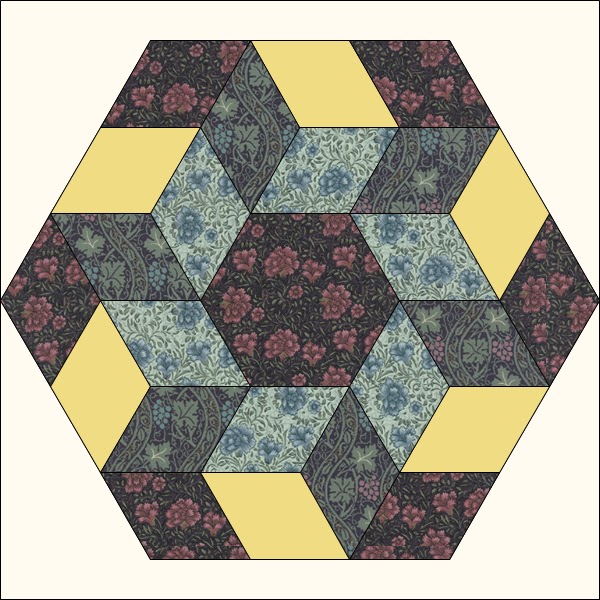
3 Templates:A hexagon, a 60 degree diamond and a long parallelogram.

I named this week's hexie Canterbury for England's famous cathedral.


When William Morris was eight years old his father took him to visit the ancient church, which was begun about 1200 in the new style that came to be called English Gothic.

 14: Canterbury by Ilyse Moore


A ceiling

The child was impressed, remembering that he felt "the gates of heaven have been opened to me." It was an experience that changed his life.

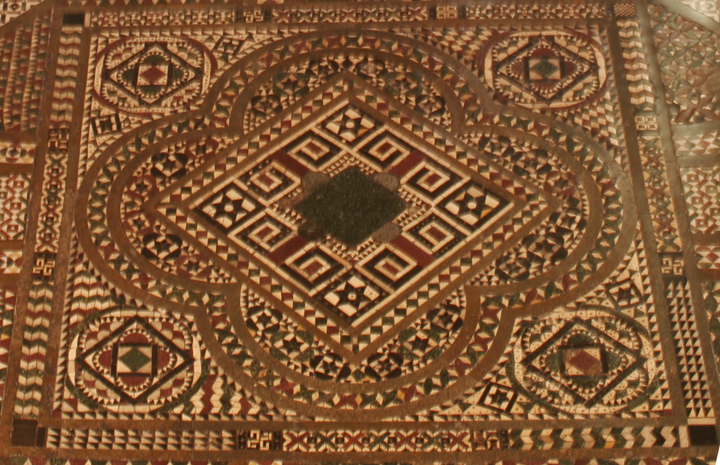
A floor

The cathedral is one of the earliest examples of English Gothic architecture.
Pointed arches are a style detail,

as are vaulted arches in the ceilings.

The impressive vault is held up by outside supports.
Those arches extending out from between the windows are
called Flying Buttresses, another characteristic of Gothic architecture.

Pattern for an 8" Hexagon
(4" sides)

To Print:
  • Create a word file or a new empty JPG file that is 8-1/2" x 11". 
  • Click on the image above. 
  • Right click on it and save it to your file. 
  • Print that file out 8-1/2" x 11". The hexagon should measure 4" on the sides.
  • Adjust the printed page size if necessary.
  • Add seams when you cut the fabric.
Canterbury by Bettina Havig

Canterbury by Ilyse Moore
Ilyse did two.

The pattern, BlockBase #264, was given the name Pinwheel in the Kansas City Star in 1934 but to remember Morris's fondness for the Gothic we could see the image as the Flying Buttresses that hold up Canterbury Cathedral.

Using just two of the pattern pieces you could make a double pinwheel.


In later life as an influential preservationist Morris had strong opinions about the maintenance and changes in Canterbury Cathedral. He wrote letters to The Times:
"For my part, remembering well the impression that Canterbury Cathedral made on me when I first stood in it as a little boy, I must needs think that a great building which is obviously venerable and weighty with history is fitter for worship than one turned into a scientific demonstration of what the original architects intended to do."
His position essentially: Keep a roof on it and leave it alone.

Canterbury Cathedral

One More Inspiration


Owen Jones published an extremely influential book on pattern in 1853.
There's a page above
and here's the whole book The Grammar of Ornament at Google Books:


Thursday, August 4, 2016

Dearle's Compton & Thistle for Morris Earthly Paradise


Compton reproduction print from my Morris Earthly Paradise;
the original a wall paper by John Henry Dearle in the mid 1890s.

Compton Hall is now a Hospice House

The is some controversy over who designed the Compton wallpaper, which was commissioned for Compton Hall in Wolverhampton by owner Laurence W. Hodson. Compton Hall sites describe it as Morris's last design, but it has an art nouveau complexity that reflects Dearle's style. The current attribution is that Dearle designed it in 1895 or 1896.

Repro Compton print cut into six triangles and rearranged for Block #2  
in the Morris Hexathon by Becky Brown.
The colorway is Kelmscott Blue.

Block #3 by Becky 
The flower in the center 
is from Compton.
How does Becky do it? Scroll down to see her methods.

The sample in the Victoria and Albert Museum's collection comes from a wallpaper book which they describe as "Volume 2, containing 25 Morris & Co. patterns from 1882-96." Morris died in 1896 and he was not well in those final years. Dearle took over designing the flat patterns.

Wallpaper sample detail from the V&A


John Henry Dearle (1859-1932)  became head designer at Morris & Company in 1896.


The Morris Earthly Paradise collection has another Dearle print,
Thistle from 1897.


Thistle in the center of Block 3 by Bettina Havig. The print
was originally a large-scale wall paper---as large as the sample below?

I used the monochromatic, textured repeat
for a small print that you can use almost as a solid.

Thistle in the Madeira Wine colorway around the edges in 
Block 1 by Becky Brown

We printed Thistle in seven colorways.

SuznQuilts has sorted out her Earthly Paradise pieces.
She's making tiny Dresden plates


Dearle stayed in the background. Morris was the public face of Morris & Company, even after his death, so company history and personal biography about Dearle is slim. When I posted about him several years ago one of his relatives corrected a common error in his birth date. He was born in 1859.
"Some dates for you to expand the information of John Henry Dearle: [Father] William Dearle married Sarah Louise Palmer in 1855. He was born in 1832 and died in 1908. John Henry was born 1859 but baptised in 1860. He was the second son out of a family of 5 sisters and 5 brothers. William's sister married my maternal Great Grandfather and , as I have been researching the family tree, I have the information at hand.
All the best,
Colin Dearle Coke"
Thank you, Colin--- Henry Dearle deserves a lot more credit and a lot more research than he gets.

 Read more about Dearle here:
http://barbarabrackman.blogspot.com/2012/11/john-henry-dearle-morris-apprentice.html

And see another picture of him here at the Victorian Web
http://www.victorianweb.org/art/design/textiles/dearle.html

The seams for Becky's #5 show the whip stitching and open seams typical
of English paper piecing. The paper
(freezer paper) has been removed.

Regarding the Paper Piecing for the Morris Hexathon. People have been asking about how to do these blocks. I watched Bettina make her models using traditional hand piecing, which she is quite adept at. I assumed Becky machine pieced the models but she says:
"NONE of mine are machine pieced - at this size is that even possible? I'm not that good! Just wanted to let you know that I don't sew those little pieces by machine. (have never even tried)
Most of my blocks were done EPP using freezer paper (faster than basting the seam over). I print your patterns directly to freezer paper. Some of the blocks with fewer pieces were done with traditional hand piecing."

Attached are a couple pictures showing the back. (Notice, I do nothing to the outer edge of the blocks)."
In other words she doesn't glue/baste those outer edges under. 

Tuesday, August 2, 2016

Antique Blocks in the Mail

Nancy sent me some vintage blocks as a gift,
Thank you, Nancy.
That peony or cactus rose variation is a great design.

The applique blocks look 1840-1880---
Turkey red and green, classic patterns. The wreath has yellow circles of reverse
applique in the center of each flower.

Carolina Lily 
One great thing about unfinished blocks is they show you
how quilters used to work.
B-A-S-T-I-N-G.

This pieced block looks to be the latest one,
probably 1880s in that very fashionable blue print
we call Lancaster blue.

The most amazing thing was this one.

Because I already have its twin sister.
The other blocks look unfinished and never put into a quilt but these two
seem to have been pulled from a stained old top.

Nancy's blocks were purchased in Arizona.

I can't remember where I got the first one but I have always thought it was terrific.
Love the stripes.

How did they get so separated and where's the rest of the quilt?

I'd guess the other three applique blocks were someone's pattern blocks that she saved to make a quilt out of someday. This variation on Wreath of Roses or President's Wreath is so nicely done you could actually use it as a pattern. So click on the picture above and print it out. If you don't need too much
guidance you have all you need.