QUILTS & FABRIC: PAST & PRESENT


Saturday, February 19, 2011

The Name on the Quilt


A few months ago the editors at The Quilt Life Magazine asked me:
What was the most surprising thing I've found out in quilt research?
I had to think for a while and I decided the answer:  
I've been most surpised by the differences between what we call a 19th-century quilt design and what the quiltmakers called it back then.

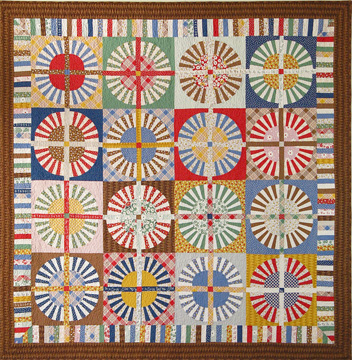
What would you call the pattern pictured above?


This quilt from the collection of the Shelburne Museum confirms a name I probably would use for this pattern. Another name I'd use would be Democrat Rose.

We don't know much about pattern names before 1890 when magazines and quilt pattern companies really began to publish them as a way to sell patterns. But some earlier quiltmakers like Charlotte A. Raynor actually recorded the name on the quilt.


Most of the examples I've seen over the years, however, do not confirm my idea of what the pattern is called. The Arizona Quilt Project found a similar quilt to the one above. The maker Sarah Gear appliqued her name and the words "Odd Fellows Rose" in the border. (See their book Grand Endeavors, page 187 for a photo of the quilt.)


How about an indigo star like the block above?
The Illinois Quilt Research Project 
found a quilt assembled  from old blocks
 like this one. In the border is appliqued:
Jackson*Star*Quilt*Made*1849
I don't know of any other patterns named for Andrew Jackson. This might be the only one.

For a picture, see page 60 in the Illinois project book: History From the Heart

I might call this pattern Missouri Rose or Love Apple or Pomegranate.
On the reverse of this one is inked:
Mississippi Beauty
Judith Connor's Quilt. Presented by Jane Shelby,
Feb the 10, 1855

The quilt is now in the Winedale Collection at the University of Texas.
Click here to see the file in the Quilt Index with a photo of the quilt.


And here's
"The Peony and Prairie Flower"
by Parnell Grumley, dated 1847,
in the Shelburne collection.
The block might be the peony,
the border the prairie flowers.


How about this pattern?
I really don't have a name for it
because I don't think I've ever seen it before.


Clarissa Strong did us a favor when she created the border in 1854, telling us it's "The Indiania Fancy Quilt." The quilt is in the collection of the Indiana State Museum. Read more about their collection at the WomenFolk webpage by clicking here:


Years ago I saw an unpublished quilt in this pattern. Badly burned, it's fortunate that it survived at all. The applique pattern is one we'd call Prince's Feather---or is it Princess Feather? It really doesn't matter, because on the face of the quilt it says: Kossuth's Feather

Lajos Kossuth was an extremely popular figure in the 1850s, a Hungarian political activist intent upon overthrowing the rule of the Austrian Emperor in his homeland. In exile, Kossuth traveled the world raising funds for his revolution. A magnetic speaker and handsome man, he toured America 1851 and 1852.

Like all publicity-conscious revolutionaries, Kossuth wore a dramatic costume. His was topped with a large hat and a larger feather. The Kossuth feather became a fashion statement. I've never seen another reference to the revolutionary name for a pattern we identify with royalty.


Read more about the history of the pattern at Karen's blog posting:
http://karenquilt.blogspot.com/2010/12/red-and-green-part-1.html

And click here to see a pieced quilt with the pattern name "Ladies Ramble" on it at the Bergen County (N.J.) Historical Society:
http://www.bergencountyhistory.org/collections/LadiesRamble1876.2.jpg
Read more about it here by scrolling down:
http://www.bergencountyhistory.org/Pages/BCHScollectionsRV.html


So when people ask me what is the "correct" name for a quilt pattern I just have to say: "There is no correct name for a quilt pattern." That surprised me when I figured it out years ago. Now I just shrug and say, "Whatever you want to call it."

Tuesday, February 15, 2011

Does This Stripe Make My Quilt Look Fat?

Strips and stripes from various online auctions and other digitial sources


Saturday, February 12, 2011

Ditsies and Mela Koehler


Brenda and her mom have finished the top they made from a ditsy floral pattern I showed last year.

I'd seen a kit in an online auction and showed it when I was discussing ditsies---vague florals of basic shapes. The pattern was easy to draft (that's the great thing about ditsies-there's nothing to them) and they made it in hand-dyed fabrics with various black batiks for backgrounds.

A very modern looking quilt in the color scheme and in the simplicity of the floral.
You can follow her progress at her Scraps And Strings blog:

 A hundred years ago these simple florals (textile designers now call them ditsy prints) were a keynote in modern design.

Artist Mela Koehler often featured simple florals in her illustrations of fashionable women. Here's a modern floral on a period costume in a postcard from about 1910.


My favorite Mela Koehler illustration.
Two dachshunds and a rainstorm

Melanie Leopoldina Köhler-Broman was born in Vienna, Austria on November 1885. As an art student in Vienna between 1905 and 1910 she was a student of Kolomon Moser, one of the stars of the Vienna Workshop movement (the Wiener Werkstätte.) Her illustrations of fashionable women and children became popular postcards and fashion designs. She was interested in textile designs, as you can see in her postcard illustrations, and also designed prints for the Workshop. She died in Stockholm on December 15, 1960.


Translation of the German ö in her name causes numerous spellings of Köhler. She signed most of her postcards Mela Koehler but some have her married name Mela Koehler Broman. Another spelling is Koeler. She also signed some Mela Koehler Wien, which means Mela Koehler Vienna.


She often included dogs with her fashionable women.
Same storm, different pet.


And here's a little eccentricity from Vienna before World War I,
Taking your pet pig out for a glass of champagne.


Original Mela Koehler postcards in good condition are worth over $100.
I'm keeping my eye out at the flea market. 

Oh, we were talking about ditsies weren't we. Read more about them in this post that inspired Brenda.

Wednesday, February 9, 2011

Snow Globe Quilts

I've been out in California for a week while it
continues to be winter in Kansas.
We've had a lot of snow these past two winters.
Hard on the shortlegged...
And the short tempered.

But if you have snow, make snow globes.
Here's a quilt by Marie Schmidt
using the snow globe pattern in my book
Sew Into Sports.


She found Christmas prints, winter scenes and other themes important in her family life.
The quilt was made for her grandson.

It's a good project to use with the Let it Snow
collection from Laundry Basket Quilts for Moda.
Beautiful batiks.

See some sports-themed snow globes at this post

Sunday, February 6, 2011

Reproduction Patterns


Sandy Klop, my fellow designer at Moda, designs patterns for reproductions using her fabric collections called American Jane.


Wagon Wheels

She uses her signature primary colors and
high-contrast range of prints to reproduce some classic antique quilts


Edy's Quilt: Galaxy of Stars


Oh My Stars!

Click here to see Sandy's American Jane webpage and order her patterns:
And click here to see her latest Moda fabrics:

Indiana Rising Sun by Michelle Yeo

Australia's Michelle Yeo also makes impressive reproductions and patterns. Kansas City Star Books is now distributing her patterns in the U.S. Click here to see the Pickledish Store with three of her patterns:


See my earlier post on her reproduction patterns by clicking here:

King David's Crown by Michelle Yeo

Thursday, February 3, 2011

Swatch Books at Moda


In the last post I wrote about my road trip
to Moda/United Notions headquarters in Dallas.
My major goal was to go through the antique swatch books
the design department has been collecting.

They've bought several books from various mills,
collections of samples printed, say in 1904.

Here's a book with swatches from the mid 1870s.

My French is rudimentary but I think the label says the book was bound in the textile city of Mulhouse in France.  


The books are full of numbered swatches, some related in color.

Others are related in print style.
Many would make excellent reproductions.
It's surprising to see these color combinations that don't fit into our idea of period fabric.
Some of the pages mix cotton prints with wool/silk combination prints in which you'd find brighter color.

This mid-century page looked like wool/cotton mixes (delaines)
I love the red stripe on green contrasted with the green stripe on red.


It's hard to believe these are mid-19th century colors.
Mint green and magenta.
Could that be in the infamous poison green?

Turkey red cottons with greens from overdyed blues and yellows.

Many of the pages contain sketches and paintings of the print rather than the prints themselves.
Can you see the very faint pencil lines covering the paper here? The artist has painted in a color idea for this print that looks like jewelry on top of seaweed.


This is an unfinished sketch for a paisley.
That's my pinky finger for scale.

These sketches are called croquis in French
(pronounced crow'-key)
The fashion industry has adopted that word for a painted design.

Here's a beauty--- a stripe with a daisy or marguerite--- from 1864

A foulard style floral from
April 1875

Wow!
I don't paint croquis for my fabrics.

I collect old swatches and scan them.
I find most of mine in quilt blocks and tops.

The swatch books are expensive. They can go for thousands at auctions.
You might ask your local art or history museum if they have any textile sample books.
Here's a page on German swatchbooks. Scroll down for pictures

We'll see what reproduction collections come out of my trip. From idea to print it usually takes over a year.