QUILTS & FABRIC: PAST & PRESENT


Wednesday, May 19, 2021

Triangle Puzzle


An interesting red, white and blue quilt
found in the Massachusetts project. 

61" x 78"

Family attributed it to Perry M Lenterman of Chicago and thought it might have been made in 1894. It's machine pieced and machine quilted and someone counted 9,750 solid color triangles---all the same shape, a tessellation.

In 1877, 22 year-old Perry Moss Lanterman married Ella Saphome Butler in Chicago, and this is likely the quiltmaking Perry whose name is variously spelled Landerman, Lenterman and Lanterman.  He was a New Yorker, born in 1856. Ella was born in Massachusetts, probably the connection to a Massachusetts relative who inherited the quilt.

Ella and Perry had four children between 1879 and 1894.  Ella died in 1896 leaving children from two to teenagers. Perry remarried in 1899 to Anna Johnson, about 20 years younger. She was born in Norway.


Well, I can't figure out the repeat. It's not an equilateral hexagon although those look like equilateral triangles.


What kind of a man makes a quilt like this?


In 1880 census taker Harriet Van Orsdel recorded Perry and Ella living at 724 Van Buren Street with their eldest son. (It's under the enormous freeway interchange downtown now.) Perry is listed as a machinist and that is consistent throughout his life.

He ran the Chicago Knife Works at 179 S Clinton. This
ad tells us the firm was established in 1863 when Perry was
about 7. He came with his parents to Chicago, so the business
might have been begun by his father Benjamin Franklin Lanterman.

One can imagine a machinist/mechanic figuring out a tessellation to keep himself entertained. And one wonders if he made other quilts. He lived from 1856 to 1925.

Here's his gravesite in Chicago:

Saturday, May 15, 2021

Flora Delanica #8: Calendula


Flora Delanica #8: Marigold (Calendula Officinalis) 
by Becky Brown

Calendulas, once called Pot Marigolds, are a Mediterranean native. This month we celebrate Mary Delany's "Hive" so the now common garden flower and its pollinators are May's Flora Delanica block.


After her well-loved Irish husband died in 1768 Mary Granville Delany moved back to England to rejoin her circle of friends. She spent summers at her closest friend's home, assisting Margaret Duchess of Portland with the estate's gardens and her collections of shells and botanical specimens.

Gothic remodel of Bulstrode Park long after the Hive buzzed there

The Duchess of Portland's favorite home Bulstrode Park was not far from Windsor. Even the King and Queen were envious of the fun and learning that went on in what was called The Hive.


 Margaret Cavendish Harley Bentinck, the Duchess of Portland (1715-1785) 

Through a series of inheritances from female fore-bearers and a fortunate marriage, Margaret Bentinck inherited enough to be considered the richest woman in mid-18th-century Britain (Sarah Churchill, Duchess of Marlborough was a rival.) Rather than spending her fortune on frivolity Margaret became a great collector of natural sciences and art. She also maintained a collection of like-minded friends.

Bulstrode house in 1794
From a watercolor by Richard Courbould about 1790
This early house was pulled down and a new one built in 1865.

The buzz of industry was generated by natural scientists, authors, librarians and artists who accepted her generosity. What a wonderful place it must have been.

Becky's Calendua

Mary enjoyed it:
"We live as magnificently as the Prince of Wales, I am as easy as if I was at home, which is charming and very uncommon."
Henrietta Cavendish Holles (1694-1755)

Initially, Mary became friends with Margaret's mother Henrietta Lady Oxford of her own generation. Before she married Patrick Delany Mary spent time with Henrietta at Bulstrode Park. Mornings were spent drawing and afternoons looking at the artwork collected by Lord and Lady Oxford. (This would be  like viewing a screen with friends today---hosts collected prints and displayed them on tables in the sitting rooms and libraries.)

Landscape "View of Bulstrode Park," signed "M Pendarves, 1741"
Mary drew landscapes most of her life, telling her sister
 they were the easiest things to draw.
They have nothing of the finesse of her papercuts.

Marigold by Ilyse Moore

After her mother died Margaret inherited Bulstrode and she and Mary grew closer.

Margaret commissioned this box with Mary's portrait on the top
when they were in their early middle age. 


Portraits of four members of The Hive; Mary referred to them as "the Hivites" in a 1755 letter. Clockwise from top left, Elizabeth Robinson Montagu, unknown, Mary Delany, Margaret Duchess of Portland. The unknown woman in the white dress looks like Anne Donnellen but might be another Hivite.

#8: Marigold (Calendula Officinalis) 
by Nancy Phillips

Mary described the widows' recreation:

 "We have variety of amusements..."  reading [although the Duchess did not like novels so no frivolous novel reading], working, drawing, billiards, looking over prints, cribbage, four meals a day, playing with the children.

Nancy's Calendula

 "Working" meant doing needlework, which might be plain sewing of clothing for the family or the poor or fancywork, forms of embroidery.

 Marigold (Calendula Officinalis) by Mary Delaney
British Museum
https://www.bmimages.com/preview.asp?image=01060990001&itemw=200&itemf=0001&itemstep=1&itemx=23

The Block
#8 Calendula

Applique on the diagonal to an square cut 10-1/2" or on the vertical center of a rectangle cut 9-1/2" x 12-1/2".

One Way to Print the Pattern:

Create a word file or a new empty JPG file that is 8-1/2" x 11".
Click on the image above.
Right click on it and save it to your file.
Print that file out 8-1/2" x 11". Note the inch square block for reference.
Adjust the printed page size if necessary.
More detail in the negative

#8: Marigold by Barbara Brackman
I let the fabric do a lot of the drawing.

A Little More Mary Delany

Mock Orange

William Gilpin who influenced "picturesque" garden design described Mary Delany's methods:
"She pulls the flower in pieces, examines anatomically the structure of its leaves, stems, and buds, and having cut her papers to the shape of the several parts, she puts them together....by laying one piece over another."

Further Reading
Read more about the Duchess here:


And this biography: Duchess of  Curiosities: The Life of Margaret, Duchess of Portland by Rebecca Stott.

Ilyse's Calendula

Recent interpretation of the Hive: "Collecting the World: Female Friendship and Domestic Craft at Bulstrode Park," by Madeleine Pelling.
And join our Facebook Group: MaryDelanyQuilts:

Tuesday, May 11, 2021

Bertha Waldauer Marshall's Crazy Quilt

 Crazy Quilt (about 1886) attributed to Bertha Marshall, 
Tennessee State Museum, 2008.185. Gift of Alan Callner. 


A while ago I did a post on crazy quilts with these
plush work swans.

Lida Finnell Allin's quilt in the collection of the Smithsonian.

They seem to have been a Kentucky product with some very elegant examples surviving in museums and private collections.

Bertha's quilt has the embroidered floral borders seen in the Kentucky quilts as well as the swan.
Her family thought the quilt might have been made near Memphis, Tennessee in the 1880s.

Bertha Waldauer Marshall (1858-1950)
towards the end of her long life.

But Bertha spent the 1880s in Greenville, Mississippi where her five daughters were born between 1883 and 1897. She'd arrived there with her mother Henrietta Rathchild Waldauer (1828-1910), her four brothers and two sisters in the 1870s.
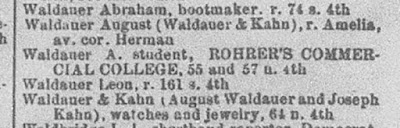

Her parents, German immigrants, moved quite a bit. She was born in Wisconsin and spent her childhood during the Civil War in St. Louis among many other German immigrants where her father Abraham Waldauer was a bootmaker. After the peace they moved to New Orleans. Abraham died in 1867 in one of the regular Yellow Fever pandemics that afflicted the city. 

Bertha's father was buried in New Orleans
but his marker has been moved to Greenville.

Lockdown in New Orleans

The 1870 census, three years after Abraham's death, finds Henrietta still in New Orleans 
where she "Ret Dry Goods Store"---retired?
Update: No---Peggy says Retail. Retail Dry Goods.

According to family memory Henrietta, wary of the city's unhealthiness, took the children up the Mississippi to Greenville where she remained the rest of her life. They may have arrived in 1873.

Henrietta appears to have been quite resourceful, again owning or managing a dry goods shop in the river port as her children grew.

Shipping in Greenville, about 1900
Library of Congress

Greenville was a retail hub for the area.

The family owned dry goods stores from the 1870s into the 20th century. Erlich & Waldauer was a dry goods store with a dressmaking department on the top floor established by brother Louis in 1886.  The Waldauers sold their share to Erlichs about 1904 and Louis founded the Waldauer Cotton Company


The river port in cotton country was a center
for cotton brokers dealing in wholesale cotton and loaning
money on future crops.


Bertha Waldauer married Edward G. Marshall (1851-1910) in March, 1883 when she was 25. He was a Greenville neighbor, a German immigrant and either a competitor or associate in the dry goods business. 
.
1890 ad for Edward's store

A Mississippi store with piles of drygoods

The 1900 census records Henrietta living with Ed and Bertha. He was a "Merchant Dry G." 


1910 was a terrible year for Bertha. Her husband died of  heart disease in New York in February and mother Henrietta died in December. In 1911 Bertha began advertising her retirement. She sold the store the following year and spent much of the rest of her life living with one daughter or another in various states. One daughter lived near Memphis which may be how the quilt became associated with Tennessee.

Her grave in the Jewish Cemetery in Greenville


The swan crazy quilt probably took several years to finish and by the style it looks like it was begun around the time of Bertha's 1883 marriage. Were the scraps of silk satins and velvets from the family store?

A more important question is why is the central swan so similar to the Kentucky embroidered silk quilts?
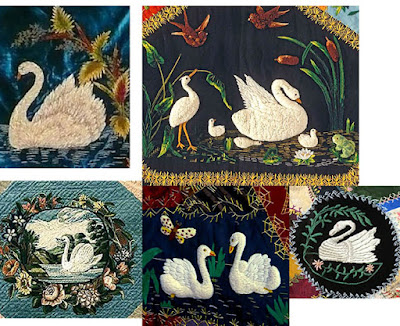
One Mississippi swan at top left with Kentucky swans.

Did Bertha go to school in Kentucky? Her oldest brother Joseph Waldauer received two degrees in medicine in Louisville.

A prosperous Greenville in the early 20th-century

"For much of the 20th century, Greenville had the largest Jewish population in Mississippi, with the most concentrated population of Jewish merchants in the state as well."


Bertha's quilt also gives us a window into Southern Jewish life. The Waldauers, the Marshalls, the Erlichs were all part of the substantial Jewish community that formed commercial life in the South. Southerners who considered themselves aristocratic disdained "trade" and Jews prospered by filling that gap. One of the Marshalls' Greenville competitors was Sam Stein whose Steinmart has grown into a national chain.

Further reading:

See a 2009 article on the quilt and the family in The Tennessee Genealogical Magazine here:
https://www.tngs.org/resources/Documents/Magazine/Vol%2056%20No%201%202009.pdf

An interview with 80-year-old Ernest Waldauer in 1977. Oral History Project / Washington Co. Library System
https://da.mdah.ms.gov/vault/projects/OHtranscripts/AU445_099322_1.pdf