QUILTS & FABRIC: PAST & PRESENT


Saturday, August 24, 2019

Daredevils Block #4: Hélène's Star

Daredevils #4  Hélène's Star


#4 by Dorry Emmer
The model makers, Daredevils all, add pieces to the basic pattern.

Scroll down to see the official pattern for a 15" finished block.

Becky Brown's block altered a bit to look official.


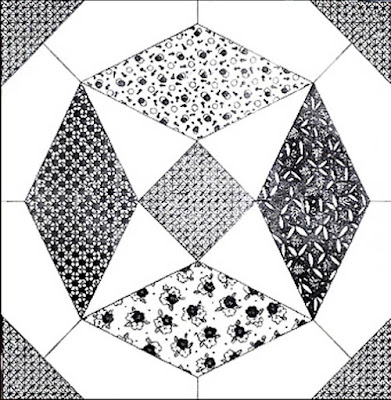
When I started collecting quilt patterns in the 1970s there were several little magazines with low circulations---cottage industries. Aunt Kate’s Quilting Bee was written, edited and published by Glenna Boyd of Oklahoma and this modern star, a four-patch, was one of her designs. which she called New Star. An added quarter circle in the corners makes a secondary pattern.

Little magazines are among the most ephemeral
of quilting ephemera. See a post on Aunt Kate:
http://aliceanjo.blogspot.com/2009/12/aunt-kates-quilting-bee.html

I worked for a little magazine in the 1970s---it got big.
Quilters Newsletter


Denniele Bohannon's #4 before she appliqued the circles over the seam lines.

The Block

Daredevils pattern for a 15" block.


Cut paper templates. Add seams to the fabric.

How to print:
Create a word file or a new empty JPG file that is 8-1/2" x 11".
Click on the image above.
Right click on it and save it to your file.
Print that file out 8-1/2" x 11". The small square should measure 1".
Adjust the printed page size if necessary.

Becky Brown's actual block. 
All that empty space in the center......

 Quick Quilt from BlockBase in 
Aunt Kate's original pattern for New Star

Hélène Dutrieu, 1911

Belgian Hélène is one of the few daredevils to live to a calm old age.
https://airandspace.si.edu/explore-and-learn/topics/women-in-aviation/dutrieu.cfm


Monday, August 19, 2019

AQSG Fundraiser: Repro Print Scrap Bags

Get rid of that fabric you are never going to use.

STASH BUSTING
NO SEWING REQUIRED
(SOME IRONING MAY BE REQUIRED)

Claire and I got this idea last year to sell scrap bags of  hard-to-find reproduction prints from our stashes (and yours) to benefit the American Quilt Study Group's Endowment Fund.


Last fall at the Seminar in Maryland she set up a table selling bags and yardage from her stash and others. She had many satisfied customers. And raised a lot of money for the Endowment Fund.


This October she is going to do it again in Lincoln, Nebraska, so bring some money.
The Seminar is October 9 -13, 2019 at the Embassy Suites Hotel in downtown Lincoln.

She takes cash, cards and checks.
NO CARDS. No barter.
Her table will be separate from the auction.

And bring some reproduction fabric to donate. It's a stash-busting event!


Even if you cannot make it to the Seminar you can send us scrapbags and yardage. Here's the plan:
  1. Go through your stash of repro fabrics and pick out some stuff you are not going to use. Yardage (fat quarter or larger) or just scraps (You know how crazy we are about scraps.)
  2. Iron these.
  3. For the scraps: Package them up in gallon plastic storage bags. You might want to sort these by style as customers will go for a style they are collecting. See a list of styles below.
  4. Make a label for each bag by putting a small piece of paper with the style name in the bag: e.g. Turkey Red, Double Pinks, Indigos, etc.
  5. For the larger yardages measure to get a rough number on the yardage. Pin a label with that measurement (e.g. 2-1/2 yards) onto the yardage.
  6. Fat quarters could go in the gallon bags or just make a stack of them. We'll figure it out.
  7. Bring these with you and get them to Claire when you arrive at the hotel. We'll have signs on the bulletin boards telling you where to drop these off.
  8. Or ship them if you can't come or you don't have room in your suitcase.


Shipping instructions:
If you ship to Virginia put a note in the bag so it shows:
ENDOWMENT FUND: FOR CLAIRE

VBerger 214 S 13th St. Adel IA 50003

Suggested Styles: You might collect bags of these:

Chintz

Turkey Reds

Chrome yellows & chrome oranges (cheddar)
prints and plain

Blacks and mourning prints in gray

Shirtings

Double Pinks

Period solids

Green calicoes

Thirties

Madder shades

Neons

Prussian blues

Woven Plaids and Stripes


Purples

Rainbows or Ombres

Indigoes


Make up your own style category. Or just throw a bunch of unsorted scraps into a plastic bag. We'll price these by the bag so fill them up.


Read more about the Seminar, October 9-13 in Lincoln this fall.
https://americanquiltstudygroup.org/seminar/seminar2019/

UPDATE: Post Sale---last I heard from Claire we made over $3,000 for our long term endowment fund at AQSG.. Thank you very much

Saturday, August 17, 2019

Daredevils Block #3: Hazel's Star

Daredevils #3
Hazel's Star
Scroll down to see the two-page pattern for a 15" finished block.

#3 Hazel's Star by Becky Brown


#3 Hazel's Star was adapted from Star of the East, another original block designed for the newspaper column syndicated under the pen names of Laura Wheeler and Alice Brooks in the 1930s and '40s. Changed the corner triangles to curved shapes for Daredevils.

The Laura Wheeler drawing---scrappy

Star of the East by Dorry Emmer
She says you have to be a daredevil to use lime green.

#3 Star of the East by Denniele Bohannon
Denniele appliqued the circles in the corners as one piece after she joined all the blocks.

Quilt pattern collectors know little about the Laura Wheeler/Alice Brooks company which was formed as Needlecraft Service in 1932. The name was changed to Reader Mail in 1944. Quilt historian Wilene Smith determined that Nathan Kogan, Max Levine and Anne Borne formed the business, but we have few ideas as to who the actual pattern designers were.
http://quilthistorytidbits--oldnewlydiscovered.yolasite.com/laura-wheeler-and-alice-brooks.php

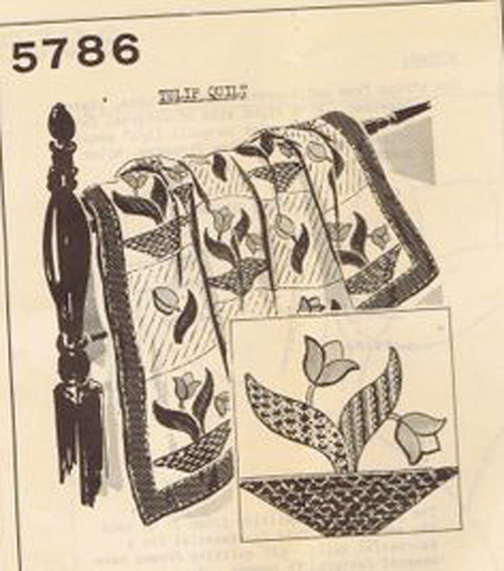
Needlecraft's Tulip Quilt, last half of the 20th century

Needlecraft's patterns appeared in dozens of newspapers in the 1930s and still run today. The 1930s were the prime years for their quilt patterns. They also sold crochet, knitting, fashion and embroidery patterns. Fictional names like Carol Curtis or Alice Brooks gave a personal touch to the patterns that were neither a column nor an advertisement, but something called a "reader service feature." Readers sent a dime to a New York address at the Old Chelsea Station post office and received a full-size pattern in the mail.

Information on Laura Wheeler is from my recent book The Kansas City Star Quilts Sampler.

The Block

Daredevils pattern for a 15" block.
Cut paper templates. Add seams to the fabric.

How to print:
Create a word file or a new empty JPG file that is 8-1/2" x 11".
Click on the images above.
Right click on each and save to your file.
Print that file out 8-1/2" x 11". The small squares should measure 1".
Adjust the printed page size if necessary.


Hazel Ying Lee 1932
Hazel died flying for the WASPs during World War II:

Wednesday, August 14, 2019

A Quilting Thread #3: Secondary Sources

About 1915

We can also look to published accounts about prices for quilting---secondary sources. 

In 1920 Emmett Leroy Shannon wrote a book on how to earn a little money on the side. Money for the Woman Who Wants It had a few paragraphs on quilting for pay. "The old rate...$1.00 per spool." He explained:
"The patron furnished everything, thread included, and the quilter had $1.00 for the work required to use up a single spool....Some will take three, five or even seven spools, according to their design."

Tying a quilt about 1910

In the early 1920s Shannon thought a fair rate might be $2 or $2.50 a spool, while the ads of the time indicate the going price was closer to $1.


About 1950

In her 1949 Standard Book of Quilt Making and Collecting Marguerite Ickis cited $1.25 a yard for a spool of 125 yards.


Searches for quilting thread prices haven't yielded much information.

This 1937 ad from a Marion, North Carolina department
store gives some prices.
"Quilting thread, 4 balls for 5c"


This may be a thread locally produced in a North Carolina mill and sold by the ball rather than the spool, perhaps that thick thread often seen in Southern quilts.

Maybe the 1970s


Linda Degh's Indiana Folklore: A Reader, published in 1980, included an interview with a Mrs. DeVault about the economics of quilting. She tells us the standard $1 a spool story in the past and then explains, "She would not quilt for less than six cents per yard."

A quilt [requiring] at least 800 yards of thread = $48. "It takes three weeks to do it."

About 1960


Let's hope professional quilters are recording their prices today.

And that's the end of this thread.