QUILTS & FABRIC: PAST & PRESENT


Wednesday, December 19, 2018

Maggie and Emma: A True Story


In 1860 Maria Jane McIntosh published a new book
A Year with Maggie & Emma: A True Story

Maria Jane McIntosh (1803-1878)

McIntosh was a novelist, born in Georgia, living in New York. The book, finished in 1859, was typical of her work, moralizing stories for children:
"This little volume contains the simplest story of simple country life in a remote, northern village...the incidents are, without a single exception, true."
The girls (the McKays) live in a town by Lake Ontario in upstate New York. In November they went to the county fair where quilts are displayed.
"One in particular, I remember, had a large eagle on the top drawn in Indian-ink, and a ribbon in his mouth, with 'Forward our country,' written in large letters in it--then underneath this eagle were very large clouds, made very black and threatening with plenty of the same ink. Then under these was a representation of Noah's ark....
Wait a minute: I know that quilt.

Quilt signed Mrs. L Converse, 1853
The threatening inked clouds are unforgettable.

Ms. McIntosh goes on:
"On either side of [Noah's ark] two trees, one containing all sorts of insects, and the other all sorts of birds that could be made from calico. These, and all the other things I shall mention...were all cut from different coloured calicoes and sewed on to the white muslin, being stuffed, to make them stand out, and formed and shaped very accurate and well...."

Birds on the left, insects on the right.
She described
"Noah and his family...dressed just as we would dress now."

"At the bottom were people at all sorts of work, to represent the wicked people God punished by the flood."

The quilt was auctioned and is in a private collection.
"Now can you think of anything funnier than taking this solemn scene from God's word, and with great pains and much ingenuity, making this strange and ridiculous picture of it on a quilt?...[The McKays thought it] the drollest, queerest thing they ever saw in their lives. But they took great care not to laugh when any one would be hurt by their doing so, for the person who made this quilt was very, very proud of it, I can assure you."

Maggie and Emma

Let's hope Luthera Rogers Converse never read Maggie & Emma. 
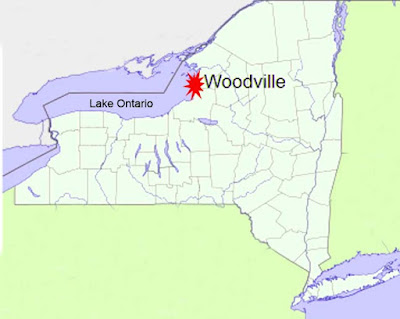

McIntosh may have been snide but she was accurate in describing the Noah's Ark quilt and probably in describing the town of Woodville, New York on Lake Ontario---a "remote, Northern village." I'm guessing the "strange and ridiculous" quilt was displayed at a Jefferson County fair in the 1850s.

The eagle at the top that McIntosh described is mostly missing now.

The inscription is not "Forward" but "Onward Our Country." I wonder if all that ink did not damage the "white muslin" so much that someone trimmed and rebound the top.

The quilt has been attributed to Lutheria Rogers Converse of Woodville. Her name was also spelled Luthera (probably her spelling) and Lutherea (all making one guess she was baptized a Lutheran).

Rufus H. Converse
Died Mar 10, 1885
Age 69 Years
Luthera Rogers
His Wife
Died Aug 7 1902
Age 82 Years

She and her husband Rufus Converse are buried in Jefferson County, New York, although she died at the home of a nephew Erwin Rogers in Grand Rapids, Michigan. According to her obituary in the Jefferson Journal she was a native of Vermont but spent most of her life farming near Woodville. In 1896 she moved to Grand Rapids.

When you look at the Noah's Ark quilt you guess this is not her first quilt. She must have made others, and indeed the Rogers family in Michigan apparently inherited others. In 2012 New York's Skaneateles Historical Society Museum showed a whitework stuffed Lord's Prayer quilt and a pieced Sunburst by Luthera. She also did hooked rugs.

Detail of her Glen Haven painting

The family inherited paintings. which have been displayed in Skaneateles. The family history records that Luthera had tuberculosis and in 1853, the year of the quilt, she spent eight weeks at the Glen Haven Water Cure hospital on the shores of Skaneateles Lake, attributing her recovery to the Water Cure diet, writing a testimonial for their newsletter, The Letter Box:
"Well do I remember what people said of me when I went to the Glen. I was gone, far gone, with consumption, it was said, and I should die at any rate in the fall when the leaves dropped...." A year year later she "pronounced myself cured. I lived strictly on the Glen Haven plan, and ate no butter, salt, or spices meat or pastry, drank neither tea or coffee."
She and her husband built a house after her cure and she outlined the painting and wall papering and carpeting she'd done. "I can tire out all the neighboring women at day's works."

She painted a picture of the place that was displayed at Glen Haven and announced in the Letter Box in 1859 that she felt well enough to work as an interior house painter, doing wall papering, wood graining and other painting for the neighbors. (I hope more than one neighbor just told her to paint the parlor with any images she could imagine.)

Advertisement from Duke University Libraries collection

Sunday, December 16, 2018

Quilt Research Collection at the University of Nebraska

Newspaper pattern from 1889

Fragile scrapbook of newsprint quilt patterns. 
Newsprint is among the most ephemeral of paper products, designed to deteriorate.

We quilt historians have long been aware of the anxiety common to collectors of ephemera---that their heirs will not see the value of the material (it is, after all, ephemeral) and compost it.

Few institutions collect 20th century needlework history.

Even enlightened heirs are faced with a dilemma. What library or museum would want it?

Joyce, Cuesta and me (a l-o-o-ong time ago)

Merikay Waldvogel and I, a generation younger than our late friends Cuesta Benberry and Joyce Gross, have been discussing this since Cuesta and Joyce started worrying thirty years ago. Fortunately their files went to interested institutions. Joyce's papers are at the Briscoe Center for American History at the University of Texas and Cuesta's at the Great Lakes Quilt Center at Michigan State University.


Now that we ourselves are worrying, Merikay and I have been working with the University of Nebraska/Lincoln, home to the International Quilt Study Center and Museum.


Archives and Special Collections in the University Libraries has established a Quilt Research Collection located in the Library Depository Retrieval Facility, a new building opened last year at the edge of the UNL East Campus. There is a reading room for researchers and a fabulous storage facility that can house 900,000 volumes.

Libraries are following technology developed in commercial warehouses.
Quilt collections material is retrieved with a mechanical picker from the
3-story high shelving.

The collections now include donations from eminent quilt researchers such as Sally Garoutte, Eli Leon, Eve Wheatcroft-Granick, Katy Christopherson, Sharon Newman, Dorothy Cozart and Pat Ferraro & Julie Silber. Merikay recently donated the enormous pattern collection of Mildred Dickerson. At least two state project files Oklahoma's and Nebraska's are there.
Quilt article from Wide Awake magazine 1890

One long-term goal is to digitize selected materials from the archives so that items like rare published quilt patterns are accessible on line. Once digitized the original files will remain in Archives & Special Collections where they will continue to be available to readers.

Merikay at her 2009 induction into the Quilters Hall of Fame

Merikay and I are thrilled that our files will have a permanent home at an academic institution, particularly one associated with the world's leading quilt museum, the International Quilt Study Center & Museum.

Another goal is to catalog the quilt collections by hiring a person dedicated to the project. We want to fund a salary for a library staff member who understands quilt history and directs the cataloging and digitization for several years. We have been working with the University of Nebraska Foundation, which now has a special account for donations for that Quilt Research Collection salary.


Mail checks to 
 University of Nebraska Foundation
1010 Lincoln Mall, Suite 300
Lincoln, NE 68508 

In the Memo line and in a note include the information:
Quilt Research Collection Fund #01147420

We'd, of course,  like you to donate financially. It's a tax exempt organization and the perfect place for your annual Qualified Charitable Distribution from your IRA. (Don't worry your pretty little heads about that information if you are under 70.)

You can also donate using an online form by clicking here: Enter your email and see a page dedicated to the Quilt Research Collection. If you'd like an electronic funds transfer (EFT) rather than a charge scroll down and click on Debit.


We also want you to consider donating your own quilt history files. Merikay and I are particularly interested in scrapbooks. But then again, correspondence between quilt historians is a favorite topic. 

Newcomb Looms pattern cards

And we'd like to include EVERY QUILT PATTERN EVER PUBLISHED. (Oh wait, I'm getting carried away with my wish list.) Well, you get the picture. Everything ever written about quilts---and they have room for it.

Think about your own quilt history collection large or small and donating it now or in the future. 

Thursday, December 13, 2018

Crazy Wheel of Fortune

Classic Forties Quilt 
Scraps of bright colors, lots of white for a neutral,
Pattern with secondary designs.

I found it at C&T's webpage advertising the new
book The Kansas City Star Quilts Sampler.

They include templates & rotary cutting instructions for a 12" block.

It's in BlockBase twice as #1299
and M005

Names:
Wheel of Fortune & Crazy Anne

Slightly different proportions. 

I'd imagine the 1949 pattern was a version of the Wheel of Fortune from the Laura Wheeler/
Alice Brooks syndicate from the Old Chelsea Station post office in New York. The Kansas City Star carried those syndicated patterns as well as their own quilt column.

Wheel of Fortune from Laura Wheeler,
perhaps copyright 1940.

Now that we have pattern templates
(Page 190 in The Kansas City Star Quilts Sampler)
we can work on shading

12" block x 64 =  72" square

The original scrappy version from the quilt above is good.

The blogger at Q is for Quilter pieced some blocks in
vintage prints.

I found a 1986 version at the Quilt Index from
the Indiana Project by Martha Leckron Harvey.

And a more recent example pieced over paper foundations.
No source though.

I imported it from BlockBase into EQ8 and recolored the patches
trying to emphasize the corner designs.


Crazy Wheel of Fortune

The I erased some lines taking out one dark purple shape.
The corner designs stand more on their own.
This one doesn't have a BlockBase number.

Maybe #1299.5

Monday, December 10, 2018

Lucinda Honstain's Civil War #4


I've changed my mind after looking at these top two pictures. This bearded man with a middle aged paunch may indeed be a portrait of Lucinda Ward Honstain's husband John Baptiste Honstain in her 1867 sampler quilt. Despite their public fighting after he returned home from soldiering in North Carolina in the summer of 1865, this figure does look like the portrait below.

Lucinda Ward Honstain's husband John Baptiste Honstain is unlikely to have been one of the soldiers  pictured on her 1867 sampler quilt as they had been publicly fighting since he returned home from soldiering in North Carolina in the summer of 1865.

See previous posts in the last few days on the Honstain Family War as reported in the Brooklyn Eagle.

This may be a portrait of Lucinda's husband.

In April, 1866 the Eagle explained:
"The matter has created a lively interest throughout the Eastern District [the neighborhood], where all the parties and their past and present grievances, both matrimonial and otherwise are very well known. Honstain has been associated with too many scrapes, which have been adjudicated in the lower Courts...."
What kind of scrapes? Well, it's a long story and hard to figure out as John B. Honstain seems to have been a first-rate liar.


Here he is in the 1865 state census at age 40, recorded as living with wife Lucinda, their daughter Emma and son-in-law Hamilton Bingham. He declared he was born in Canada, which is probably the truth. Honstain seems to be a German name; his mother was Mary Jane Meyers (1797-1877) from Quebec; his father, another John Honstain, was a Prussian immigrant. The family moved to New York some time after John Baptiste's birth in 1821.

He was a soldier. Suzanne Antippas finds references to the New York State Militia, where he may have met Lucinda when they were in their early 20s near her home in Sing Sing (Ossining.) In later life he said he fought in the Florida Seminole Wars and the Mexican War of the late 1840s. Before the war he is listed in directories as a tailor and a clothing seller.


Soon after the Civil War began John Honstain joined the 4th New York Infantry. His sword was auctioned on eBay a few year ago with a good deal of paperwork about him. The auction copy is muddled but mentions he "was dismissed from the military in August of 1862 for personal reasons."

The actual reasons seem to be a disagreement with a superior and his effective desertion during which he was captured by Confederate troops and held in prison for a few months. Some sources indicate he was exchanged although he denied this all his life, saying he disguised himself as a Confederate doctor and escaped.

An 1889 military history says he was "cap [tured]. at Tarborough, N.C. July 22, 1863, held in Libby Prison until October 24, 1863, when he escaped; never exchanged." Or maybe it was Andersonville Prison he escaped from, according to records at his gravesite in Ohio.


I can see him muttering "No exchange! No exchange" for the rest of his life. He doesn't mention his discharge after the desertion, when he went back to New York and in the summer of 1862 raised a Company (I) for Spinola's Empire Brigade, the Hillhouse Light Infantry, encouraging recruits to come by the house in Brooklyn in the evenings to sign up.


July, 1862 ad in the New York Herald

We then find him in the fall in of 1862 in the 132nd New York Hillhouse Infantry as a Major.  He was injured in an ammunition explosion at the Battle of Batchelder's Creek near New Bern, North Carolina in June, 1864.

The 132nd Regiment's Colors

Block from Lucinda's quilt

I go into detail here because it does give us an idea of Lucinda's wartime experiences worrying about her husband (I bet he was quite a charmer) and because these facts were replaced with so many alternate facts by John Honstain after the war.

As we have seen their marriage did not survive the war by many months. They separated, fought, spent time in court and he soon left New York, moving first to Wisconsin where brother Edward lived and then to Ohio where he obtained a divorce. He remarried at least twice, fathering several more children, half-siblings to Emma back in Brooklyn. He changed his name variously to John B. Housteau and Jean Housteau, living under Housteau until the end of his life in 1911.

Hannah Lamira Housteau St. John's grave.
She married again after John left.

His second wife was a Wisconsin relative Hannah Lougue Lamira (1846-1888), married January 1, 1867, according to Melissa Jurgena's findings. They had a daughter Jennie (1868-1910).

His third: Stephenia Siefert, born in Germany in 1850, married April 19, 1870, with whom he had five children. In Youngstown, Ohio he was again a tailor and a clothing retailer, partnering with George E. McNab for a few years. He and Stephania were active in the Union Veterans' organizations the Grand Army of the Republic and the  auxiliary Women's Relief Corps. He was successful, building a large house at 1011 Mahoning Avenue in 1886.


Suzanne Antippas read his pension records, writing: "Honstain tried many times to secure a Civil War pension but in a miracle of coordination of military paperwork, the Pension Office put his two regimental records together and denied the pension because of the court martial. He even petitioned his congressman, who did the same."

John wrote a biography published in the 1903 Genealogical & Family History of Eastern Ohio, which I will post here just to give you an idea of his personality. Lies in yellow.
"John Baptiste Housteau, a merchant tailor at Youngstown, Ohio... was born on the Rhine, in France, June 15, 1821, and is a son of John Housteau, who was born also in France, in 1749, and died at Toronto, Canada, aged one hundred and fourteen years. Our subject escaped from his home in Paris as a stowaway on a ship, when only nine years old. 
In the spring of 1831 he landed at New York, and he can recall the time when the present site of Castle Garden was but a swamp and morass. He attended the laying of the corner stone of Bunker Hill monument, and he can recall the time when not a single railroad crossed the state of New York. His life has been full of adventure, and he has seen much military service.  
He belonged, as lieutenant, to Company I, Thirteenth New York Regulars, in the Seminole war in Florida, and was captain of the first Zouave regiment organized in New York for service in the Civil war, and raised the first company. He served all through the war and arose to the rank of colonel and acting brigadier general, being promoted for gallantry. "


They bought it all in Youngstown and supposedly erected a statue of him there.

Lucinda seems to have been well rid of him. I tell you all this just to emphasize that even if she missed some good times, it seems quite unlikely   SEE ABOVE.  If he is any of the soldiers portrayed on her wonderful quilt which seems to have been stitched during the months of their separation, he is probably the unflattering depiction of the horseman at the top of this post.

Obituary for "Colonel Housteau," 1911

That's the end of the Honstain posts for now.