QUILTS & FABRIC: PAST & PRESENT


Thursday, October 20, 2016

Antique Quilt Exhibits: Fall 2016 Through Winter 2017


Weather will be too cool to put the top down soon. Head out today!

Antique Quilt Exhibits: Through Fall 2016 &Winter 2017

Alabama, Montgomery
Montgomery Museum of Fine Arts. Sewn Together: Two Centuries of Alabama Quilts.
January 28 through April 16, 2017.

California, Redlands
San Bernardino County Museum. Stitches in Time. Pieced quilts and woven coverlets from the collection.
Through January 2017.
Illinois, Chicago
DuSable Museum of African American History. Unpacking Collections: The Legacy of Cuesta Benberry, An African American Quilt Scholar. 
Through September 28, 2017.
In 2018 the show will be at the Mercer Museum, Doylestown, Pennsylvania.
http://www.dusablemuseum.org/

Iowa, Winterset
Iowa Quilt Museum. Stargazing: American Star Quilts. Antique and contemporary pieces.
Through January, 2017.

From the Western Kentucky University collection


Kentucky, Bowling Green
Elizabeth Richardson Quilt Gallery, Kentucky Museum. Backward & Forward: 20th Century Quilts.
Through March 5, 2017.


Minnesota, Minneapolis
Minneapolis Institute of the Arts. Cut from the Same Cloth: American Quilts at Mia.14 American quilts from the collection, dating from the mid-1800s to the mid-1900s.
Through March 19, 2017.
I am giving a lecture on February 2, 2017: Thursday. 6:30. “Cut from the Same Cloth: Dry Goods & Quilt Design”
http://new.artsmia.org/exhibition/cut-from-the-same-cloth-american-quilts-at-mia/

Nebraska, Lincoln
International Quilt Study Center & Museum/Quilt House.

Nebraska Quilts. January 10-April 8, 2017
Ladies Ramble Quilt

New Jersey, River Edge
Bergen County Historical Society. Ladies' Ramble. Opens January 29th, 2017
Selections from BCHS quilt collection on exhibit.
http://www.visitnj.org/nj-events/ladies-ramble#sthash.pr7CzQpn.dpuf
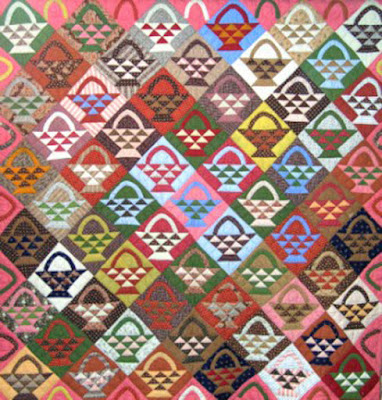

Pennsylvania, Harleysville
Mennonite Heritage Center. A Riot of Color: Quilts from the Community. Thirty colorful quilts from the Mennonite communities of Bucks and Montgomery Counties.
Through March 2, 2017.
http://mhep.org/exhibits/


Pennsylvania. Westchester
Chester County Historical Society. Quilts: The Next Layer. Over a dozen recently donated quilts
Through January 31, 2017.
http://www.chestercohistorical.org/


U.K. Cheltenham, England
Cheltenham Town Hall. Quilty Pleasures: tours of the Wilson Art Gallery quilt collection.
Three hour-long tours on March 11, 2017
http://www.cheltenhamtownhall.org.uk/event/quilty-pleasures-168155/

U.K. Torquay, England 
The Quilters Guild holds its 38th annual conference 31 March - 2 April 2017.
http://www.quiltersguild.org.uk/about/conference-agm

Virginia, Harrisonburg
Virginia Quilt Museum. Golden Age of Applique. Curated by Debby Cooney.
Opens February 14, 2017
http://www.vaquiltmuseum.org/upcoming-exhibits/


Virginia, Williamsburg
Colonial Williamsburg, Abby Aldrich Rockefeller Folk Art Museum. A Century of African-American Quilts features twelve quilts from the collection dating from 1875. Through January, 2018.
https://www.colonialwilliamsburg.com/do/art-museums/rockefeller-museum/century-of-quilts/
In conjunction with an upcoming exhibit Printed Fashions: Textiles for Clothing and the Home, 1700-1820, a conference is scheduled for March 26 - 28.
http://www.cvent.com/events/printed-fashions-textiles-for-clothing-and-the-home/event-summary-cf13f005b41d415e861abce1869909fa.aspx

Washington DC
DAR Museum. "An Agreeable Tyrant: Fashion after the Revolution" considers how Americans fashioned a new identity through costume.Fifty manikins in twelve period room explore clothing from 1780 to 1825. No quilts advertised but what the heck.
Through April 29, 2017. Inside information indicates a symposium is planned for the spring. Stay tuned.
http://www.dar.org/museum/exhibitions/current-exhibition

Washington, Walla Walla
Fort Walla Walla Museum. Sewn Into History: A Century of Quilts. Over 20 quilts from the Museum's collection will be on display, ranging in dates from the mid-19th century through the 1930s. Through January, 2017.
http://www.fwwm.org/quilt-show-2016


Tuesday, October 18, 2016

Quilt #3 for Henry Clay


Appliqued quilt by Elizabeth Schultz, 1847
Collection of Ashland: The Henry Clay Estate

In 1847 Pennsylvanian Elizabeth Schultz sent this quilt to her hero Henry Clay who was campaigning to become the Whig party nominee for President in the 1848 election. Kentuckian Clay had unsuccessfully run for the office in 1824, 1832, 1840 and 1844.

Clay's major issues, particularly during his early career, centered on free trade and taxes on imported items. His position as "Protector of Home Industries" encouraged support among Northern manufacturers large and small, while alienating Southern producers of raw goods who looked to Europe for manufactured goods and did not want to pay the 20% taxes on imports.

Displayed on a bed at Ashland in the 1970s.

The appliqued piece was forwarded to Clay with a letter from Thomas B. Stevenson, a Whig newspaper editor who described it:
"cloth, thread and every thing of home production, and every stitch of it wrought by Mrs. Schultz of Pennsylvania, a venerable lady of seventy-six years of age....a spontaneous offering of the heart's homage."
I mentioned this quilt on a blog post a few years ago in a discussion of tariffs, trade and fabric after the War of 1812:
"One might understand that Schultz produced the fabrics by home spinning and weaving but what was meant was that these were factory cottons produced in the United States."
87" x 101"
1988.844

Ashland loaned the quilt for the American Textile History Museum's recent exhibit Home Front and Battle Field and you can see a good photo of it in their catalog on page 14.

Schultz appliqued roses cut from chintz with green and red leaves in
conventional applique of domestically-produced cottons.

In 1988 family of descendant Robert Pepper Clay donated the quilt to Ashland.

Henry Clay (1777-1852)
Photo of Clay taken in 1850, two years before he died
of tuberculosis. Born during the Revolutionary War, he
was 70 years old when Schultz sent him the quilt.

A Clay flag from the collection of the New York Historical Society. Various candidates and parties were represented by American animals--- Whigs by raccoons. Clay was known as That Same Old Coon (some kind of a compliment to his reliability if not his age).


Clay wrote Stevenson a letter asking him to thank Schultz in July, 1847.

I am not the only observer to notice a plethora of quilts for Clay. A few years earlier a joke about quilts and Henry Clay was republished in numerous newspapers.

"One of our contemporaries gives the following as an appropriate inscription for the next counterpane presented to Henry Clay.
Beneath this quilt lies Henry Clay,
Whom locos put to bed one day,
Be quiet, Hal---to rise is vain,
Press'd down by many a counter pain.You're well tucked up---cease then to scoff---
You cannot kick the kiver off!"
Locos were a faction of the Democrats---the Whig implication was they were crazy, but the Locofocos took the name as a rallying cry.

Read more about Henry Clay and quilts:

Saturday, October 15, 2016

Morris Hexathon 24: Brighton Church


Morris Hexathon 24: Brighton Church by Becky Brown

I named this week's hexie Brighton Church for St. Michael's and All Angels, decorated by the firm of Morris, Marshall, Faulkner in the early 1860s.

St. Michael's original building was designed by 
George Frederick Bodley.

Philip Webb's window

Bodley hired the Morris firm to do the windows and other decorations in several of his churches. This particular church is an excellent example of how co-operatively the partners worked. Even mathematician Charles Faulkner, the firm's accountant, took part in the art. 


Morris Hexathon 24: Brighton Church by Ilyse Moore


In her biography of Edward Burne-Jones, The Last Pre-Raphaelite, Fiona McCarthy sketches "the camaraderie and experimental fervour" of the young partners:
"The Firm's work on Bodley's churches was essentially teamwork....The chancel roof...was hand-painted by Morris, Webb and Charley Faulkner, working precariously on the scaffolding. When it came to stained-glass windows Philip Webb was chiefly responsible for the overall arrangement while Morris controlled the colour and assembly of the windows in the Red Lion Square workshops."
Detail of the ceiling painting by Morris, Webb and Faulkner


This week's pattern echoes a mid-19th century quilt design. You need three templates:
a hexagon and two triangles.


Detail from Baltimore Album Quilt made for Rev & Mrs.
William George Eggleston,
in the collection of Colonial Williamsburg.

The words on the seven-star quilt block above: "Margt. Iles. Ellicotts Mills Nov. 8th 1844"

See the whole quilt here:
http://emuseum.history.org/view/objects/asitem/Exhibitions@44/7/title-desc;jsessionid=DDB9427538F3A1341B001DBBED419110?t:state:flow=393cc48f-ca59-4272-a156-2720e76cf361

There is no BlockBase number for this particular star with spiky points.

Pattern for an 8" Hexagon

(4" sides)
To Print:
  • Create a word file or a new empty JPG file that is 8-1/2" x 11". 
  • Click on the image above. 
  • Right click on it and save it to your file. 
  • Print that file out 8-1/2" x 11". The hexagon should measure 4" on the sides.
  • Adjust the printed page size if necessary.
  • Add seams when you cut the fabric.

Visit St. Michael's in Brighton to see the Morris circle's work in the original church on the left here. The larger addition was built in the 1890s.

St. Michael's and All Angels Church has an online gallery of the Morris firm's work here:

One More Inspiration

Mid-19th-century hexagon quilt sold by Bonham's in England.

Some star points are fussy cut from striped fabric.

Thursday, October 13, 2016

Reproduction Quilts: Basket Ideas

"Ethel's Treasure Baskets" by Cynthia at Wabi-sabi quilts.

Cynthia interpreted an antique basket quilt for the American Quilt Study Group's challenge this year.

The original is in the collection of the New England Quilt Museum.
See more here:

Baltimore Blues
60" x 70"
Baskets are also the theme of the project sheet that
accompanies my newest Moda line 
Baltimore Blues.

You can buy a kit as well as a pattern.


Pieced baskets were a new idea in the 1840s and '50s when the Prussian blue prints in Baltimore Blues were popular.

Here's one of a pair in a quilt dated 1846.

Lydia Rounsavel's 1846 album
I believe this was once in the Flack collection.

These two in the corners are the earliest pieced baskets I have on file.

Date-inscribed 1853.

Wisconsin project & the Quilt Index
Hawk's Inn Historical Museum collection

The empty baskets are filled with signatures and dates.

The Basket by A G Ellison, Age 9 yrs 1853
Nickols Collection of the Mingei Museum

What to call the pattern?
Basket is good as A. Grace Ellison's 1853 quilt says.
It's the same name Marie Webster gave it in 1915
It's BlockBase #662

The general pattern was published as "Basket" by the Orange Judd Farmer magazine in 1899.

To get a period look it's not only pattern and fabrics---it's style and set. So if you want to stitch a period #662 with your kit here are some period style pointers.

I did a few digital sketches of period basket sets:
All- over on point.


Mass Quilts and the Quilt Index
(with a little cut-out chintz throw back in the center.)

From Skinner Auctions

Note the large print border, which is also a little throw back.
It'd look good in blue.

Too many baskets?
Add sashing.

Fanny S. Lightner, Nebraska State Historical Society.

You could put it on point, piece the sashing and add an appliqued border
as in this example dated 1858, by Mary Morgan


I just dropped those baskets on the background
but there is something to be said for totally unmeasured sashing.

You could float them with a light sashing

Pin them with a red cornerstone

Punch them up with a little chrome yellow and Turkey red

About 1900

Always a good move.

Late 19th century

Late 19th century
Another design idea is to do a counterchange
coloring--- alternating color
or alternating shading


Here's a sophisticated composition from the 
mid-19th century from Laura Fisher's shop.

Inspired by that one
I drew this one. 
25 light baskets, 16 dark baskets.