QUILTS & FABRIC: PAST & PRESENT


Monday, July 16, 2012

Metropolitan Fair Charm Pack: Free Pattern

The precut squares, fat quarters and strips of JellyRolls for Metropolitan Fair should be in shops. Here's a free pattern for a quilt made with the Charm Squares, the 5" square precuts.


Mince Pie

Slice your Moda Charm Packs into triangles. Reassemble.
It's Mince Pie.


Mince Pie was a dessert served at the Metropolitan Fair in 1864, traditional fare in any New England Kitchen
The New England Kitchen was a popular attraction
at that event that raised money for Union hospitals.

I know it's not really time for mince pie.
 But the Charm Packs are available now. They'll be hard to find in November.


The small scrappy quilt (38" x 46") above is made from 2 Moda Charm Packs.
You'll also need some extra yardage for the border- 1/2 yard.

The Block
We're using precut squares so we aren't going to worry about measuring. As in pie it's all about slicing.


I can't find this block in BlockBase anywhere---hard to believe no one ever published it with a name. I like Mince Pie.


Slice your two packs of charm squares (5" x 5") into 4 triangles with an X

to make 4 triangles from every Charm Square.
Cut all 84 squares up and mix and match on the design wall.


I'd piece 4 triangles into 4 larger triangles and then seam them together.


Concentrate your shading decisions on the X in the middle, contrasting the lights and darks here. When you set the blocks, rotate them so one X has a light shade at the top and the next has a dark shade at the top.

The 5" squares will give you a block that finishes to a little bit less than 8". It doesn't matter exactly how big it is because the blocks will all be the same size. You need 20 blocks set 4 by 5.

I used this stripe for the border, which finishes to 3". It's Number 8234-11. The print is called Jacob's Well, the color Celery Salad Green. (Celery Salad and Mince Pie---I'm not making up this menu.)
For the border cut
2 strips 3-1/2" x 40-1/2" for the sides.
2 strips 3-1/2" x 32-1/2". You'll probably trim these because the blocks are a little smaller than 8".

Here's my math---
You can get 168 triangles per Charm Pack (42 x 4).
Each block requires 16 triangles.
That means you get 10 and a half blocks per Charm Pack.
With two packs you get 21 blocks (set in as grid of 20= 4 x 5)
3 packs will give you 31 and a half blocks
4 packs= 42 blocks---Set these in a grid of 6x7 and the quilt without a border finishes to about 48" x 56"

The waiters are ready for the diners at the 1864 Fair in Philadelphia. 
From the Library of Congress

Read more about the Metropolitan Fair Civil War reproduction collection here

Friday, July 13, 2012

The Mennonite Quilt Sale 2012

Scrap Happy by the Southern Hills Mennonite Church
 in Topeka, Kansas

Carol who belongs to my guild told me the quilt she and friends made for the Kansas MCC Relief Sale this year raised $5100 at the April, 2012 auction.


 They used a pattern they found in Better Homes & Garden Quilts and a red paisley from my Moda collection Civil War Reunion.

Double Dutch by Shari Wiens

The sale is an annual event to fund the church's emergency relief services.


Wholecloth quilt by the Hutchinson Amish Church

Individuals and church groups donate traditional quilts,

A vintage Lancaster County PA quilt
 antiques and contemporary quilts.

Star Flower by Julie Esau

Midsummer Night Garden by the Pleasant Valley
Mennonite Church, Harper, KS.
 I was glad to see they used the pattern for my
Prairie Flower quilt from Star Books.


Queen Ann Star by Four Ever Friends, Hesston
This quilt brought in the highest bid: $8100.


Autumn Leaves by Emma Stuckey and the
First Mennonite Church in Pretty Prairie
The large leaf print is from my Arnold's Attic line last year.

The quilt auction raised $134,721 this year.
I was pleased to find people using my fabric and patterns.
See all the quilts here:

Tuesday, July 10, 2012

The Garden Quilt: Interpreting a Masterpiece

Paradise in Kansas by Ilyse Moore.
Quilting by Freda Smith. 

Ilyse and I have a new pattern book:
The Garden Quilt: Interpreting a Masterpiece


My part was drawing the pattern and writing about the sources.
Here's what Star Books says about it:


Ruth Finley described The Garden applique as "the triumph of the needle....No two Garden quilts were ever quite alike...." Here Ilyse Moore and Barbara Brackman give you a pattern for a new interpretation of the Garden medallion or, as Rose Kretsinger called it, The Paradise Garden.  They've drawn from several applique masterpieces and show you how to make Ilyse's Paradise in Kansas, a Garden quilt for the twenty-first century.

 
Me and Ilyse
Ilyse improved upon my pattern and made a magnificent quilt. She gives tips for applique and organization.

We began with the center of Rose Kretsinger's Paradise Garden, which is in the collection of the Spencer Museum of Art at the University of Kansas.


Rose's on the left and Ilyse's on the right.


Kansas Pattern by Charlotte Jane Whitehill (1886-1964),
Emporia Kansas, Collection of the Denver Art Museum


We substituted a border from Charlotte Jane Whitehill's Kansas Pattern. A Kansas Pattern, made in 1930, is unusual in that it is appliquéd as a border with no center. My guess is Rose Kretsinger designed this border for fellow Kansan Lottie Whitehill.


Ilyse reworked the grape designs and re-colored the parrots in the Kansas Pattern to make a Paradise in Kansas (we have so few parrots in Kansas these days that they might as well be blue as pink).

It's a 24-page pattern book with a pullout, $16.95.
Read more about the book here at the Pickledish Store:
https://www.pickledishstore.com/productDetail.php?PID=1306
It should be at your quilt shop momentarily.

Saturday, July 7, 2012

Missing Nancy Hornback

Applique Quilt by Mary Parks Lawrence, Kentucky,
 from the Kansas Quilt Project

 
Nancy by Ray Rowden from Deb Rowden's book Quilter's Stories.
 See Deb's remembrance here:

Nancy Hornback, who died last month, was a quilt scholar who changed our views on applique quilts. All these quilt photos are from her chapter in the Kansas Quilts & Quilters book called "Nineteenth-Century Red and Green Applique Quilts."

After raising seven children she went back to graduate school in the areas of material culture and women's studies. She focused (she was very good at focusing) on red and green applique and the design and cultural sources.

Quilt by Lydia Marie Erwin Mason

Nancy was instrumental in starting the Kansas Quilt Project and maintaining it. When we began in 1986 we knew very little about what we'd find (although we thought we knew it all.) We found out right away that the red and green appliques that Nancy was looking for weren't made in Kansas. Just realizing that the design was regional was rather monumental.

Quilt by Mary Elizabeth Hamon Stoke, Kentucky

Nancy thought about the color, the symmetries, the images. She traced these to Germanic folk arts. She and I went to Germany looking for antecedents.

Quilt top by Mary A. Turley, 1869

My favorite thing her diligent research found, however, was this photo of the quilt at the top of page by Mary Parks Lawrence.


 It shows Mary's daughter with the same quilt on the bed. You don't happen across coincidences like that. You work really hard to find them.

Quilt by Sarah Forsyhte Pollock, Ohio

She also made quilts, focusing on red and green applique.

With Terry Thompson she wrote two books on contemporary applique
 in the traditional manner.


Any time I found a great red and green applique quilt I sent her a picture. I certainly will miss her enthusiasm.

Wednesday, July 4, 2012

Extreme Show Off Piecing: Rose Tree

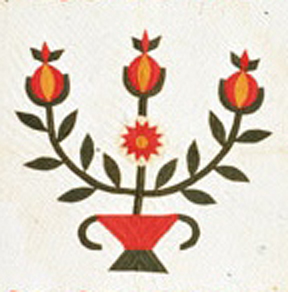
Rose Tree, Missouri Rose or Prairie Flower,
 mid-19th-century from an online auction

Once Bets Ramsey and Merikay Waldvogel realized in the Quilts of Tennessee project that some of the rose quilts we assumed to be appliqued were actually pieced they began looking closely for seams. Surprisingly, they found that a few of these quilts we might call Rose Tree are pieced.

This detail shows how the pattern can be pieced into a circle.


Here's a quilt now in Texas (in the collection of the American/International Quilt Association)
that shows how the circles were then pieced into the background.


Two details from the Tennessee project.


I've seen perhaps a dozen pieced rose trees over the years. My digital picture file contains quilts primarily from Tennessee and Texas. The Quilt Index files from the Quilts of Tennessee project are a good source as are the files from the Briscoe Center for American History, University of Texas at Austin: Winedale Quilt Collection.

Few of the variations are all pieced, some are all applique and some are a combination. Some come with a pot or a tree trunk.
 There are often nine blocks as in this one from an online auction. It has a nice balance with a pieced (?) rose in the center.
From the photos it looks like some of it is pieced, some applique. See the seams in the center of the rose here and the way the top of the tree trunk has a curved seam.


These floral trees are numbered 44 in my Encyclopedia of Applique. The names published in the 20th century include

Conventional Tulip - Marguerite Ickis
Rose and Buds - Nancy Cabot
Prairie Flower - Carlie Sexton
Missouri Rose - Hall and Kretsinger
Rose Tree - Kretsinger

This pattern typifies the problems with 20th-century published names. We can't assume they were used in the 19th century by the women who made the quilts.

Jane Shelby, 1855
Mississippi Beauty

The Texas Sesquicentennial Quilt Association's Texas Quilt Search found an appliqued variation inscribed with these words:

"Mississippi Beauty
Judith Connor's Quilt
Persented [sic] by  Jane Shelby
Feb. 10, 1855"

See more of the Mississippi Beauty at the Quilt Index:
http://www.quiltindex.org/fulldisplay.php?kid=4F-88-CA

Two others:
http://www.quiltindex.org/fulldisplay.php?kid=4C-83-C21
http://www.quiltindex.org/fulldisplay.php?kid=4F-88-9A

Detail of a Texas quilt by Susan Bell Miller at the Briscoe Center


Rose Kretsinger's New Rose Tree from the Spencer Museum, about 1930. This one is all appliqued.
http://collection.spencerart.ku.edu/eMuseumPlus?service=ExternalInterface&module=collection&objectId=11181&viewType=detailView


The International Quilt Study Center and Museum has a few in their collection:
Here's one dated 1892 (#2007.038.0011)
http://cdn.firespring.com/images/1ffcb1ad-2213-4569-ab47-f254a73622d3.jpg


Another dated example, 1857 by Eliza J. Herron (1997.007.0908)
 http://cdn.firespring.com/images/397308df-f80f-42b3-9042-dbc5377dcb69.jpg


They also have one  from the 1930s (1997.007.0820)
http://cdn.firespring.com/images/69d12cc6-abd1-4e90-b147-3b806fafe8a9.jpg


Rose Tree from an online auction.
The central roses and the buds could be pieced
but the leaves are probably all appliqued.

And blogger Barbara Chainey has pictures of one in Patricia Cox's collection.
http://barbarachaineyquilts.wordpress.com/2012/02/12/a-few-more-details/

See my post about the pieced roses here:
http://barbarabrackman.blogspot.com/2012/06/show-off-piecing-whig-rose.html