 The Library of Congress has a wonderful prints and photographs site that is full of surprising images including this Japanese woodblock print. Click here to see the search page: http://lcweb2.loc.gov/pp/pphome.html I think I found this by searching for the word sewing. Once the hits come up click on the button Preview Images.
Sunday, July 26, 2009
Library of Congress Archive
The Library of Congress has a wonderful prints and photographs site that is full of surprising images including this Japanese woodblock print. Click here to see the search page: http://lcweb2.loc.gov/pp/pphome.html I think I found this by searching for the word sewing. Once the hits come up click on the button Preview Images.
Monday, July 13, 2009
Stars on Point

The bolts of The Morris Garden fabric should be in the quilt shops any day now. If you are looking for pattern ideas I'd suggest a simple sawtooth star. Set it with alternate blocks of large-scale fabric and turn it on point. It's a great way to show off complex fabrics.
My friends have been making this quilt for years. They've traded print squares and traded stars (generally 10" finished stars). Here's a collage of a few. (Roseanne Smith at top left and bottom center & right, Judy Severson in the center, Jerrye VanLeer top right, Carol Gilham Jones, bottom left)
If you made stars that finish to 9" you could use a package of Moda's Layer Cakes (fabric precut to 10" squares) for the alternate squares.
It's also an authentic pattern for an early reproduction quilt to feature chintzes and toiles. Click on the links below to see three early versions from the International Quilt Study Center and Museum at the University of Nebraska Lincoln.
http://www.quiltstudy.org/includes/photos/quilt_database/large/1997_007_0065.jpg
http://www.quiltstudy.org/includes/photos/quilt_database/large/1997_007_0281.jpg
http://www.quiltstudy.org/includes/photos/quilt_database/large/2003_003_0239.jpg
http://www.quiltstudy.org/includes/photos/quilt_database/large/1997_007_0065.jpg

http://www.quiltstudy.org/includes/photos/quilt_database/large/1997_007_0281.jpg

http://www.quiltstudy.org/includes/photos/quilt_database/large/2003_003_0239.jpg

Wednesday, July 8, 2009
Snow Ball Wreath

I got some photos of a quilt top made in Alabama in the 1930s or '40s asking for help with pattern identification. I recognized it immediately as one of the most complex designs from the newspaper pattern source that used the names Laura Wheeler/Alice Brooks. It's number 1515 in my Encyclopedia of Pieced Quilt Patterns with the name "Snowball Wreath."
The quilt in question is appliqued with leaves tucked behind the pieced snowballs but the original pattern is designed to be all pieced. You can find it in BlockBase, the computer program that is a digitization of my Encyclopedia. Here's the drawing from BlockBase. You can print out templates, any size.
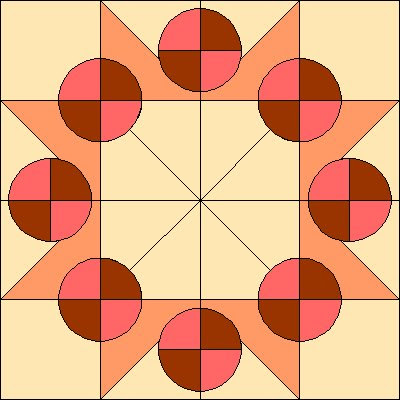
It's always fun to see if any of the audience for the newspaper patterns ever made up the designs. I don't recall seeing this one actually made into a quilt. If you are inspired send me a picture.
For more on BlockBase from Electric Quilt click here:
http://www.electricquilt.com/Shop/BlockBase/BlockBase.asp
The quilt in question is appliqued with leaves tucked behind the pieced snowballs but the original pattern is designed to be all pieced. You can find it in BlockBase, the computer program that is a digitization of my Encyclopedia. Here's the drawing from BlockBase. You can print out templates, any size.

It's always fun to see if any of the audience for the newspaper patterns ever made up the designs. I don't recall seeing this one actually made into a quilt. If you are inspired send me a picture.
For more on BlockBase from Electric Quilt click here:
http://www.electricquilt.com/Shop/BlockBase/BlockBase.asp
Monday, July 6, 2009
More Thrift Store Quilts
 Sujata Shah, 36" x 48", recycled shirts.
A few more quilt tops from correspondents in Washington state.
Sujata writes:
"This quilt is based on the Gee's Bend quilts. I used to teach at a local shop and ran a club for couple of years. The club was called, 'Inspirations from Quilts of Gee's Bend'. I got really interested in free hand cutting and curve piecing. This is made out of shirts and I plan to hand quilt it with pearl cotton. "
Sujata writes:
"This quilt is based on the Gee's Bend quilts. I used to teach at a local shop and ran a club for couple of years. The club was called, 'Inspirations from Quilts of Gee's Bend'. I got really interested in free hand cutting and curve piecing. This is made out of shirts and I plan to hand quilt it with pearl cotton. "

Foggy Day Quilt by Dorothy LeBoeuf, 20' x 20"
Dorothy writes:
"...to dispell the fog. Made from solids in stash plus awful curtain fabric. So freeing to work with this stuff, after working with today's expensive fabrics. Also freeing to not use a ruler althugh it seemed strange at first. We are going to be sad when we run out of the awful curtain fabric."
 A shirt and "the awful curtain fabric"
Scrap Challenge by Dorothy LeBoeuf, 64" x 75"
 "Silk garments waiting on the muse."
Wednesday, July 1, 2009
Stepping Stones Nine Patch

People are asking for suggestions as to what to do with The Morris Workshop fabric. One possibility that uses simple patchwork to show off complex prints is the "Stepping Stones" pattern Moda did for our first William Morris collection. That free pattern for A Morris Garden, is still posted on Moda's Free Patterns page. Click here:
http://www.unitednotions.com/fp_a-morris-garden.pdf
The quilt top on the left is done in the Morris Garden fabrics. I found it on Sadie Bird's blog, and the other is by Rebecca Rohrkaste, showing off large scale prints. The one below is a collaboration between Georgann Eglinski, Bobbi Finley and Carol Gilham Jones.
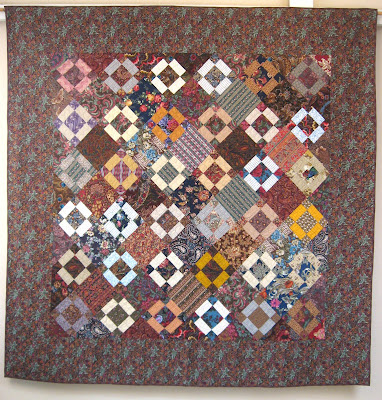
To see more antique versions of this basic nine-patch on point check out the Quilt Index on line. Click on these for an early quilt and two by Amish women in Illinois.
http://www.quiltindex.org/fulldisplay.php?pbd=MichiganMSUMuseum-a0b7o2-a
http://www.quiltindex.org/basicdisplay.php?pbd=IllinoisISM-a0a0f6-a
http://www.quiltindex.org/basicdisplay.php?pbd=IllinoisISM-a0a0p1-a
http://www.unitednotions.com/fp_a-morris-garden.pdf
The quilt top on the left is done in the Morris Garden fabrics. I found it on Sadie Bird's blog, and the other is by Rebecca Rohrkaste, showing off large scale prints. The one below is a collaboration between Georgann Eglinski, Bobbi Finley and Carol Gilham Jones.

To see more antique versions of this basic nine-patch on point check out the Quilt Index on line. Click on these for an early quilt and two by Amish women in Illinois.
http://www.quiltindex.org/fulldisplay.php?pbd=MichiganMSUMuseum-a0b7o2-a
http://www.quiltindex.org/basicdisplay.php?pbd=IllinoisISM-a0a0f6-a
http://www.quiltindex.org/basicdisplay.php?pbd=IllinoisISM-a0a0p1-a
Monday, June 29, 2009
Game Board

One of my favorite possessions is an old checkerboard made of linoleum squares. I've looked at it every morning for twenty years and thought that would make a great quilt---just four-patches in different contrast pairs.

I finally made a little table topper out of quarter-yard cuts of greens and browns from The Morris Workshop collection. I put a free pattern for it on my webpage so click here to download it. It's towards the bottom right on the home page as "Game Board." http://www.barbarabrackman.com/
I thought I was pretty clever until I found this picture on eBay of what looks to be a double knit quilt top. Somebody else had the same idea!

Saturday, June 27, 2009
The Plaid Fad

Plaids are quite popular in antique quilts. Here's a picture of a top with a woven and a printed plaid, probably from 1840-1860. I thought it was Queen Victoria who popularized plaids as symbolic of Scottish tradition during her reign that began in 1837. But I recently read a book about her uncle King George IV who visited Scotland in 1822 decked out in his tailor's idea of a regional costume.

According to biographer E.A. Smith in George IV (page 201):
The "King condescendingly donned what was supposed to be Highland costume…though the Highland dress was still strictly limited to the clans of the northern and western parts of Scotland it quickly became the fashion to adopt it as a mark of Scottish national pride."
Victoria and Albert probably heated up the fad for plaid in the 1840s but George's kilt explains why there are so many plaids in quilts before Victoria's reign.
Click here for more information about the history of tartan kilts.
Disclaimer: As in all internet sources (including this one) you never know how accurate any of it is.
http://www.your-kilt.com/history-of-the-kilt.html
And more thoughts on plaid…
http://aestheteslament.blogspot.com/2008_12_07_archive.html
http://www.your-kilt.com/history-of-the-kilt.html
And more thoughts on plaid…
http://aestheteslament.blogspot.com/2008_12_07_archive.html
Subscribe to:
Posts (Atom)