QUILTS & FABRIC: PAST & PRESENT


Monday, May 11, 2015

Baltimore Album Quilts 3x3


I'm looking for a unified field theory for applique. How this miserable task started was I have a new/old applique quilt with three different blocks. It looks Baltimore-ish to me. The blocks aren't layered flowers, triple bowknots, white roses or the wreath above: simpler designs. (More later about that quilt.)

So I thought I'd try to find the three patterns in Baltimore Album quilts.

Not actually my files. Mine aren't this neat.

My files (both paper and digital) are a mess.

Joyce Gross and Cuesta Benberry comparing notes.

If only Cuesta and Joyce were around. Many years ago when computers first became practical we did a numbering system for every Baltimore album (BAQ) in our files. I never talked the dynamic duo into computerizing their files but they had some mighty nice notebooks full of every BAQ we ever saw---hundreds in numerical order and we could find them in a minute. (I'd guess their notebooks are with their papers: Joyce's at the Briscoe Center in Texas, Cuesta's at the Museum of American Folk Art in New York---UPDATE: Merikay reminds me they are at MSU's Museum in East Lansing Michigan.)

I thought maybe I could apply our numbering system to my pictorial files. As I recall, we started with the number of  blocks in the set. 3 times 3 = 3x3. We also added border info since there are fewer border possibilities than block possibilities. We could instantly say it was a 3x3 with an appliqued border and see if we already had a picture.

Therefore the quilt below would be a 3x3. I arbitrarily made it 3x3-1.


3x3-2 is an old black and white picture from 1983

 I found I had seven examples based on a 3x3 set. Some of these quilts are small but most are large: 84" across.


This last one is a recent addition. It's in the DAR Museum's
Eye on Elegance exhibit. See this link:


Once I had the BAQ's numbered I was sure I could find the applique patterns I was looking for. I can now coordinate the numbers in my Encyclopedia of Applique for many of the simple designs.

BAQ #3x3-1-A3
Encyclopedia # 05.55 variation

And I feel a lot better now. This block in the quilt at the top of
the page has both a BAQ number and an Encyclopedia of Applique Number.


There are two variations in my pattern index.


#5.54 is from an unnamed album quilt dated 1844.


#5.55 is from a quilt in the Shelburne Museum. They gave the 19th-century quilt a 20th-century name: Laurel Leaves. 
Stella Rubin has a great example for sale. She calls it
Laurel Leaves, which is the standard name today.


Here are two variations from vintage quilts.
This one from a quilt dated 1849 by Mary Jane Shoemaker
from Rockingham County, Virginia.


I'd never noticed how consistently the top 3 leaves are colored.
The quilt artists probably didn't think of them as Laurel Leaves but some kind of flower
with paired leaves. 


Block 3x3-1-A3 has a gap in the middle but I'd still call it
a variation of  5.55. Maybe I'll number it 5.56

Well---that block isn't in my new quilt but I love having things in such nice order. And having better pictures than my black and white tracings in the Encyclopedia.

A variation with heart-shaped flowers from Mary Ann Gray's quilt.

I'll keep looking for my blocks and I'll show you my BAQ files in neat order for the next few months. Next time the 3x4's.
The biggest problem will be when I get to indexing the 5x5 section. There are dozens and dozens of BAQs set like that.


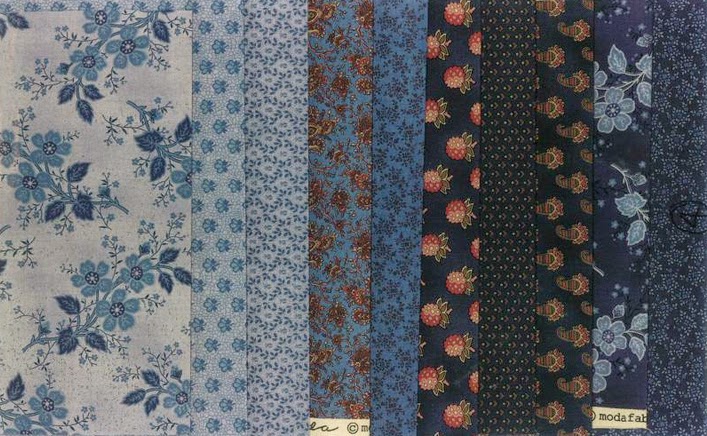
And I'll also show you a simple pattern that you could update---adding a patterned background like this mock-up of a blue and white print from my Union Blues line.

And feel free to print out my digital  BAQ index pages if you like to keep your inspiration in order.


Friday, May 8, 2015

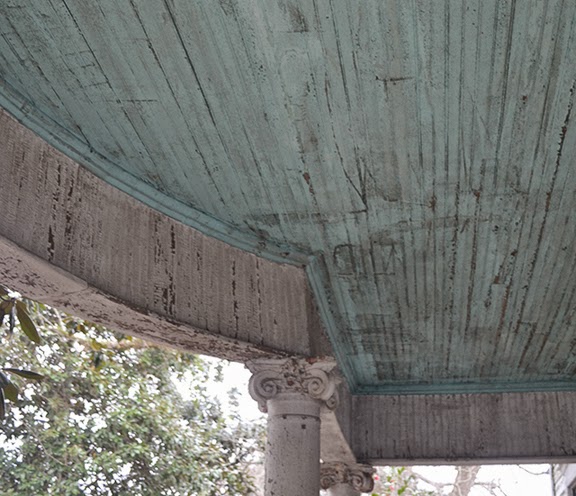
Haint Blue


A few weeks ago I learned a new color name from the
discussion among my Stars in a Time Warp starmakers.

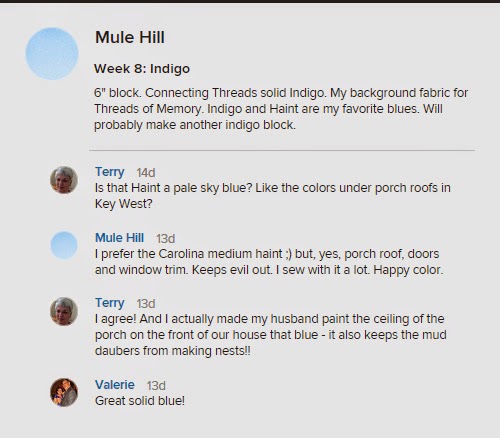
Mule Hill said Indigo and Haint were her favorite blues.

Terry asked: Is that Haint a pale sky blue? Like the colors under porch roofs in Key West?

MH: I prefer the Carolina medium haint but yes, porch roofs, doors and window trim. Keeps evil out. I sew with it a lot. Happy Color.

T: I agree! And I actually made my husband paint the ceiling of the porch on the front of our house that blue---it keeps the mud daubers from making nests!!

Haint, I assume, is a Southern word for a haunt or a ghost.


Well, now I know what haint blue is. In Kansas we call it "You know the color on the front porch ceiling." Haint blue might be easier to say.

I'm not from Kansas but when I went to college here fifty years ago I had good guides to the popular culture. They were mostly from Southern Kansas but their knowledge of the proper colors to paint a house held true in the abolitionist town of Lawrence.

The siding was white. The window screens and screen doors
had two options, shiny black or screen door green, a hunter green.
The green was dark with a little bit of blue in it.


We also called it John Deere green.


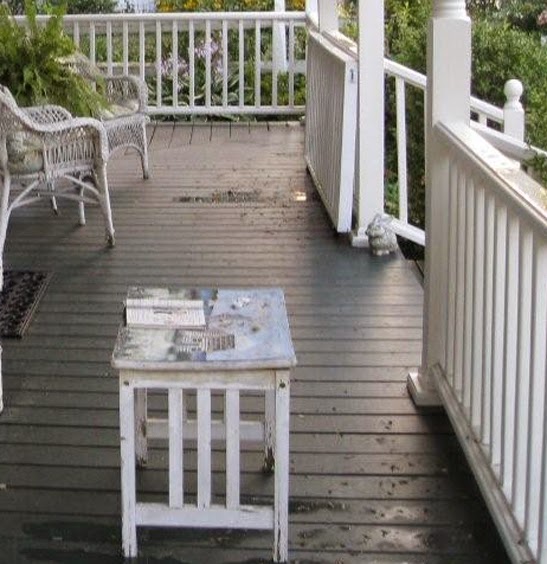
The porch floors were gray

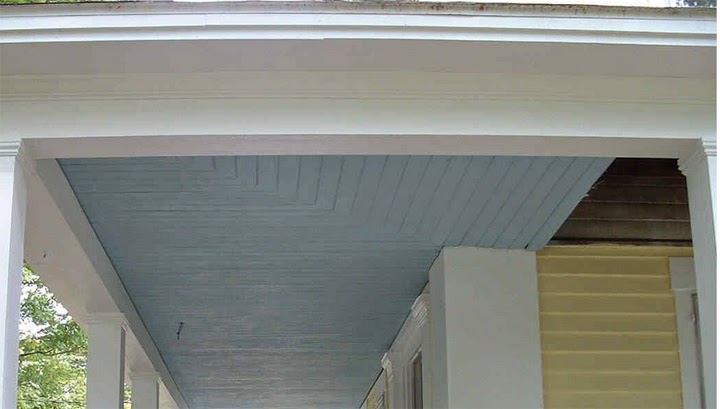
And the porch ceiling was "porch-ceiling blue."

When I asked why everybody painted the porch ceilings blue ( a color usually not repeated anywhere else in the building's color scheme) I was told it keeps the flies off the ceiling. Probably because they think it's the sky and they won't land there.

I liked the color, the tradition and the promise of no flies. I painted the porch ceilings blue.

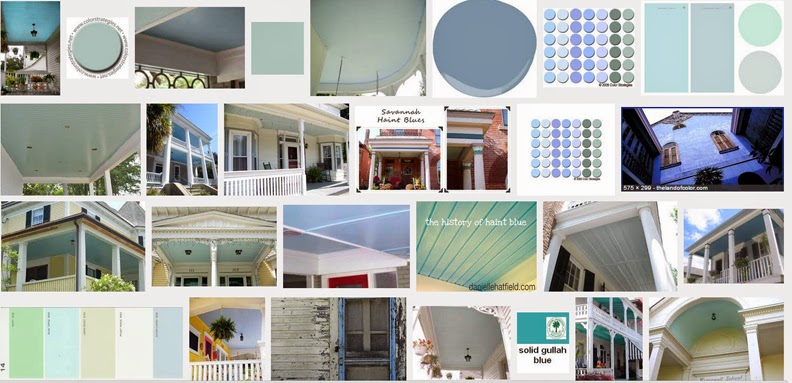
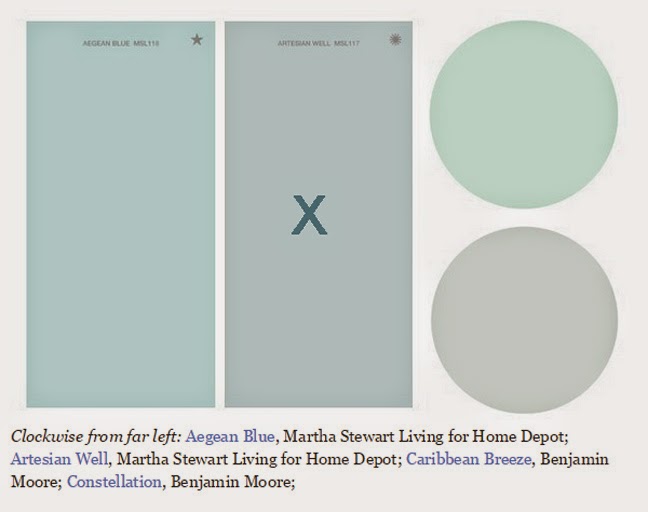
If you look around the internet for exactly what color "haint blue" is you will find a wide variety of opinions...

from turquoise to blue gray.


In Kansas it's a true blue---maybe like the swatch with the x in this snapshot from the Huffington Post. But it's clearer, not so gray.

Alice's Scrapbag
I've been using it a lot lately and like Mule Hill says,
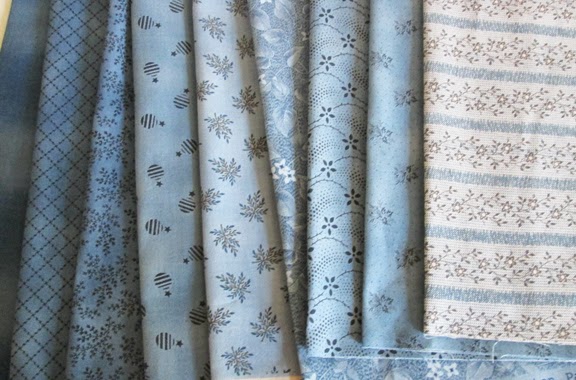
it goes well with indigo

Union Blues

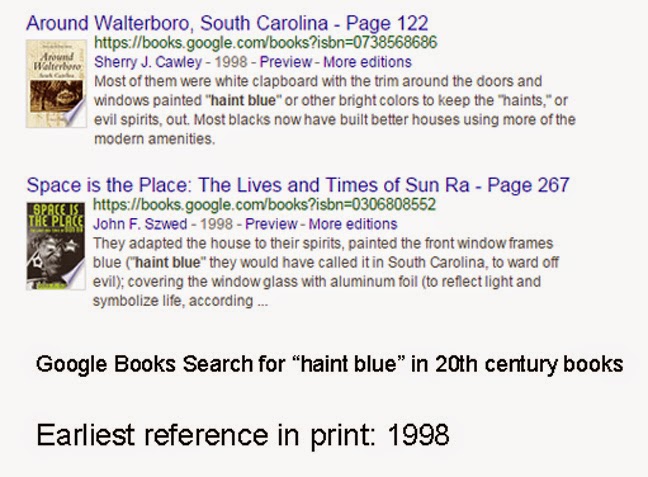
I also did a Google Book Search for "haint blue"and the earliest I could find the term in print was 1998. So it's a Southern folk term that only recently has been written down.

Now everybody is using it.

And you've got to admit it's a better description than "under the porch ceiling blue."

Does it confuse mud daubers and flies? Read this:

http://www.gardensalive.com/product/ybyg-507-does-the-color-blue-repel-pest-insects/

Tuesday, May 5, 2015

Reproduction Prints Are So Dull?

An old Fuddy-Duddy

Reproduction block by Becky Brown

Occasionally I run across a comment or overhear a shopper claiming that she doesn't care for reproduction prints because they are too drab.

Valerie's reproduction print block
See more about repro blocks every Wednesday at


Becky Brown

Really?

Wendy at Constant Quilter

ddwgram


Think Yellow!

Nancy' Swanwick's stars. 
She had a stack of 49 when
I photographed these.

I taught a class in these stars recently and the class was supposed to swap a star or two. Only 1 person of 25 would give up her stars. It wasn't me.
We liked them toooooo much.

Here are some great star blocks from my weekly Stars in a Time Warp QuiltAlong.


Two by Amy


Two by Jeanne


Victoria

SF

SpeedieEdie


 by Valerie

1

2

3 by Louise


Check out our Flickr page:

Vintage quilt from about 1890-1920

My advice: Buy a lot of yellow yardage when you see it. Add it to your reproduction stash. Use it all the time.

Saturday, May 2, 2015

Empire of Cotton: A Global History

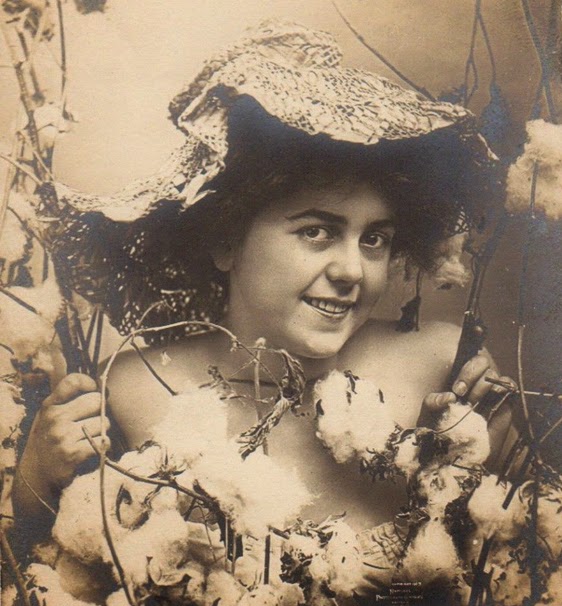
Cotton Calendar Girl
1910

When this  American pinup was published in 1910, the United States was the world's leading cotton producer. Through our nationalistic lens we continue to view cotton as a distinctly American product.


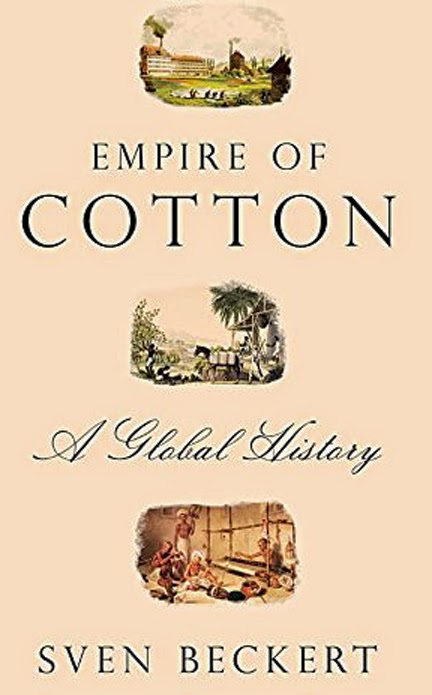
Empire of Cotton: A Global History by Sven Beckert has changed my view.

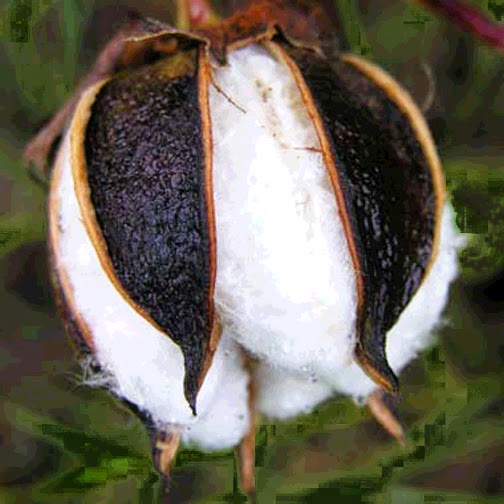
Cotton grows in the world's hot climates.
Different soils and weather conditions produce different qualities.


 The book, which recently shared the 2015 Bancroft Prize in history, is described by the publisher:
"The empire of cotton was, from the beginning, a fulcrum of constant global struggle between slaves and planters, merchants and statesmen, workers and factory owners. Beckert makes clear how these forces ushered in the world of modern capitalism, including the vast wealth and disturbing inequalities that are with us today. The result is a book as unsettling as it is enlightening: a book that brilliantly weaves together the story of cotton with how the present global world came to exist."

The book is a 600-plus pages of popular history combined with academic theory (heavy on the theory.) Beckert, co-chair of the Program on the Study of Capitalism at Harvard University, shows us cotton's dominant role in international trade and in the industrial revolution.

Enslaved cotton workers at a 
Southern plantation about 1860.
From the Robin Stanford Collection at the Library of Congress

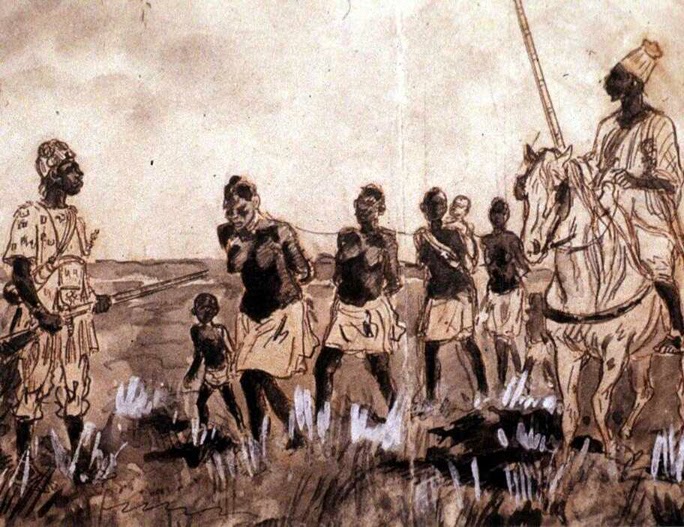
The information that impressed me most was cotton's connection to slavery. I knew, of course, that slaves in the Americas produced much of the world supply before the Civil War, but I did not realize that cotton was the commodity that motivated African slave traders to capture and sell human beings. Africans were not looking for gold. Cotton was the medium of exchange.

Slave traders with women captives.
Painting by Alphonse Lévy about 1875.
Collection of the Musee des Arts Africains et Oceaniens

As the publisher notes, the book is disturbing and unsettling. It's also must-reading for textile historians. Those who long for the good-ole days of American cotton dominance should read it too. 

Nostalgia fades with each chapter.

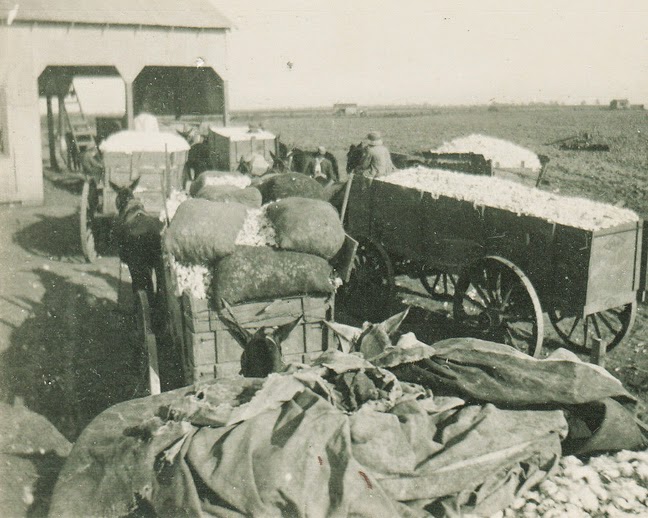
Cotton arriving at a mill in Fresno, Texas,
about 1900

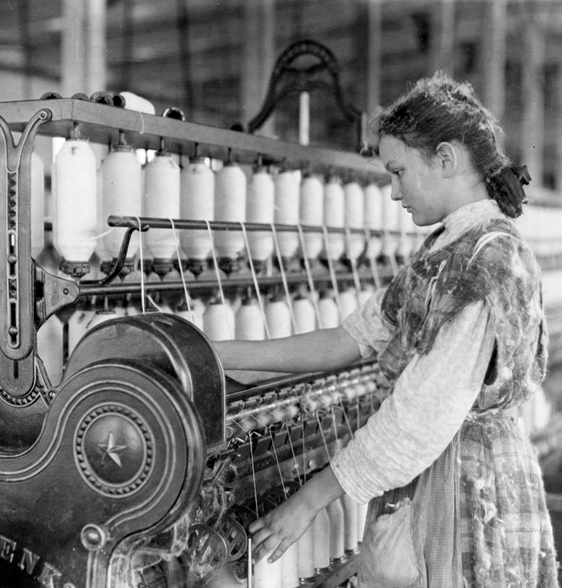
Cotton Spinner in Cherryville, North Carolina.
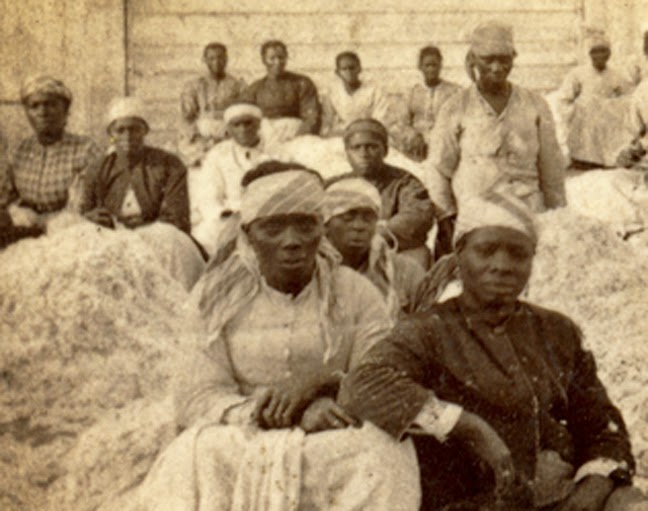
Photo by Lewis Hine, 
Collection at the Library of Congress, about 1910

Among the notes I made are lists of various words for the plant and its fiber. Many European languages use a variation of the Arabic qutun.

Arabic: qutun
French: coton
English: cotton
Spanish: algodon (perhaps from al qutun?)
Portuguese: algodão
Dutch: katoen
Italian: cotone

But the Germans have their own word  Baumwolle, literally tree-wool.

Another etymology: Beckert traces our word Muslin to the Kurdish word for Mosul, a place too much in the news about Iraq lately.

Woman cotton worker in Calcutta today

Read Karen Long's review in Newsday here: