QUILTS & FABRIC: PAST & PRESENT


Friday, November 7, 2014

A Tale of Two More Chairs

Side chair newly upholstered with the Strawberry Thief
reproduction from my 2015 Best of Morris for Moda.


On my Modernism blog this week I show some mid-century modern chairs found in Roseanne's basement. I said I hadn't seen any Stickley furniture in any one's basement in quite a while. But I did find these chairs at a garage sale last summer. The original upholstery was a green cotton duck. I immediately thought---William Morris repro.

There are no labels on the chairs. 
They aren't Stickley---at least I couldn't find any like this online.

A Gustav Stickley spindle chair

And they are quite short--although I can't see that they have been cut down.
They make great side chairs.
(I'm really trying to make my new 1970's house
Mid-Century Modern but it keeps turning out Arts and Crafts.)

See my mid-century modern chairs at this post:
It's a good thing it's a big house as these pairs of chairs have so little in common.

I can't find a thing about these fumed oak chairs with 12 square spindles. I bought them because they looked so Frank Lloyd Wright.

He did several similar chairs
but none like mine.


And I found this Liberty inlaid spindle chair at the Victoria and Albert Museum in 
London last summer.
I think mine might be a knock-off, perhaps for children.

Sage colorway
I knew I wanted to re-upholster the chairs in the Strawberry Thief
but I had to wait till I received some yardage. The Best
of Morris won't be in shops till February, 2015. Moda airmails
me some early. (Lucky me!)

Indigo Colorway
The Strawberry Thief print is done in three colorways in this line.

Black Colorway
It was hard to choose but I decided on the black and blue-green.

Click here to see more of The Best of Morris:

Monday, November 3, 2014

Thousand Pyramids Charm Quilt

Thousand Pyramids Charm quilt and Dorothy Barker

I recently got out an old reproduction quilt and spread it over Dot's love seat.

I made the triangle quilt in the early 1990s and it's been folded up
too long. I thought I'd lay it out for a week or two to get out the wrinkles
and then refold it.


The base of the finished triangles on this one measures 2". They are isoceles triangles,
with the base shorter than the side lengths.

I had made my mother-in-law a bed-size, charm quilt like this and
I made a smaller one for me with the leftovers 


This was before I was working with Moda to design reproductions so the darks and lights were from my scrapbag, prints not really marketed at the time as reproductions. I overdyed the really bright white shirting prints with tan Rit Dye to tone them down. I was looking for madder reds and browns, pinks and shirting prints.

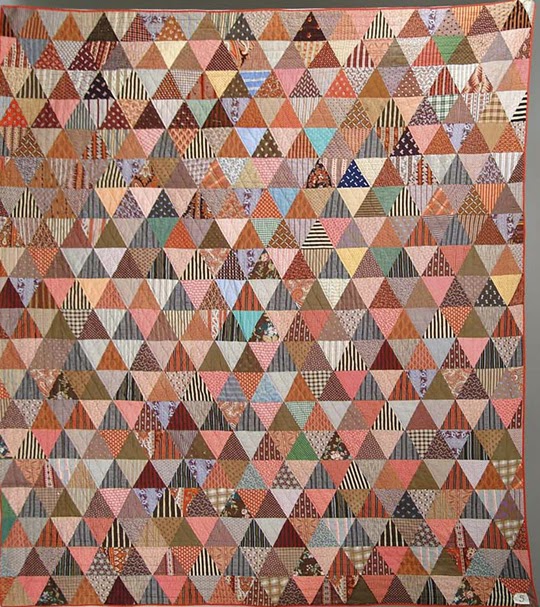
Sort of like this one from about 1870-1890

I remember that I was frustrated in piecing this because the differences in the measurements on the sides were hard to see and I was always attaching a base to a side and having to rip. 

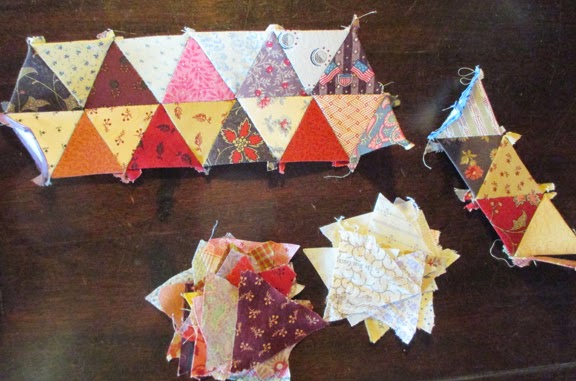
I have been looking for a paper piecing project that is NOT hexagons. I think I'll make another one of these with my own Moda reproductions. But I will use equilateral triangles, in which all the angles are 60 degrees and all the sides are the same length.

I looked that pattern up in my BlockBase program and
saw that it is #111a with several names.

I like Joseph's Coat from the Joseph Doyle Company about 1910 and Thousand Pyramids from Ruth Finley's 1929 quilt book.

You can buy paper piecing patterns for equilateral triangles already cut. If you want to cut your own: Paper Pieces gives you a free equilateral triangle grid to print out. Click on this link and scroll down.


I fooled around with their grid: Enlarged it 110% and fit it onto an 8x11 sheet which I printed on index paper.

Click on this image and Save it to a JPG file or a Word file.
Print it out on an 8-1/2 x 11" sheet of heavy paper.
The triangles measure 2" on each of the 3 sides.

If you want to stitch triangles without paper templates here's how to cut
an equilateral triangle from a charm pack.


 I have a Charm Pack (5" squares) of my Richmond Reds reproduction line from Moda.

Cutting equilateral triangles from 
Moda Charm Pack Squares:


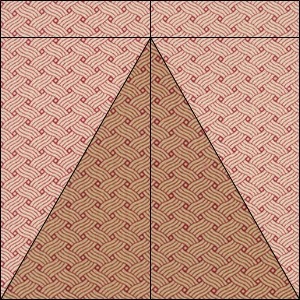
Begin with a 5" square.
Press the square in half so you
have a fold line down the middle.

Cut a strip off the top 5/8" wide.
Cut a line from the center top of the fabric 
to the exact corner on either side.
Your triangle will be 5" on all three sides.


You are ready to make a charm quilt with no two pieces alike.
The larger triangles really show off the prints.

Charm quilt from the 1870-1900 period

Quilt about 1880-1920 from the Nickols Collection
at the Mingei Museum.

You might be better off aiming for a charming quilt with duplicate prints. It's the
scrappy look that is so appealing. 

The quilt above looks like it was begun on the top left side
with madder browns popular in the 1870-1890 period and finished in
the lower right with blues and grays popular in the 1890-1920 period. 
Don't dawdle too long. Taste could change.


Charming quilt from 1930-1960 with the triangles shaded in diagonal rows.


Here's an updated look from Carla at Grace & Favour blog who used a Cherry Christmas charm pack
by Aneela Hoey from a few years ago. (Carla's look to be isosceles triangles---(longer sides, shorter base) They still work.
http://carla-graceandfavour.blogspot.com/2012/11/a-cherry-christmas-quilt.html

Here are links to more on the mysteries of the equilateral triangle:

Cutting with a 60 degree ruler from Diary of a Quilter:
http://www.diaryofaquilter.com/2013/12/ive-been-playing-with-60-degree-or.html

Cutting with a  regular grid ruler from Fresh Lemon Quilts:
http://www.freshlemonsquilts.com/?p=2132

Thousand Pyramids from about 1880-1920

I'm making progress in just a few days. And I found I still have some scraps
left over from the first project over 20 years ago.

You have to be nuts to save scraps that small.


So I was browsing the web after writing the above and I see somebody
at Atelier Bep had the same idea using my Richmond Reds. And she's finished already.


Friday, October 31, 2014

Scary Stories


I save horror pictures---the kind where a quilt fades so badly the original design is significantly changed.


For Halloween I thought I'd scare you

with pictures of quilts made between 1880 and 1920

when the new synthetic dyes were so unreliable
you could start with two identical looking reds

and after one washing wind up with a little
red and a lot of tan.

Do notice that the spiky points in this New York Beauty/Rocky Mount
quilt are almost completely faded to white.

Boo!

The worst culprit in the gang of fugitive dyes
was red.


But green also disappeared...

leaving few clues behind.

Could this happen to YOU?

Unlikely today because we use more color-fast dyes.
But that's the point of goblins---they could be under the bed.

Yayoi Kusama Pumpkin Sculpture, 1998

Wednesday, October 29, 2014

Union Blues for Spring Delivery


Typical eagle from Baltimore Album quilts 
of the 1840s and '50s


Union Blues, my new Moda reproduction collection, is
scheduled for delivery to shops in mid March and shop buyers
are planning their spring arrivals now.


The collection includes a variety of blues, light tan shirtings,
and darker taupe browns and olives.


Among the blues are a few rainbow or foundue prints,

The first three eagle blocks here are from antique Baltimore
Album quilts.

which are good reproductions of the shaded Prussian blue
prints popular in the 1840s and '50s.

We have two shades of blue and two shades of 
taupe/brown in the rainbow or ombre prints.


Buy lots. The ombre prints will be very useful for mid-19th-century repro quilts.


From Sea to Shining Sea by Gaye Rice Ingram

Gaye made good use of reproduction ombre prints in this small quilt
based on the Baltimore eagles.  

See some Prussian blue period quilts from the Quilt Index at this site: