

Merikay Waldvogel Collection

Over at the 6KnowItAlls:ShowUsYourQuilts Facebook page we showed Linsey-Woolsey quilts in the month of August. Scroll down to see a link to the page and ask to be a member. We'll let you in!
We saw many quilts ---well---not too many as they are rather unusual and people don't recognize them when they see them. We relied on Merikay Waldvogel's 1987 article “Southern Linsey Quilts” in Uncoverings Volume 8 (available online at the Quilt Index, but photos are not included---link at bottom of page.) However, the same article WITH color photos was published in Quiltmaking Beyond the Myths: Selected Writings from the American Quilt Study Group. Look for it online.

Merikay is our Know It Alls Expert on the topic.
She wrote about this one: "A Linsey quilt I’ve owned since 1985. My husband found it being used as a rug in a dirt-floor cabin in Blount County. He was helping a friend move out of the cabin and the friend told Jerry he could have it. It has striped linsey, but also a lot of solid blue … called “janes” and some solid brown which some folks have said might be similar to fabric used in Confederate soldiers’ jackets. I still have a lot of questions about Southern linsey quilts....unusual in that it is a pieced pattern and there has been minimal fraying and seams pulling apart."


A little photoshopping to emphasize what they are using for a rug.
Looks like a linsey quilt to me.
The sturdiness of a quilt surviving use as a rug is one characteristic of the linsey quilt. The stuff (as they used to call wool) is durable.

Paula Cochrane showed us one of a few she owns, this
one a tied crazy. The irregular pattern here is something more typical
of the crazy quilt era "after 1880" than before. Some of the fabrics are probably
decades older. I color corrected and squared up her photo a bit.
- How to recognize linsey quilts
- Was weaving linsey cloth regional?
- Was cutting up linsey fabric to make quilts regional?
- Was linsey factory made?
- What is homespun about linsey?
Linsey or Linsey-Woolsey is a combination of wool and linen or cotton. Look for the white yarns to identify linsey. The linen or cotton is often left uncolored, but it can be dyed. Before machine spun cotton yarns were widely available (say about 1840) the combination was linen and wool---hence the name "linsey-woolsey." After cotton yarn was a common American product the combination was cotton crossed with wool---but the name remained "linsey."
We are visual people and contributors offered several examples to help us.

Suzanne McDowell: "While stronger [than cotton] the best linen thread was likely used as warp for personal garments (as in next to body) … once cotton spun yarn became widely available it replaced linen as the warp in linsey woolsey… the name did not change in most cases…


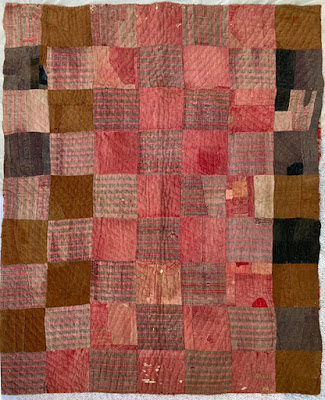
Marjorie Childress collection

Marjorie has only one linsey quilt and here it is---
very typical in patchwork of squares, although
some squares contain irregular piecing.
Weaving experts explained the warp/weft conventions:
Carol Cook: "The warp should be stronger and usually has less stretch or 'give' in the finished fabric which is why quilters like the lengthwise straight of grain for the long border strips. Less likelihood of 'wavy' borders.

Lynn Lancaster Gorges showed a piece she believed to be all wool, wool warp, wool weft---not linsey.

Sharon Waddell showed two from her collection, both with triangle
piecing---cutting diagonally across that weave would provide some
piecing challenges.

Hines family, North Carolina


Quilt in the collection of the Gregg Museum of Art & Design at North Carolina
State University, gift of Kathlyn Sullivan who has collected North Carolina quilts.
Much striped and checked linsey in the center area.
Notes from Kathy:
"The fabric is home-loomed ... a triumph of gathering the wool and cotton fibers, then carding, spinning, dyeing and weaving them—all by hand—before the actual cutting, sewing, and quilting could begin. The center portion is made from a catchall of leftover home-loomed garment scraps and/or carefully salvaged areas of worn out clothing. It is framed with blue and orange wool checkerboard squares that give the quilt a pleasant graphic design. Made for warmth, this quilt also has wool batting between its scratchy outer layers. There are more than twenty different fabrics in various weights and coarseness, hand quilted in long stitches."
http://searchgreggcollection.arts.ncsu.edu/mDetail.aspx...

Farmworker's shirt from Historic Deerfield

From Merikay's 1987 Uncoverings paper.

Online auction

CDV from Merikay's collection
" Name on back: Mrs. Liveston. Under her lightweight silk dress is a striped linsey petticoat. Probably from East Tennessee. The dress style was dated to ca. 1860 by Virginia Gunn."

"I don’t know for a fact, but I’d like to think she is proudly revealing her linsey petticoat to show her pride in making do despite war shortages."

Metropolitan Museum of Art
from Peggy Westerfield's textile collection
Linsey dresses also served as everyday outerwear. As late as 1866 Abba Alcott (Marmee in Little Women) noted that daughter Louisa was living at home in Massachusetts and making her a linsey-woolsey dress. The red dress here from Theriault's Auctions.

"How people forget their former situations. When they came here they were thankful for linsey gowns and now though my Papa bought each of them a printed cotton, yet nothing would do but a white dimity..." Quoted in Carolyn Delatte, Lucy Audubon: A Biography.Kay Triplett noted that Harriet Jacobs (1813-1897), who escaped slavery in the 1850s, retained "A vivid recollection of the linsey-woolsey dress given me every winter by Mrs. Flint. How I hated it! It was one of the badges of slavery.”

From Lynn Lancaster Gorges's collection

Lengths of linsey in a quilt from a Slotin Auction sale.

The other side. Which is the top and which the back?
Join our Facebook group 6KnowItAlls:ShowUsYourQuilts:
Read past posts on linsey:
http://quilt1812warandpiecing.blogspot.com/2012/03/linsey-woolsey-quilts.htmlhttps://civilwarquilts.blogspot.com/2015/01/a-slave-made-quilt.html
http://civilwarquilts.blogspot.com/2015/08/ann-knoxs-linsey-quilt.html
http://civilwarquilts.blogspot.com/2015/09/another-view-of-ann-knoxs-quilt.html
https://civilwarquilts.blogspot.com/2015/01/a-slave-made-quilt.html
------


