QUILTS & FABRIC: PAST & PRESENT


Friday, June 9, 2023

Bets Ramsey is 100 Years Old


And aren't we lucky.


Want to know more about Bets???
Check out the Quilt Index:
Either page links to the other page as well as Bets's own quilts and her writing in Uncoverings and Quilters' Journal.
Her artist page is, https://quiltindex.org//view/?type=artists&kid=1-111-1 and has the timeline of her life and a list of her publications.
Her story page is, https://quiltindex.org//view/?type=stories&kid=1-112-22 and has the most videos.


Watch an hour-long YouTube video with old friend Merikay Waldvogel interviewing Bets last year for the Quilters: Save Our Stories series by the Quilt Alliance.


Monday, June 5, 2023

Illinois Star Variations


A mysterious pattern from an online auction a while ago.

Yellow-green and probable Turkey red.
19th Century?

The block should be somewhere in here among the Maltese Cross
designs in BlockBase. These have at least 8 seams meeting in
the center, rather a challenge and not too common.

What makes this one even odder is the way the seams appear.
A lot of insetting ---Y seams etc.

I'm not stitching it.

Another example that looks early-20th-century but with a more
practical construction. Still a challenge though.


Variously called Illinois Star.

BlockBase+ has a pattern for #2744---no Y seams but
16 seams meeting in the center.


See the Nancy Cabot sew-along page for more about the Chicago Tribune's 1933 version from 

And as I always say when  you have more than 4 seams meeting in the center. Don't forget they have invented the dot!


Thursday, June 1, 2023

Herbarium Applique Block of the Month

Block #1 in Herbarium, a Dahlia Wreath by Deanna Street

Over at my other blog CivilWarQuilts we do an applique block of the month each year with stories about women who lived through the Civil War. This year's is Herbarium, based on eight mid-19th-century samplers I've found with similar patterns, some blocks based on plants' natural appearance rather than the stylized roses & tulips in formal repeats that we usually see.

 Elsie Ridgley is using 1930s reproductions.

#2 is White Oak

Our history lessons discuss the importance of "botanizing" and herbariums in the science education of the mid-19th century American schoolgirl. 

Someone's Herbarium

Each block recalls a teacher, a botanist or a collector who organized her specimens into a book, a Herbarium (an Herbarium---if you don't pronounce the H.)

Nat Palaskas is going for an Asian aesthetic.

Matt Macomber loves busy prints And is great at doing innovative combinations.


The applique is relatively easy, a good place to begin or improve your applique skills.

Suzie Mullins is drafting her own patterns, drawing from my pictures.

 Rebecca Schnekenburger is adding birds, always a good addition to any garden.  

Helen Vanderloop's romantic look

Kathy Suprenant

Becky Brown
#3 Starry Wreath was just posted yesterday

And do check in at our Facebook group HerbariumQuilt. It's public so you don't have to join. Post your pictures.
https://www.facebook.com/groups/1956642391352208


If you would like to buy the pattern package for $12 to print yourself see it here at my Etsy shop:
https://www.etsy.com/listing/1420573283/herbarium-12-applique-blocks-in-a-civil?

Saturday, May 27, 2023

Star With a Southern Spin


Sifting through my files of pictures from online auctions.
What about this?

It's not in my Encyclopedia of Pieced Quilt Patterns.


But it's easy to draw in EQ8


So here's a pattern for a 12" block.
Spin Cycle.
Probably an  unpublished Southern design about 1900.

Monday, May 22, 2023

Interesting Solutions to Common Design Problems


Certain patterns must be adjusted in some fashion to fit a format
with 90 degree corners.

The half-block might have been a more practical solution.

Some do reject the common solutions and explore new options.


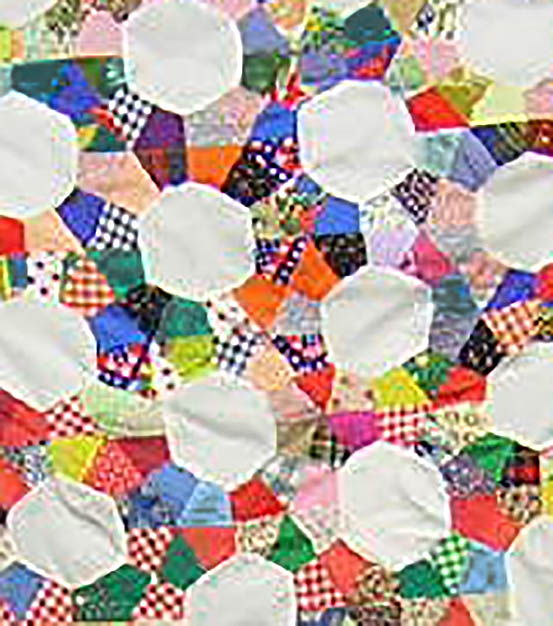
Any hexagonal pattern has to be tamed....

You cannot just let them run free.

The large star of diamonds often presents problems when you
draft your own diamond. Here we have a 9-pointed star. Best
solution is probably to applique it to a background and hope no
one can count beyond eight.


Related problem. Fill in the gaps and call it eight.

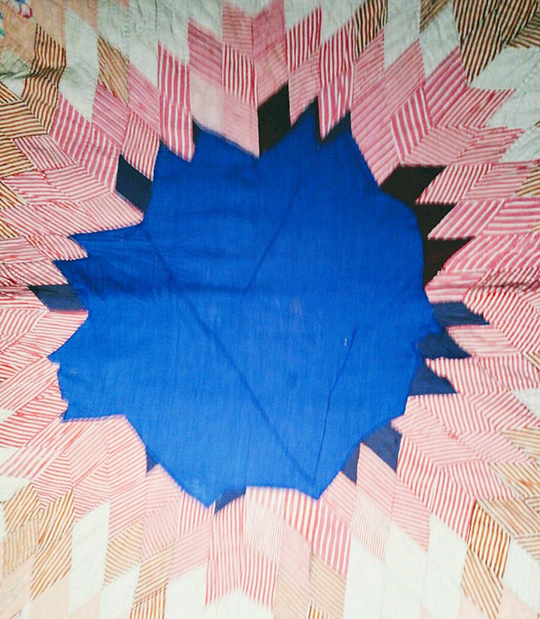
Another Lone Star problem is a bump in the center.

Not a good solution--but a solution....


Wednesday, May 17, 2023

Regional Clue---Run-on Corners


Quilt from about 1900.
Note the multiple strip borders, 3 on one side,
1 on 2 sides, and none on the last side.
 
Many style characteristics tell us this is probably a Southern quilt: 
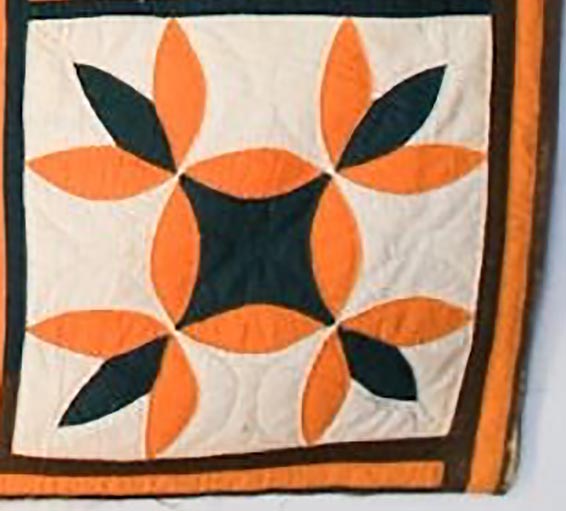
The fabric with an emphasis on solid chrome orange, brown and teal green/blue.
The use of strip borders and, in particular, the way the corners were handled is often a clue.

Attributed to the Allen Sisters of Tennessee
5 Strips, pieced as individual border units and then attached.

Attributed to Nannie Vanzant Moore of Tennessee

This kind of border resolution is never going to win you any prizes today when mitered symmetrical border corners are the standard. One name for the non-conforming border style is "run-on borders." They are a product of strip + strip borders---the way the strips are attached.

Wooten & Wooten Auction
Ester Maples of Georgia

How regional is the corner style? 

Southerners liked a triple sash set and as Ester did, often
extended it to the edge as a border.

I looked at all 924 quilts that the New Hampshire project (Phase II) has loaded onto the Quilt Index. I looked for strip borders but I wasn't looking for a single strip. I looked for two or more. Of those 924 only 13 quilts used a strip + strip border.


And NOT ONE of those had run-on corners, all nicely planned like this basket, about which they had little information. That is less than .02% of the nearly 1,000 quilts. I think we can say that a triple strip border, mitered or butted or run-on, is NOT a clue to a New Hampshire quilt.
Ollie Mooney, Shelby County, Alabama
seen in the North Carolina project

To contrast with New Hampshire I looked on the Quilt Index for quilts made in Alabama---No Alabama project quilts up there yet but 207 quilts made in Alabama are pictured. Of those 9 had more than one strip pieced into the border and one of those, this one by Ollie Mooney had run-on corners. That is about twice as many strip + strip borders as New Hampshire but I don't think I have enough data to support my hypothesis.

Comparing New Hampshire to Tennessee might be more illuminating. The Tennessee project recorded 2055 quilts on the Quilt Index. I saw 51 that had more than 1 strip (unpieced) border and of those 17 had run on corners.

So here's a Scoreboard


Southeastern Pennsylvania, about 1900

Apparently multiple strip borders and corner style are indications of  regional taste, style that needs to be explored in greater detail. Pennsylvania Germans also favored multiple borders but often in a variety of widths and corners were resolved without running on.

As did the Amish

Recorded in the Arizona project. No source information
but likely Southern

See posts on border style:

https://barbarabrackman.blogspot.com/2013/07/borders-and-asymmetry.html?fbclid=IwAR1PUNlTkjNa9pjjRFBMv6R3H6MAXAee0gHfEDuiapK1H4LRL6yuPx_mVVk

https://barbarabrackman.blogspot.com/2013/06/run-on-borders.html?fbclid=IwAR2m9S8jFT1cGWTb_e7IcysRwj2MuNcZRLRsh2izNlAp0UDgcWGtpb8E1qw