QUILTS & FABRIC: PAST & PRESENT


Saturday, October 15, 2022

Jacob Lanzit Buys a Sewing Machine


A young man with a machine

Jacob Saul Lanzit (1834-1907) came to the United States from Czernowitz in what is now Ukraine in 1858 in his mid-twenties. He kept a diary as he prepared for his journey and for about a year after his arrival. A copy in German is in Cincinnati's American Jewish Archives, donated by son Robert in 1957.

Without any English he had trouble finding a job in Chicago but he got work running a cigar stand and as a barkeeper...."Time passes; business gets worse." Chicago and the rest of the capitalistic world was recovering from the Panic of 1857, a devastating financial upheaval. 

Jacob returned to New York, peddled stationery and worked on his English. In January, 1859 he resolved "to learn a profession." Choosing between cigar making and operating a sewing machine he decided to take a six-week class "to sew on Singer's machine...Tuition $3." 


Ad from the Brooklyn Eagle, 1859. Wheeler & Wilson operators 
seemed in high demand, perhaps because the machine 
required more skill than Singer's.

1858 ad

"It is hard work, to be sure, but I am now in America; that means working."
Machine-stitched silk lining added to a man's coat

He found a job stitching linings in a factory that soon closed down. "I bought a machine for $40 and went without eating." 

He advertised his availability in the newspaper and found a job again making linings. By August with $20 in the bank and a sweetheart named Rachel (Rosa) Marx (Mark) he was optimistic. Times, however, remained tough. 

"Whenever I want to visualize a mean character, I can only use the word tailor." Arguing with his boss, he quit. "Still owed $17 on the machine. What could I do?" He began making linings on his own, achieving some success.

Machine-quilted yardage was often used as lining for crazy quilts in the 1880s.

Essex Street & Hester on  Manhattan's Lower East Side, about 1910.

 "I rented a larger apartment on Essex Street (rent $6.50) and began to have a lot of work."

Jacob and Rosie married in 1859 and in the 1860s raised at least 4 children.

New York Sun, 1866
Post-war demand for machine operators 

During the Civil War Jacob worked as a shirt maker and opened a "Fancy Goods" store on Canal Street. Rosa was a milliner.

In 1877 he was listed in a city directory as a shirtmaker, still living on Essex Street.


The 1880 census found them with two boys and two girls. Jacob was as a printer with his sons and daughter Gussie working in the shop. The eldest Henry eventually moved to Los Angeles and opened a print shop, which still may be in business.

In 1887 Jacob was looking for a bi-lingual employee.

See Jacob's grave and Rosa's at Find-A-Grave:

A talented machine operator stitched this
lining for a coat for President Abraham Lincoln, in the collection of 
Ford's Theatre National Historic Site. See a post: 

I read Jacob Lanzit's adventures in the sewing machine trade in Jacob Rader Marcus's 1955 collection Memoirs of American Jews , 1775-1865.


Sunday, October 9, 2022

Laurana Rowe North's Quilts


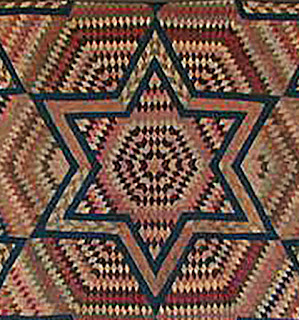
Quilt #1, a Star Medallion

The New York Historical Society owns two rather fancy quilts donated by Laurana Rowe North’s grandchildren in 1949. William Russell Bogert and his sister Helen Bogert Parmele believed Laurana (1783-1875) to be the maker. They recalled the story that she stitched both on her “wedding trip to Atlanta, Georgia in 1812.”

Portrait of William Russell Bogart Jr.
 by Man Ray

That’s a lovely story but we hope she didn’t spend her honeymoon stitching tiny diamonds together. The family tale has several flaws; the quilts do not look like they were made in the early 19th century, and Atlanta didn’t even exist until about 1837 (They may have confused Atlanta with the older Augusta.) Further fact checking might help us better date the quilts.
 
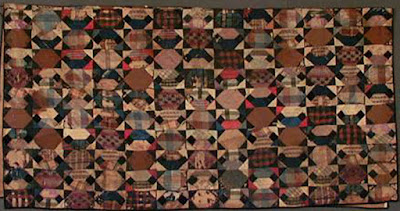
Quilt #2 Rectangular blocks
Both quilts look like they are pieced of silk.
Laurana (also spelled Lauranna) was born in Farmington, Connecticut some time in the late 1780s to Isaiah and Mercy Gridley Rowe.

Sketch of an artist sketching Farmington by John Warner Barber
for his Connecticut history book.

Pewter plate from the family firm

Isaiah was a pewtersmith, a craftsman who worked household utensils, like a silversmith but using cheaper media like tin and pewter.

Isaiah Rowe's Family Record was filed with
a soldier's pension request---now in the National Archives.

Laurana may not have been her given name; no Laurana is on the list but she may be the second daughter here. The image is hard to read.


In 1817 Laurana married John Adna North a blacksmith from Farmington. He had sailed to Cuba in the early teens for his health (his lungs were thought to be pre-tubercular, requiring a Southern climate) and returned to the U.S. through a Southern port. He went on to Augusta, Georgia a growing city on the Savannah River along the South Carolina state line.  

There he contacted Laurana's father Isaiah Rowe who had an Augusta mercantile establishment, an encounter that was probably planned. Her brother Adna S. Rowe (John must have been a cousin as Adna is a distinctive name) took over the Augusta business when Isaiah retired about 1818 and  Adna and John became partners in North and Rowe of Augusta. Laurana was apparently still in Connecticut.

A biography of son John tells us a slightly different story that John senior "made his first visit to Augusta...during the progress of the war of 1812." An entrepreneur at a young age, he hauled a wagon full of Georgia cotton overland to Philadelphia, sold it and returned to Georgia with "a load of general merchandise" to set up a store.

Adna's sister Laurana  Rowe is recalled in family history as taking a steamboat (the first steam trip !?) up the river from Savannah to Augusta where she wed John North on August 25, 1817.

North & Rowe logo on pewter

N & R below the eagle---North and Rowe. Their pewter is quite collectible today because little has survived. North & Rowe produced pewter items for their Augusta mercantile business but who the actual pewtersmith was is a matter of conjecture by pewter collectors. 

The rectangular blocks are hard to figure out from the small photo
but they might look like this:

Alternating two unusual patchwork designs.

Laurana gave birth to perhaps 8 children and their birthplaces tell us something of her travels. Her eldest Jane Antoinette North Richards was born about 1819 in South Carolina, somewhere east of the Savannah River (according to the 1870 census.) Two years later James Harper was born but he did not live past infancy. A second James Harper arrived two years later and lived until 1907.

The North family has several stones in New Haven's 
Grove Street Cemetery in Connecticut. Laurana and her husband may
indeed be buried here but markers for her children are
cenotaphs---memorials to people buried elsewhere.
 
Two boys who died as infants

Philip drowned at 11 and Henry, age 39, died at Macon, Georgia 
shortly after the Civil War was over.
Cold Spring is a town in Putnam County, New York

One who survived and thrived was John Adna North II, born in New York in 1831. His biography tells us: "About 1825 the family returned to New York city" as "Southern climate proved inimical to the health of the mother." North & Rowe ceased operation in 1823, probably a more accurate date for the move to New York.

Son Henry was also born in New York and may have had a twin Mary Martyn North. The Norths returned to Connecticut in the 1830s or '40s, living there for the rest of their lives. Son John grew up in New Haven and moved to Augusta when he was about 20, living there through the Civil War and leaving many Georgia descendants. Laurana's brother Adna Rowe died on a visit to Tallahassee, Florida in 1837. Her husband John died in  April, 1865 in Connecticut.

The 1870 census found widowed Laurana and daughter Antoinette
living in Stratford, Connecticut. Laurana died about 5 years later.


Tracing Laurana North's homes through her children's births tells us she lived in Connecticut with some time in Augusta, Georgia about 1820 and some in New York City about 1830. Are her quilts old enough to have been stitched in Georgia or New York or are they more likely Connecticut quilts?

Without better pictures it's hard to make a guess, but they do look like the kinds of silk quilts made after 1850 and into the 1870s and '80s when silk scraps were available inexpensively. As Laurana died in 1875 we can then wonder if she was the maker. No answers but intriguing quilts.

Tuesday, October 4, 2022

Nancy Cabot/Loretta Leitner: A Short History


The gang at Accuquilt has invited me to give a short lecture
on quilt history today about a new die for their cutting machines.

Click here:

(October 4, 2022 Noon Central Time)
Here's some background on my discourse.

Quilt show at Carson Pirie Scott, January, 1933

Chicago in 1933 was home to a quilt mania.

Illinois Historical Society
Quilt entered in a contest at the 1933 Fair

The Chicago Tribune saw an opportunity for a popular column selling patterns, assigning Needlework Editor Loretta Leitner to publish a regular feature under the pen name Nancy Cabot, beginning in January.

The column's name might remind readers of the often-described Colonial sources of American quilts, a history greatly exaggerated at the time.

1935 standard image of a New England colonial maid
in a ladder-back chair with a braided rug just finishing
up a "Colonial quilt."

Loretta Leitner Rising (1906-1958)


Over the next five and a half years the column published hundreds of patterns.

Scrapbook of Nancy Cabot patterns

Designs included modern ideas and traditional patterns,
some mailed in by readers. Loretta produced an attractive column,
undistinguished by historical accuracy.

A modern design given a dubious history,
dating "back to 1840 and a Hawaiian missionary."
Her flights of fancy were impressive.

May 22, 1935

Nancy Cabot was in tune with these Colonial Revival images, giving
trend followers mixed messages about whether they should
be looking forwards or backwards.

It's difficult to say how often the quilt column appeared. For example, for May, 1935 I found 9 clippings on these dates: 3, 6, 7 12, 22, 23, 27, 28, 29. The pattern column may have appeared when there was room. My Encyclopedia of Pieced Quilt Patterns includes 775 attributed to Nancy Cabot, and that is just pieced designs and pieced designs where she generated the name rather than copying an earlier source.

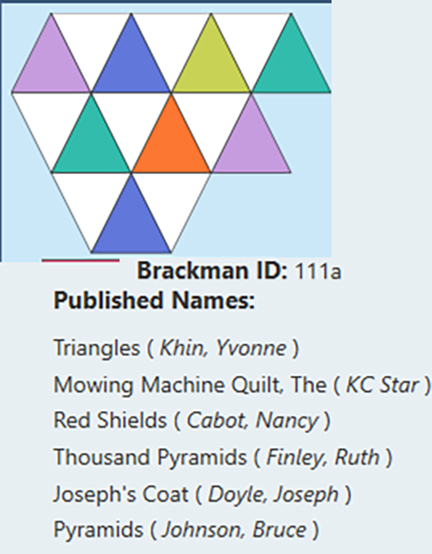
For example, "Red Shields" is the odd name she gave this overall triangle pattern.
I bet she made a lot of those names up.

In 1938, pattern historian Wilene Smith tells us, the Cabot column changed sources from the Tribune building to New York syndicate Peerless Fashion Service. It all gets quite confusing after 1938.

Sunday spread, 1940

Whether she continued producing the Nancy Cabot column or not, Loretta Leitner continued with  the Tribune till her death in 1958. She wrote for the Sunday Department, creating needlework features like this one under her own name in the 40s.


We don't know much about her personal life. She was a Chicago native whose first job when she joined the paper about 1926 was processing letters to the "Embarrassing Moments" column. She married Morris Herbert Rising but never used his name in her career, remaining Loretta Leitner. She had one son Morris Jr.


Friday, September 30, 2022

Southern Spin #7 Brave Sunflower


Brave Sunflower by Denniele Bohannon

Last month's Sunflower with 9 petals was just practice for this month's with 16.

The block (#3480) was published several times in the Kansas City Star, once as A Brave Sunflower. Did that mean you had to be brave to try it?


Oklahoma Sunburst, published in 1934
Print on an 8-1/2" x 11" sheet. See the inch square for scale.


The pattern dates back to the 1830s. It seems that quiltmakers all over the small United States showed off their skills with sunflower variations but after 1870 or so Southern seamstresses continued to challenge themselves, while Northerners went on to other styles. The one above dated 1885 according to the Texas project.

Mid-20th-century.  15 petals.

Mid 19th---9 petals
Saw this one for sale at the New England Quilt Museum shop
a few weeks ago. Northern Spin.