QUILTS & FABRIC: PAST & PRESENT


Thursday, March 21, 2019

Garnhart Group of Quilts #5: Assumptions

 Vase chintz likely to date from 1835-1845

The fact that so many quilts descended in the families of Catherine Garnhart's 11 grandchildren has led family, curators and historians to conclude that Anna Catherine Markey Garnhart made quilts in a signature style in Frederick, Maryland from about 1820 to 1850, the years when her grandchildren were born. These exceptional bedcovers were handed down in her family for generations.

As Dorothy Cozart wrote in a 1986 paper on Catherine Garnhart for the American Quilt Study Group:

"Because of the regard held for these quilts it can now be documented that Anna Garnhart made a few outstanding quilts."
An Early Nineteenth Century Quiltmaker and Her Quilts

Collection Plains Indian & Pioneer Museum
Initially attributed only to Mrs. John Markey
Catherine's first husband was named David Johann Markey

This quilt is quite a bit different from the others but it has the same elements and descended in the family of grandson John David Markey, (1822 -1898) through his descendant Geneva Isabelle Covey Drake of Fargo, Oklahoma.

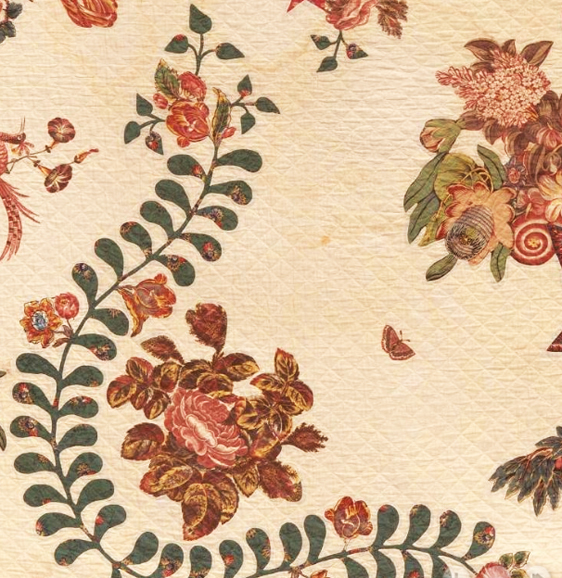
This basket in the Covey family quilt is a combination of chintz
applique flowers, conventional applique leaves and stems
and an unusual decorative design.

I remember being so impressed with Dorothy's linking of an Oklahoma museum quilt to the family despite the errors in the attribution "Mrs. John Markey." It is hard to keep track of one's great-grandparents given names since families often refer to ancestors as Grandma Markey. A photograph of Catherine in the Covey family collection is identified on the reverse:
"This is Sherman's great-great-grandmother, the one that made the eagle quilt." No name.

Grape wreaths with the Covey family's on the left---
Blocks in most of the Garnhart group do not have those conventional applique details
seen in the leaves in the center of #5.

The donor thought it had been made for Catherine's grandson John David's birth in 1822 and then given to his daughter. A note preserved in Geneva's Covey family dated 1901 from Catherine's aunt Anna Catherine Markey Mantz Jones described it as being made about 80 years ago (1820).

"Grandmother [Catherine] made it for [John David]...grandmother made us two girls one each." There really is nothing in the published note that indicates the quilt was given as a birth present, but somehow that story and that date has stuck with several of the quilts.


We have seen that the fabrics likely date the quilts to a decade or two later than that time frame, perhaps 1835 to 1850. Every "fact" in a family story must be checked against records and we have seen that names are wrong and assumptions are misinterpretations. Women in the mid-20th-century Covey family may have made quilts for birth gifts for their children---why wouldn't Catherine have done the same 130 years earlier? The crib quilts in the Garnhart group may have been intended for newborns but it is more likely the larger quilts were given as wedding gifts, coming of age gifts, or just a gift to even out the score---every grandchild gets a quilt at some time.

One of the New England group of eagle quilts

As Dorothy Cozart wrote: "It is not surprising that Catherine chose to make quilts. She had the leisure time and the money with which to buy the fabrics." So we need to examine the major assumption. Could one woman have made 11 quilts  (plus others like the one above) in those 15 years between 1835 and 1850?


Catherine Garnhart in 1840 was about 67 years old, a widow comfortably fixed in a substantial home in a large town with a son and an elderly mother living closeby. According to the 1840 census, Catherine was head of the household and living alone. Only one female is listed in her home.

Catherine had servants but apparently no slaves. She had eight surviving grandchildren, five by son David Markey II and his wife Susanna Bentz Markey and three by daughter-in-law Eliza Markey Thompson who was soon to be widowed for a second time. (Three more grandchildren by David were born in the 1840s.) She was born into a strong German culture and remained a German speaker all her life.

 Assumptions about her quilts are many.

1) She made a quilt for each grandchild, possibly at birth or marriage. Quilts descending in the Markey family are paired with grandchildren who were born from 1822 to 1847. Only one grandson, the youngest, did not marry. [David Jacob Markey came to an ignominious end in 1895 when he was killed in a fight on a Harper's Ferry boat dock.*]

2) The quilts are distinctive and can be recognized by her style.


3) She was an extremely skillful seamstress as seen in the delicate and abundant reverse applique.
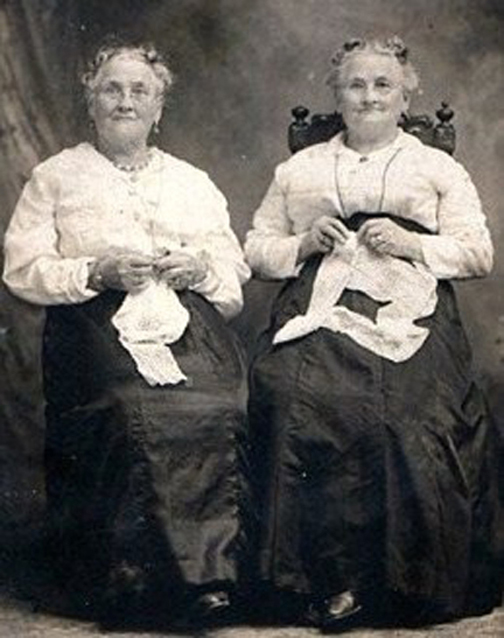
Twins (?) at their needlework, about 1900.

4) She spent a good deal of time at this occupation. Turning out a minimum of about one quilt a year for 15 years would require countless hours with a needle in her hand appliqueing---to say nothing of time devoted to shopping for fabric, cutting small images from furniture chintzes, assembling various-sized blocks into a top, framing them with multiple borders and quilting several.

Once marketed as a "Mary Evans quilt"

Does this sound familiar? A woman living about 50 miles away in Baltimore at the same time once received the kind of credit that Catherine Garnhart has. If you have been looking at antique quilts for a while you may recall when Baltimore album quilts were assigned to a single creator. Mary Evans was considered the Rembrandt of the genre of high-style Baltimore Album quilts.           


You may also recall when Elly Sienkiewicz gave a paper at the American Quilt Study Group's 1989 seminar. "The Marketing of Mary Evans” argued against the one-woman/one-style concept in several ways. Elly's personal experience in re-making historical blocks requiring 50 hours for each was one thread of evidence. She asked a friend to count her hours in making an elaborate applique finding a  professional seamstress needs a year or more of forty-hour weeks to make one classic 104" square quilt No one person could have made the dozens and dozens (hundreds) of  Baltimore album quilts.

Block in a Baltimore album in the collection of the 
Metropolitan Museum of Art

Debby Cooney and Ronda McAllen recently gave a paper "Baltimore Album Quilts: New Research" at the 2017 AQSG Seminar, summarizing current thinking:
"It is very unlikely that one woman could have made the huge number of high-style blocks that are known all with hundreds of pattern pieces to be pinned, cut out correctly, positioned to overlap other pieces and basted in place in set schemes."

BAQ from the Cooney/McAllen collection

If Mary Evans did not sew the similar blocks who did? The theory today is that similar blocks were sold by several designers and/or seamstresses as basted kits, finished blocks and patterns---a school of Rembrandt, perhaps. Cooney and McAllen identify others associated with the quilts, among them Mary Simon, Maria Bond Wehner Williams, Elizabeth McKenney Sliver, Mary Chase and various milliners and proprietors of fancy goods shops. Hobbyists could have appliqued the pre-basted blocks themselves or purchased a finished block for a gift or their own quilt.


The Garnhart group attributed to Frederick, fifty miles from Baltimore, includes far fewer quilts than the Baltimore album group that Debby Cooney estimates as 400. But parallels between the Garnhart family quilts and the BAQs are too strong to continue to assume that one woman designed and stitched the quilts.


There has to be another logical origin story.
Was Catherine Garnhart a very good quiltmaker or a very good customer?
Tomorrow: Conclusions

*The younger David Jacob Markey was considered mentally ill and erratic. He was berating his boss ferry Captain George Leonard who hit him in the face. Markey fell down, hit his head and did not get up again. Leonard said he thought he was just drunk, so made his scheduled ferry trip. When he returned he was surprised to find himself arrested for murder. He served three years before his sentence was commuted by the Governor. David Jacob Markey was mentioned as coming from a nice family and indeed he did.

Wednesday, March 20, 2019

Garnhart Group of Quilts: #4 Pattern and Techniques

Crib quilt in a private collection.
Pictured in Stella Rubin's
How to Compare and Value American Quilts

Quilt in the collection of the Brooklyn Museum

Yesterday's post was about common fabrics found in the quilts attributed to Catherine Garnhart. Today's is about common patchwork patterns in the group. We mainly recognize the Garnhart group by the pattern blocks and how they are arranged into the quilts. This basket cut from a grid or plaid print is found in 5 of the quilts.


One of three quilts descending in the family of 
Hannah Thompson Woods


A closeup shows how cleverly the fabrics were cut.

We don't see a lot of conventional applique in these quilts. Cut-out chintz applique is the predominant technique.

Chintz applique: the design is cut from a furnishing fabric
and transferred to another background.

Do note the grape leaf at the bottom in the bird block is a third technique---reverse applique in which the background is cut away to reveal another fabric underneath. 

It's difficult to tell if the eagles are regular old conventional applique
or done in reverse.  I see a shadow indicating brown fabric under the white
 but it may just be a stain.

Eight of the quilts in the group feature eagles, some with patchwork shields...

Three almost identical quilts use pieced striped fabric for the shield.

From the quilt in the Brooklyn Museum. 

Reverse applique is a style signature of the group of quilts:

This quilt loaned to the DAR exhibit Eye on Elegance by the family features
 grape wreaths and a leafy border done in reverse applique.

Reverse applique can be detected in a photo by the slight shadow outlining the leaves here,
evidence of the green fabric under the white.


The shadowing is visible in these two grape leaf wreaths from the quilt donated by the family to the Plains Indian & Pioneer Museum in Oklahoma.

A different leaf found in two quilts

One of the hallmarks in the group is a reverse appliqued
border of trailing vines, cut in simple leaves.

Recognizable even in this poor photo of a quilt Florence Peto
pictured in American Home in 1938

And then there is a more complex reverse appliqued (?) vine border....
looks like it has a shadow under each leaf.


More complicated leaves are found in five of the group.

Piecework plays little part, although most of them have a border of triangles.


Some triangle borders may be pieced but it's possible they are appliqued, dogtooth style with triangles slashed in a strip---one clue to that is the identical fabric in each triangle in the border.

Green dogtooth detail in a basket

We also recognize these quilts by the overall style, the manner of combining blocks and borders.

They have a directionality. You usually have no doubt where the top of the quilt is.

The center larger blocks tend to have a direction and
they are placed in the same plane.

I analyzed the sets.

The style is so distinctive we think we recognize one 
in an 1845 fair display in New York City.

See the whole watercolor of the quilt display at the City Museum of New York.


And Mary Turley Robinson definitely captured one in her print of Nantucket arts in 1938. 

A diagram, in case you are looking for an applique challenge.

Tomorrow: Re-examining assumptions

Tuesday, March 19, 2019

Garnhart Group of Quilts #3: The Fabrics

Quilt attributed to Catherine Garnhart, 1849
DAR Museum, Gift of the Markey family.

In this post we look at fabrics common to the Garnhart quilt group and other bedcovers. Many were chintzes used often in quilts made between 1830 and 1850.

Quilt  attributed to Catherine Garnhart 
 Collection of the DAR Museum

We begin with a popular floral, this iris-like bloom in a quilt that the family thought appliqued about 1825 but not quilted until 1846.


Two views of that flower appear in a print dated 1830-1840 in the collection of the Victoria & Albert Museum. Terry Terrell recognized it a a Mexican Shell Flower. See Terry's website with information on this print: http://www.flowersonchintz.com/Flower%20-%20Tigridia.htm

Shellflowers alternate with a bouquet featuring a white calla lily and a cluster of purple auricula (primroses).

Block dated 1842

Several date-inscribed quilts by others use the same print, either the bouquet or the single stem or both. The range in my photo files is 1842-1846.

Jeana Kimball has a single block dated 1844.

See a post about this floral chintz here:

International Quilt Study Center & Museum, dated 1842-1844

This chintz sampler has the calla bouquet in each corner with the Mexican shell flower adjacent here.

Mary Rooker Norris's 1846 quilt 
Collection of the DAR Museum. 

The print is chopped up in the corners of the dedication block here.

1842-46 is a narrow range of dates. The Victoria & Albert's production date of 1830-40 (they are quite accurate there at the V&A) indicates that the print appeared in the United States relatively quickly. With evidence from all the chintz applique dated after 1840 and the fabric dated 1830 at the earliest, one would not expect to see any quilts using the print before 1830.


The calla in the vase in the quilt attributed to Catherine Garnhart at the top of the page seems to have been printed in a different colorway---or else it's faded so much we can't tell if its the same lily. The footed vase or urn is also a popular chintz. Style characteristics are a white highlight in the center and a red peplum (is that the right word?) the curlicue at the top of the foot.


A different colorway in another quilt attributed to Catherine Garnhart in the DAR collection (see the top of the page).

This vase with the red curlicue under the bowl appears four times in this quilt.

But in the corners the only part used was the foot and the red curlicue.

Below the eagle in this one

Same print in other groups of appliqued bedcovers:

Chintz applique with a medallion format at the International
Quilt Study Center & Museum
https://www.quiltstudy.org/quilt/19970070253

Sunburst quilt passed down in the Darnall family
Maryland Historical Society


IQSCM has two chintz medallions with the same center. I found a third in William Rush Dunton's book on Baltimore quilts (Plate 67 right). None of the quilts with this vase is date-inscribed and the estimated dates range from 1820-1850. 
We see the vase in quilts but I've been unable to find yardage with this particular floral arrangement in that footed vase. I'm looking for a vase with a few carnations and some trailing stems. 


Dunton was a bit too early in dating the chintz applique in plate 67 as 1825. I'd guess the print was available in the U.S. after 1830. Do note at the top of the page: the Garnhart family story that the top was quilted in 1846. This seems a more likely date for the applique rather than their 1825 estimate based on a child's birthdate.


Dunton wasn't all that accurate on dates. He was dealing with family stories and he had a limited view in the 1940s. In the caption for another chintz medallion he hedges his bets: "Said to have been pieced in 1733 by Mrs. Tibbs."
About 100 years off.

We see the same wicker basket in a Garnhart quilt, one
of a pair along the sides of the composition


The basket is cut from a pillar print---
yardage photo from Boston's Museum of Fine Arts collection.

IQSCM  collection
Again I've got photos of several chintz applique quilts using this print
but none with a date.

This intriguing quilt uses 20 of the pillar print capitals as vases,
but the seamstress must have had only a narrow (and very long) strip
as she assembled each of those arrangements from two or three chintzes.
I'd bet this is a Maryland quilt---the reverse appliqued feather vines,
the central star....

She pieced two other florals to her narrow strip.

Another from IQSCM with the pillar in the corners


Pook & Pook Auction, the Bennet family in Maryland

From a 1981 Quilt Engagement Calendar
America Hurrah the dealer

Rebecca Everingham Wadley
From the Georgia project book Georgia Quilts

From the Wilton House Museum collection in
Richmond, Virginia, the basket in the lower center.

Another pillar print--this one with a bird of paradise or pheasant
and some fruit. 

Detail of the Elizabeth Welsh quilt
Brooklyn Museum

The print is trimmed and appliqued without any other flourishes
in the corners of the Welsh quilt.

Yardage in whole-chintz coloring

The Winterthur Museum has a couple of pieces. They date the fabric to 1835.
There are two capitals, one in the pillar and one at an angle below the bird

In this Garnhart group quilt the top capital becomes a container.


Four of the images in this Garnhart family quilt, are cut from the fruit and pillar print.

And one last pillar print,
the chintz in the border of  two or three of the Garnhart group.


Also seen in the border of this block style Irish-chain.
No date but 1835-1860 I'd guess.

I could go on with more prints, but the point is made I hope:
The common fabrics the Garnhart quilts share with other bedcovers date most logically from 1830 to 1850. Although some of the grandchildren who handed down the quilts were born in the 1820s, it is unlikely the quilts were given at their births, information passed on in family stories.

A major source for the family lore is the 1919 biographical manuscript by great-grandson Frederick Gibson who was 4 years old when Catherine Garnhart died. That manuscript is in the D.A.R. Library.

Tomorrow: Techniques