QUILTS & FABRIC: PAST & PRESENT


Thursday, March 17, 2016

Tessellations 9: Curved Shapes

Charm quilt top about 1880-1900

I've been posting about tessellating shapes that one could use in a charm quilt for several months.
This installment: Curves.

Above is BlockBase #181a,
an old design, published with several names in the early 20th century.

Eveline Foland drew a pattern for the Kansas City Star in November, 1932.

The scale or shell shape is a classic of geometric ornament.
Here are several variations from Owen Jones's 
1850s book The Grammar of Ornament.

The pattern is seen in British quilts from about 1800

Moda collection
It may be British---perhaps mid-19th century.

Look for a Moda kit inspired by
the antique above.
Collections for a Cause: Love

End of the 19th century, American.


The reason the shell tessellates is because
it is a triangle---a three sided shape with curves.
Or a four-sided shape with curves.... 
Depends on how the shape is drawn.

BlockBase will print you templates any size you like.

Quilt by Mary Sears, early 1880s.
West Virginia project. Photo from the Quilt Index.


These shell shapes will stack up too.

Quilt about 1900

You can take any tessellating shape with straight lines
and if you curve it right the new shape will also tessellate.

Lynne Goldsworthy at Lily's Quilts re-shaped a 60-degree triangle
http://lilysquilts.blogspot.com/


A pattern with BlockBase #272.5,
published in Ladies Circle Patchwork Quilts in 1981.

Here's a popular tessellation, a four-sided shape with curves---

Essentially a rectangle distorted with curved lines.

The Friendship Quilt
by Eveline Foland in the Kansas City Star
"Everyone welcomes a friendship quilt, and many families can boast more than one that has been handed down from mother to daughter. This is a very old, quaint pattern and is a nice size for the pieces to be used. Not two are alike...."

I don't know how old---Eveline might have been thinking 1880s.

It's BlockBase  #185a or 185b with many names
  • Friendship Quilt
  • Spools
  • Double Ax
  • Double Bit Axe


Plus Mother's Oddity from Capper's Weekly in 1928
People tend to call it Apple Core today.

1994 magazine cover
Apple Core from Sharlene Jorgenson

There is an unfortunate association 
with a certain piece of underwear.

Apple Core is good.

BlockBase will print you this version
any size you like.


Indiana State Museum dated 1933

I found a few innovative curved tessellations:

Susan Dileanis sent me a photo of her tessellated Twisted Apple Core
pieced of reproduction prints.

Twisted Apple Core at Annie's Quilts


And Chantell's Creations does many things with this half a clamshell.

See this post about curving a tessellating shape at David Bailey's World---Tess Elation
http://www.tess-elation.co.uk/designintro/design11

It will tessellate, but do you want to sew it?

I've created some Pinterest pages with the tessellations I've been posting about.
Here's a link to the one on Tessellating Curves in BlockBase:

And see Jeanneke's unusual curved tessellation here: It's a curve-sided hexagon:
http://www.jeanneke.com/#post162

Monday, March 14, 2016

Spencer Museum Quilts: The Heaviest Quilt in the Collection

Martha A. Haggard, White Cloud, Kansas.
Carpenter's wheel pattern, estimated date 1895-1897.
Collection of the Spencer Museum of Art

Gift of Mr. and Mrs. Clark Langworthy

I am giving a talk for my guild this week on quilts in the
collection of the Helen F. Spencer Museum of Art at the University of Kansas.

Spray-painted quilts on the grass a few years ago.
Thanks exhibits team!

I am honorary quilt curator---

and over the past thirty years or so I've catalogued the quilts and curated several exhibits from their fabulous collection. The museum is closed for renovation this year but I am looking forward to the re-opening in 2017. We'll have new storage and exhibit spaces.

I know the quilt collection well, but I have taken some time the past few weeks to explore the internet for quiltmakers' biographies. Genealogy that took me weeks to find twenty years ago is easy to update in an hour or two.

Martha Kington Haggard
(1815-1900)
I'm not positive this is her.

My favorite new revelation is about Martha Kington Haggard. Besides learning how to spell her maiden name----it's the unusual Kington rather than Kingston---I found out more about her personality.

She was born in Virginia; died in Kansas.

Martha Kington married John Peterson Haggard in 1846. He'd been born in 1806 so was almost a decade older than her. They spent their married life in Hancock County, Illinois, where John died in 1851 at about 45 years old leaving her with eight (?) children from two to fourteen years of age. She never remarried and after the Civil War accompanied some of her children to White Cloud in the northeastern corner of Kansas, where two sons were in the hardware business.

An ad for the Haggard store in 1867

Spencer has only one quilt by Martha Haggard in the collection. But it's a favorite.


We call it the Wonder Quilt (I don't quite know why but it is certainly wondrous.)
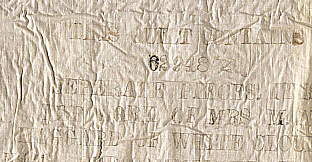
On the reverse it is has a stamped notice:
"This quilt contains 62,948 separate pieces. It is the work of Mrs. Martha A. Haggard of White Cloud, Kansas. She commenced it at 80 years. Completed it in 2 years. It took 36 yards of cloth and 24 spools of thread to make it. In size it is 6 ft. 4 inches by 7 feet."

We don't display it often as it is one heavy textile: Thirty-six yards of fabric---give or take some seam allowances.  I did some math to check Martha's figures and calculated that in the 110 blocks there are actually 79,950 pieces.

Here's a nickel on top of a block.
Right now its a red, white and khaki quilt but
I bet it was once red, white and blue. The picture at the top
of the page shows a little blue remaining.
Those new synthetic dyes in the 1890s were woefully fugitive.

I figured someone like Martha Haggard might have made the newspapers with her textile feats.
And I was right. She might as well have had a press agent. 

Here the local White Cloud Kansas Chief mentions one of her postage stamp quilts with inch-sized pieces in 1879.
"The premium on patch-work quilt at the Fair was awarded to Mrs. Martha Haggard of White Cloud. She is about 70 years of age, and the quilt, composed of many hundred small pieces, none of them containing a square inch, was made entirely by her."
Several years later we find mention of the quilt in the Spencer collection.


"Mrs. M.A. Haggard, of White Cloud, has just completed a patchwork quilt, which contains 70,738 separate pieces of cloth, and in the making she used up twenty-three spools of thread. It took all of her spare time for two years." Kansas City Journal, March 13, 1897
This helps us date the quilt confirming the beginning date of 1895 when she was eighty years old as she said on the label.

In 1898, a year after finishing that quilt, Martha appeared in a short feature that was reprinted in several papers from the Kansas City Journal. 

"Mrs. M. A. Haggard is the name of an industrious old lady who resides in White Cloud....
'When I was 53 years old [about 1868] a neighbor made light of my undertaking a common log cabin quilt, and said I would never live to finish it. This was very amusing to me, so I resolved to keep a list of my unnecessary needle work from that date. Besides my common sewing and housework —and I am a great reader — this is a list of work done by me in the past 30 years.
  • Scrap quilts, pieced, containing from 500 to almost 63,000 separate pieces, 112
  • Quilted quilts. 39
  • Embroidered bed spreads, 10 
  • Embroidered pillow shams, 5 
  • Embroidered head rests, 6
  • Embroidered and tufted sofa cushions, 21; 
  • Embroidered doilies, 7; 
  • Embroidered splashers, 2; etc. etc.' "
One hundred twelve pieced scrap quilts. And where are the rest of them?

Friday, March 11, 2016

A New England Quilt from along the Old Cambridge Pike

From the exhibit 
Behind Closed Doors: Asleep in 
New England at the Concord Museum in 2014

The star at this show in Massachusetts a few years ago was an album quilt in warm browns
and brilliant blues.


Album quilt signed by 96 friends of Rebecca Brooks (1824-1906)

 of Concord, as a gift for her marriage to Joseph Allen Smith
 on March 15, 1849.Collection of the Concord Museum. 

The picture above is from the Quilt Index, documented by the
Massachusetts project.

A link to the museum's excellent catalog page

Several bloggers took photos
and there are details at the museum's website too.


The dedication block in the center

A record of the marriage


90 x 100"
Here's a plan for a similar quilt with 10" finished
blocks. With the cut-out corners you'd need 82 blocks.

It would look awfully good in my Old Cambridge Pike
fabrics. See the free pattern below.

 I drew it in EQ, which is celeberating its 25th birthday this week!
EQ7

Cutting for each 10" finished block.

A -  Cut 4 strips 3-1/2" x 6-1/2". Trim these after piecing.
B - Cut 1 square 7" and cut into 4 triangles with 2 diagonal cuts.
C - Cut 1 square 3-1/2".
But what to call it?

I've always been disappointed in the published names
for this block.

Godey's Lady's Book published it in 1860 but
they didn't give it a name.


I recently found this exchange in the Rural New Yorker magazine in 1879:

In August "Constant Reader" asked editor Faith Ripley:
"Please ask some one to give a design for piecing a remembrance quilt, one that will require only one block of each kind of print, and not so large that where you have but little of some friend's dress you will be obliged to leave it out."


October 4, 1879 
In the Correspondents' Corner:
Dear Miss Ripley:
"I will reply by sending a simple design of a remembrance quilt, which does not require a large amount of material, and is very pretty when made of different kinds of calico; using bleached muslin for the light part.... SBB? Sandy Creek NY
The name Remembrance quilt seem a general category of what we might call album or friendship quilt.

Hearth and Home magazine published the design about 1910 and called it Kentucky Cross-Roads, but it's not really a Kentucky pattern.

 The Ladies Art Company called it Snowflake in
the late 19th century. It's BlockBase  #2880 and 2881---a chubby x and a skinny one.


Farm Journal and Nancy Cabot  called it Old Italian Design or Old Italian Block.

Here's the Nancy Cabot column from the Chicago Tribune in 1936.
"Old Italian Block clearly demonstrates the love of some woman for the
richness of Italian fabrics."

Pshaw----maybe from an Italian mosaic floor.

Tolford Quilt dated 1844-45. Concord, New Hampshire.
Quilt Index.

I was thinking Old New England block might have been a better name.
But after looking at some early date-inscribed examples maybe it should be Old New Jersey Block.

Quilt dated 1844, Hunterdon County, New Jersey
1997-007-0317
from the collection of the International Quilt Study Center and Museum

Quilt dated 1843, Holcombe family, Hunterdon County,
Lambertville Historical Society, New Jersey


Quilt dated 1841, Philadelphia, from the Quilt Index and the New Jersey Quilt Project.

Or Old Central Midlands block,
as the cultural geographers sometimes refer to the places west of New York City.


Do a search for "Italian" as a quilt pattern
in the Quilt Index and you'll find quite a few examples---
none from Kentucky or Italy, however.