QUILTS & FABRIC: PAST & PRESENT


Saturday, December 21, 2013

Christmas Shopping

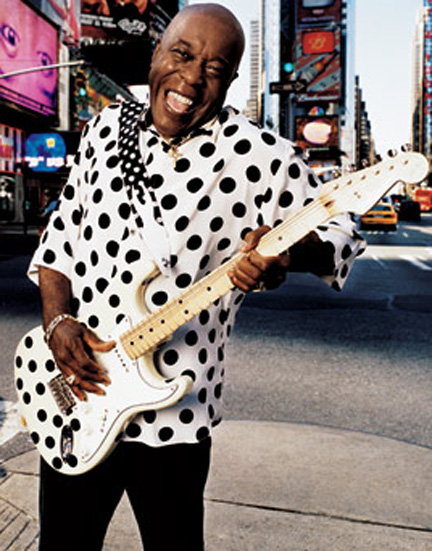
Buddy Guy
The best dressed man in Rock and Roll.

I know what I am getting my sweetheart for Christmas.

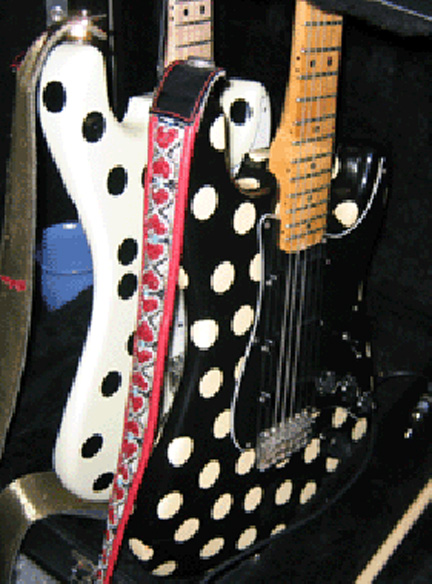
A Buddy Guy Fender Stratocaster in Buddy Guy's signature Polka Dot body.

Buddy has at least two


Well, maybe my sweetheart might not appreciate it. 
I hate to spend that
kind of money just to have to return it. I think I'll
just stick removable office dots on his favorite bass
as a surprise.

Wednesday, December 18, 2013

Factory Cutaways: Shirting Factory Wovens

I've been posting about factory cutaways
and how they determined quilt style.
Here's a string quilt from about 1915 that has the distinctive shapes discarded by clothing factories,
plus a limited range of fabric style.Nearly everything in the quilt is woven pattern or solids...

The kinds of fabrics woven by southern mills from about
1880-1930. (Do note there is one piece
of patchwork cheater cloth in it, the only printed fabric
I noticed.)

Woven plaids and stripes
were often called ginghams at the time.

They were quite popular for clothing about 1900-1920
and the quilts made with them might have been
scraps from the family wardrobe.

Montgomery Wards catalog
Here the stripes are also called chambrays

The woven patterns were inexpensive and durable---
perfect for children's clothing.

Crib Quilt about 1910

Sometimes you see a quilt made of various colorways of one woven pattern or fabric so close in style you
can believe it was purchased by the pound from a mill or a clothing factory.

Tennessee mill, 1910
When Lewis Hines documented the children
working in American cotton mills
about 1910 he captured the plaids and checks
in their wardrobes.


Nine Patch of striped fabrics about 1910


It's hard to imagine the variety in the dresses
of these girls and women about 1910
but there were probably bright plaids and pastels in the mix here.


Bow Tie About 1910

It was easier to get purple wovens
than purple prints at the time.
Mills could dye cotton yarns purple cheaper than
printing a purple figure.


You see the coming 1930s rage for pastels
in the teens with these pale quilts.

Simple pattern in both fabric and patchwork
 
People sometimes use the word homespun for these rather austere stripes, checks and plaids but they were likely to have been factory-made.

Sunday, December 15, 2013

New York Beauty: Evidence of a Pattern Name

Mid 19th-century quilt sold by Bonham's Auctions

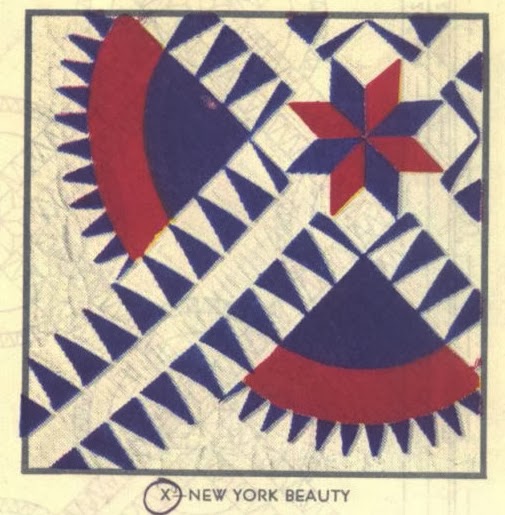
In the last post I wrote about the consensus among quilt pattern historians that the name New York Beauty was a commercial pattern name originating with the Mountain Mist company in the early 1930s, rather than the vernacular name given it by the quilters who actually stitched the design in the 19th century.

And our surprise to hear from Vicki Betts that she'd  found an 1854 reference to New York Beauty in a woman's diary. By putting in she meant she was putting the basted top in the frame.

"Oct. 29  Going to put in my New York beauty tomorrow if nothing happens to hinder
Monday Oct. 30th put in the New York Beauty but only began to quilt"

Apparently we are going to have to rethink our thoughts on the topic.

Quilt from the Bigham family of Tennessee

The new conclusion might be:
New York Beauty was among the vernacular names used for the pattern above in the nineteenth century.

But Merikay warns me to be skeptical. There are still many variables in this equation.

The best evidence that a 19th-century quilt is associated with a name is the name on the quilt.


This sampler quilt dated 1862 with names from the Wortendyke family has one block signed "M.E."
and the words "The Swallow." I would assume that M.E. knew this popular pattern as The Swallow.

That name persisted into the 1930s when the agricultural magazine
The Rural New Yorker used the same name for the same design,
as seen here in BlockBase pattern #3099.

Other excellent evidence is a  pattern name published with a picture in the 19th century. Unfortunately you don't see many patterns with pictures published until the late-1880s, so most earlier names went undocumented.

1889 Sun-Burst Patchwork pattern
from Butterick

Ladies Home Journal 1894

And too many of those commercial patterns are unaccompanied by a 
vernacular name, as in the images above called
"Completed Square"
"A Simple Design"
and
"An Aesthetic Quilt".


Occasionally you come across a pattern name in a diary or letter that has been passed on with the quilt mentioned, a rare occurrence. I found a reference to the name Flowering Almond in an 1860 letter from Elizabeth Nessly Myer. The family had a quilt similar to the applique above.*  In the early 20th century Comfort magazine published a similar pattern as Flowering Almond, a name that persisted into the 1980s when Bets Ramsey and Merikay Waldvogel did the research for The Quilts of Tennessee. 

* Mill Creek Journal, Kay Atwood editor and publisher, Ashland, Oregon, 1987.


But lacking an image linked to the name, we shall have to remain skeptical whether the quilt in the 1854 diary was the pattern we think of as New York Beauty.


I think I will phrase the issue like this from now on:

The pattern has many vernacular names in the South, commonly "Rocky Mountain Road" or "Crown of Thorns". A similar pattern was published and sold by Mountain Mist in 1931 as "New York Beauty", which is today's standard name nationwide. An 1854 diary refers to a "New York Beauty" quilt but whether it is the same design is unknown.



Thursday, December 12, 2013

New York Beauty

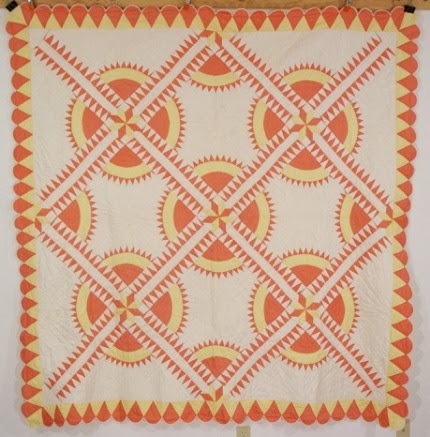
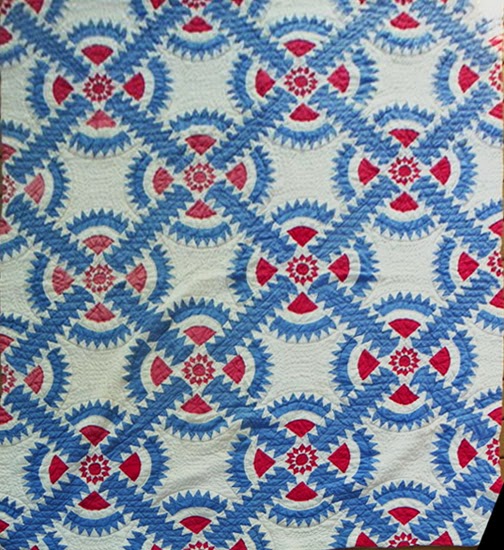
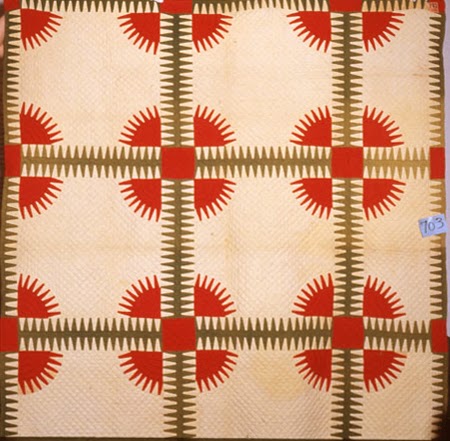
What do you call this design?


Collector Bill Volkening has been specializing in the pattern. 

Volkening's Collection on display

Here's what he says:

"...Most people call them New York Beauties. A recent search of the Quilt Index showed as many as 18 names for the pattern. New York Beauty was, by far, the most popular name. A majority of the pre-1930 quilts that weren’t classified as New York Beauty were called Rocky Mountain Road or a derivative name. Crown of Thorns was the second most popular early name..."


In an essay online at the Quilt Index Leslie Jenison writes about the names:

"The New York Beauty quilt was known by several names in the nineteenth century: "Rocky Mountain Road", "Rocky Mountain", ”Rail Through The Mountains”, "Crown of Thorns", and "The Great Divide". In the 1930s, the “New York Beauty” title was adopted by Stearns and Foster Mountain Mist® company for an old quilt pattern to be published as a new design. It hadn’t been popular in New York in the previous century, but it was in Tennessee."

Jenison shows this quilt discovered in the Kentucky
Quilt Project. The family's name:
President Polk in the White House.
James K. Polk from Tennessee successfully
ran for President in 1844.

See a Polk biography here:
And see the form on the quilt above at the Quilt Index


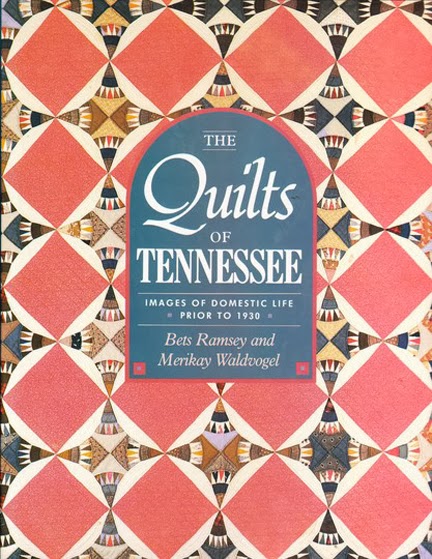
My Tennessee friends Merikay Waldvogel and Bets Ramsey were surprised at the number and variety of quilts in the design they found in their Quilts of Tennessee project in the 1980s. In their 1986 book The Quilts of Tennessee they counted the Log Cabin as the most popular antique quilt they saw, the Nine-Patch second and the Rocky Mountain (or New York Beauty) third.


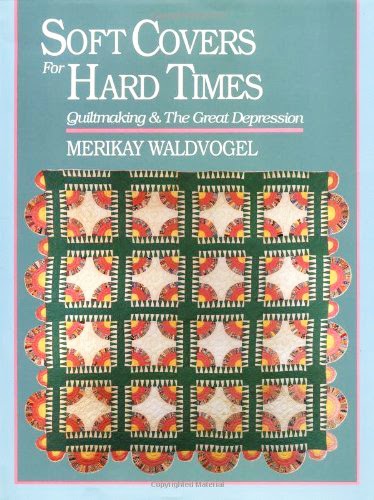
Nineteenth-century names for this pattern became a favorite topic of discussion among pattern historians in the late 20th century. Our conclusion, expressed in Merikay's 1990 book Soft Covers for Hard Times (page 21):

"This pattern [for the cover quilt] was commonly called Rocky Mountain Road or Crown of Thorns in the 1800s in the South. When the pattern was printed commercially in the twentieth century it was renamed New York Beauty."


The Mountain Mist pattern company still 
sells the pattern for New York Beauty

But our conclusion has been called into question by a recent find by 
Vicki Betts of the University of Texas at Tyler Library.
In transcribing a Texas diary from 1854 she found remarkable references to a quilt pattern name:

"Oct. 29  Going to put in my New York beauty tomorrow if nothing happens to hinder

Monday Oct. 30th put in the New York Beauty but only began to quilt"

More in the next post!

Monday, December 9, 2013

Antique Quilt Shows Early 2014


Grab your coats and get ready to travel.
Here's a list of exhibits featuring antique quilts
through Spring, 2014.

GAR Feathered Star, Illinois
This quilt was shown in the Springfield venue last year

Illinois, Lockport
Illinois State Museum Lockport Gallery, Civil War Quilters: Loyal Hearts of Illinois
This show of quilts and other objects from the collection of the ISM, originating in Chicago and in Springfield last year, will open in Lockport May 6, 2014.


The Garden by Josephine Hunter Craig, Emporia, Kansas
Collection of the Kansas State Historical Society
Kansas, Topeka
Kansas Museum of History. Speaking of Quilts: Voices from the Collections and the Community.
Through August 31, 2014
http://www.kshs.org/


From The Pilgrim/Roy Collection

Massachusetts, Boston
Boston Museum of Fine Arts. Quilts and Color: The Pilgrim/Roy Collection.
Through July 27, 2014.
60 quilts chosen for color and graphics by Gerry Roy and the late Paul Pilgrim.
Massachusetts, Lowell
New England Quilt Museum: 
     Roots of Modern Quilting: A Fresh Look at Old Quilts. Through December 28, 2013.
    Charmed: Every Piece Is Different. April 17-July 6, 2014

Whole-cloth quilt pattern
by Linda Baumgarten

Nebraska, Lincoln
International Quilt Study Center and Quilt Museum:
Design Dynamics of Log Cabins, quilts from the Holstein collection.

The Whole Story: Quilting Patterns. Guest Curator: Linda Baumgarten, Curator of Textiles and Costumes at Colonial Williamsburg with Carolyn Ducey. Through June 1, 2014.
 Expanding the Collection: Recent Acquisitions 
http://www.quiltstudy.org/exhibitions/online_exhibitions/tws/tws_intro.html


Made for “AK” in Pennsylvania the textile
illustrates the life of a Zouave soldier. 
Collection of Kelly Kinzle.

New York, Manhattan 
The New-York Historical Society. Homefront & Battlefield: Quilts & Context in the Civil War.
Curated by Madelyn Shaw and Lynn Z. Bassett and organized by the American Textile History Museum, this 2013 show is up through August 24, 2014. Catalog available.


Edward Thorp Gallery “American Quilts and Coverlets from the 19th through Mid 20th Century,”  curated by Laura Fisher through June 7, 2014. 


http://edwardthorpgallery.com/2014-textiles
Ohio, Cincinnati
Heritage Village Museum. Antique Quilt Exhibit, 19 quilts from the collection. 
Through July 27, 2014.

Oregon, Tillamook
Latimer Quilt & Textile Center. Bill Volckening's Collection: Quilts made between 1780 and 1850.
March 3-May 4, 2014.


Virginia, Mt. Crawford
Textiles in 18th & 19th c. Virginia. June 14, 2014.
One-day seminar at Jeffrey S. Evans & Associates Gallery. 9:30 AM to 4:00 PM ET. Speakers: Mary Holton Robare, Kim Ivey, Kathleen Staples, Jeffrey S. Evans.

Virginia, Williamsburg
Colonial Williamsburg. Foster and Muriel McCarl Gallery. Quilts in the Baltimore Manner. 
A dozen quilts 1845 to 1855. Curated by Linda Baumgarten and Kim Ivey.
Through May 11, 2014.
http://www.history.org/history/museums/abby_art_current.cfm 

DeWitt Wallace Decorative Arts Museum. Threads of Feeling: Poignant Stories.
Exhibit from London's Foundling Hospital features scraps of mid-18th century fabrics left as tokens with abandoned babies. Though not a quilt exhibit, the fabrics and the stories are fascinating. Through May 26, 2014.
http://www.colonialwilliamsburg.com/do/art-museums/wallace-museum/threads-of-feeling/ 

Virginia, Winchester
Winchester-Frederick County Historical Society, A Collection of Quilts (from the society's collection.)
Through Oct 31, 2014.
Also June 13-15, 2014, Quaker Quilts - Special 3-Day Exhibit.
 http://www.winchesterhistory.org/society_events.htm