QUILTS & FABRIC: PAST & PRESENT


Monday, March 18, 2013

Oriental Poppy

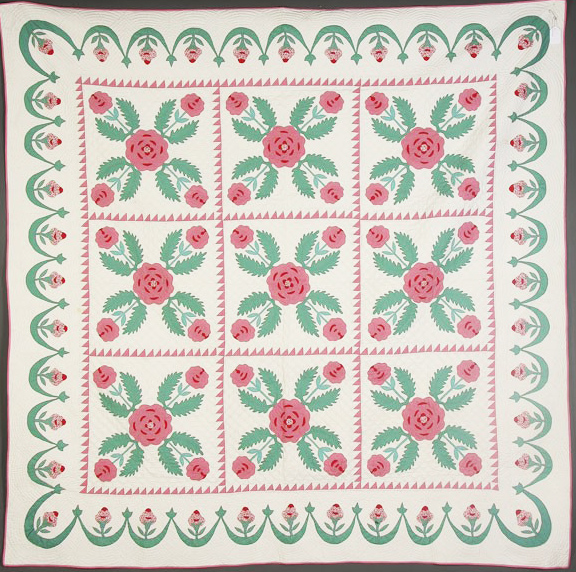
A copy of Rose Kretsinger's
Oriental Poppy Quilt
sold at auction recently.
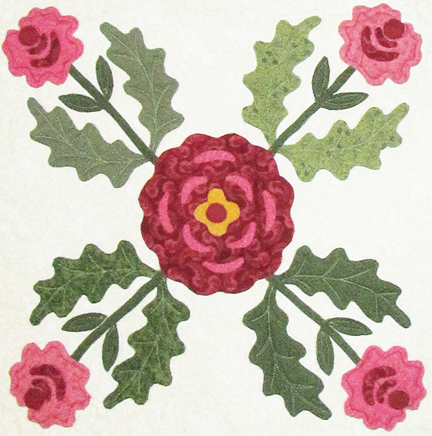
Oriental Poppy by Karla's Mom, Ina Mae Carney

Karla's mom made a version of Rose Kretsinger's Oriental Poppy for a sampler pattern that Karla Menaugh and I did for our Sunflower Pattern Co-operative years ago. 


We are planning to re-do the pattern in book form so I have been doing some more research on the design.
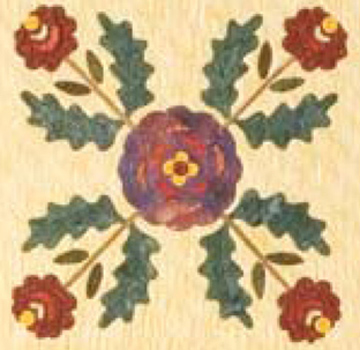
Oriental Poppy
by Cindy Korb

Rose Kretsinger made her version in 1927 in Emporia, Kansas. In April, 1931, the Emporia Gazette  featured a story about the quilt: 

"a copy of an old pattern, which is nameless, but which Mrs. Kretsinger calls the Oriental Poppy because it is composed of poppy-like red flowers and heavy leaves. The pattern for the quilt was provided by a maid in the Kretsinger home, and has a long and romantic history. About 75 years ago a grandmother of the [Kretsinger's hired] girl stored her hope chest in her Chicago home just before her wedding. The home burned in the great Chicago fire, and only fragments of the furnishings remained in the ashes. The hope chest was destroyed, but smoldering pieces of the folded quilts it contained were preserved. The girl inherited these tattered pieces as souvenirs, and Mrs. Kretsinger was able to sketch two patterns from them." 

I've always found the Chicago Fire story a bit hard to believe, but Rose did copy patterns from old quilts, so I thought I would see if I could find any antiques with this pattern.
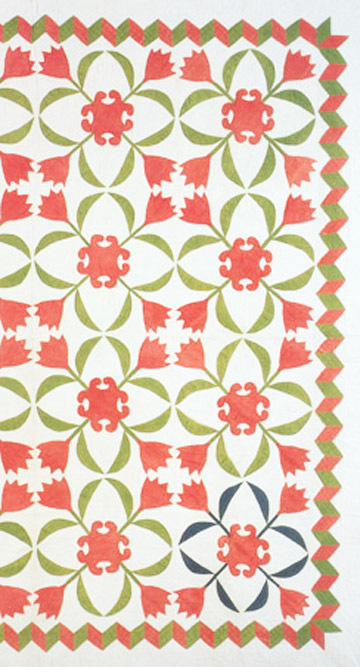
Mid-19th-century quilt
 from the Shelburne Museum

The basic structure is a central shape out of which grow four plants, each with a flower on a stem and a pair of leaves. There are lots of similar designs with that basic layout, several of them listed in my Encyclopedia of Applique, numbered 8.49 to 8.58 with names like Tennessee Tulip from Ruby McKim's "Patchwork Parade of States" in the early 1930s and Summer Tulips from the Nancy Cabot column in the Chicago Tribune in 1937.

Many of these tulips or other flower grow out of this fleur-d'lis-like scalloped center. Below are several blocks with the same geometry that I found in mid-19th-century samplers.
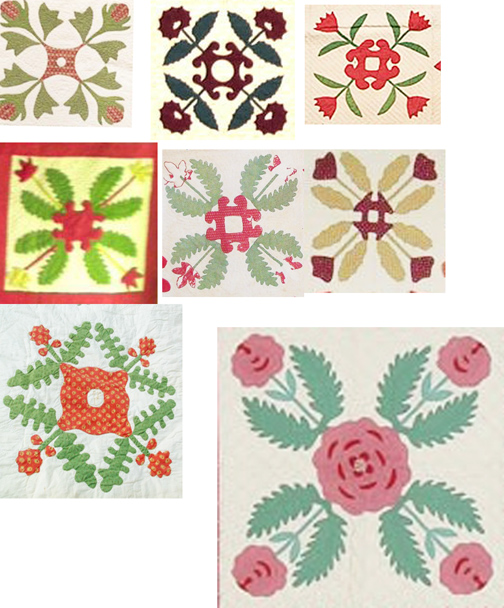
You can see that Rose's Oriental Poppy (bottom right)
 has quite a different center.
It's a floral and not a scallop shape.

Most of the blocks above are from Maryland quilts. Mary Manakee's version is top center.  I love the completely wacky leaves on the block at bottom left.

The blocks differ in the leaves as well as the flowers, but many have serrated leaves. Florence Peto showed similar leaves in one of her quilt books and called it a Thistle. The "heavy leaves" would make you think of a cactus, a thistle or an oriental poppy.  
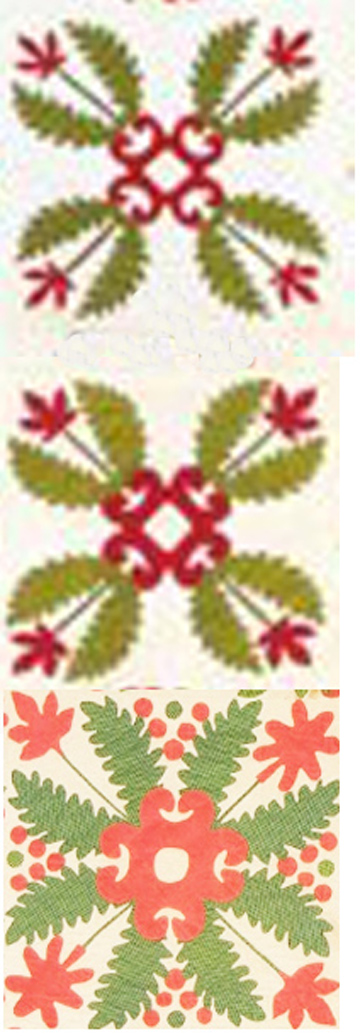

There were so many Maryland quilts I started thinking "Baltimore Album" and I did find several versions in those classic samplers above. You can see how Rose might have interpreted the center as a flower rather than a scrolly shape.

So now I am wondering if the hired girl's burnt-up quilt might have been an applique sampler, whether from Baltimore or elsewhere. The newspaper said, "Mrs. Kretsinger was able to sketch two patterns" from the quilt. I wonder what the other one was. All this speculation probably won't wind up in the re-issued pattern book---no room---and no evidence.

You see the pattern in  places besides Baltimore. Click here to see a Preble County, Ohio sampler in the collection of the International Quilt Study Center and Museum with the block in question:
http://cdn.firespring.com/images/6dd81bfe-4cf6-4c44-8b9d-0f0707af16db.jpg


Above is a version of our Emporia Rose Sampler that Cindy Korb did from the first pattern. If you made one we'd love to see a snapshot. We are looking for examples for the book.

Drop me a note in the comments and I will get back to you.

See more about the Oriental Poppy
http://barbarabrackman.blogspot.com/2010/03/more-inspiration-from-rose-kretsinger.html
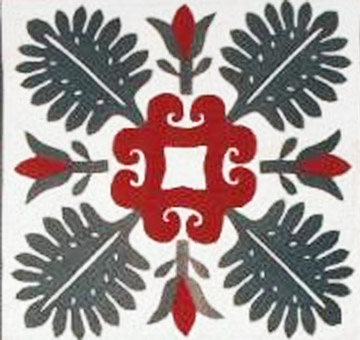


And check out WillyWonky's blog post here for his discovery of a pair of North Carolina quilts in the pattern above:
http://willywonkyquilts.blogspot.com/2011/02/missing-links-to-mystery-pattern.html
All the parts are there, just in different places.

Thursday, March 14, 2013

3.14 is Pi Day


Mathematicians interested in making math fun
have made this National Pi Day.
It's a math joke.

Pi is a mathematical constant, the ratio of a circle's circumference to its diameter, a number that is approximately 3.14. Which is today's date.
I would suggest you do a web search for the words pi day to get ideas on how to celebrate. 


Me--- I will probably make a pie (or thaw a pie, whatever.)

And I'll give some thought to the circle, it's circumference and diameter. And be glad I rarely get out my compass anymore.

I will be grateful that somebody else somewhere drafted these circular pieced designs.


If I ever got the urge to piece something like this I'd go to the EQ7 program libraries and click on files like Wheels, Dresdens, and Compasses.


I'd make paper templates out of freezer paper (no seam allowance) so the arcs, radii and circumferiii would all be perfect. See Elsie Campbell's post on using freezer paper for intricate piecing here:


Dad's Plaids by Elsie Campbell

But I think I'll just sit down with a piece of pie until the urge goes away.


Tuesday, March 12, 2013

Dixie Diary Blocks: Free BOM Pattern

#2 February
Checkered Allegiances
Star2Tia

Over at my Civil War Quilts blog we are doing a block of the month this year called Dixie Diary.
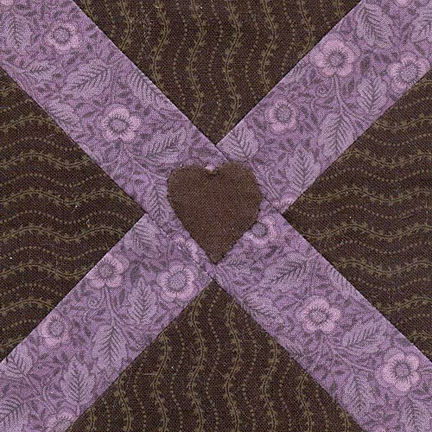
The blocks are simple and there's an optional applique star or heart for each one.

#2 February
Checkered Allegiances
RCCheryl

This is the second block I called Checkered Allegiances.
The blocks are either basic traditional blocks or basic piecework that I made up---and wondered why nobody ever thought of it before, like the block above. It's simple but quite effective.


The monthly story is based on a diary published by Sarah Morgan who lived in Confederate Louisiana.

#2 February
Checkered Allegiances
AEAQuilts

When the Civil War began Sarah was 19, spoiled and self-absorbed. The great thing about the diary is you watch her mature as the war drags on. She grows up under extremely trying circumstances. We are only to Block 3 so we have yet to see any change, but she is funny and so sincere in her self-absorption at the beginning---sort of Scarlet O'Hara-esque.

#3 March
Shouting Yankee Doodle
 Morgan Girl
I've found a few of the blocks that followers are making on our Flickr page to show you. I've squared up a few and brightened them in Photoshop so they look as great in the photos as they do in real life. 
See our Flickr group here:

#2 February
Checkered Allegiances
Honas52
 Honas52 is using the blue and buff color scheme that was so popular for cotton prints between 1840 and 1865.

#3 March
Shouting Yankee Doodle
Honas52

#3 March
Shouting Yankee Doodle
Calico Quilter

#2 February
Checkered Allegiances
Lynn Hyman
 I'm using pink and brown in my examples and stitchers are using lots of great pinks.


#2 February
Checkered Allegiances
KKline
 KKline has appliqued a detail of a Union print featuring hands.

#1 January
Her Flag Flying
American Homestead

#1 January
Her Flag Flying
ColvinKiwi
 The applique is optional---and some people are planning to add it at the end. But the blocks look terrific without it.

#1 January
Her Flag Flying
  Star2Tia
I figured this would be a good beginner series. Star2Tia and I are using prints from my Metropolitan Fair reproduction collection.


#1 January
Her Flag Flying
Lynn Hyman

#2 February
Checkered Allegiances

Thalia T is doing a "gothy" miniature----
a very interesting color choice.

#1 January
Her Flag Flying
Thalia T 

And very authentic---purple calicoes were often worn as "half-mourning" something all too common during the Civil War.

Thanks to all the block-stitchers who have posted their efforts.

See the Civil War Quilts blog here:
http://civilwarquilts.blogspot.com/


I'm posting a free pattern for a block on the first Saturday of every month during 2013. If you want to find the patterns already up there scroll down in the left hand column for the box that says "Search This Blog". Type in dixie and hit search over there and the results will appear at the TOP of the page that comes up. It's kind of counter-intuitive to scroll up for the search results but that's where you will find them. Click on the highlighted post and it will appear in a new window.


Many blogs have this Search blog feature which helps you navigate to what you are looking for.

Saturday, March 9, 2013

Spacer Borders


Many of us would describe this Irish Chain quilt as well proportioned. Viewed as a piece of art on the wall, the double border and the bright-colored binding frame the inner composition nicely. The quilt is probably from about 1880 to 1910 or 1920.

Similar aesthetic

For both these quilts I am guessing origins in a German Sectarian Community, possibly Pennsylvania, but perhaps Ohio, due to several design characteristics noted by quilt scholar Ricky Clark in a chapter in the book Quilts in Community: Ohio's Traditions. A vivid palette, multiple borders and contrasting binding were favored by women of German ancestry and Anabaptist Protestant faith, women described as German Sectarians. The best-known among these conservative Protestant communities are the Amish and Mennonites.

Amish quilt from the early 20th century.
Women in Amish communities in places like Iowa and Kansas
also used this aesthetic.

Once late-20th-century quilters began seeing these classic Amish and Mennonite quilts in print and in museums we began to think of their double borders as a design necessity.

Amish quilt date-inscribed 1928

Mennonite quilt

Today we tend to call the inner border a spacer border, especially if it is narrower than the outer border. It's a fairly recent term. I found that Marsha McCloskey advised using "a spacer strip...a plain inner border" in her 1984 book Projects for Blocks and Borders, indicating that the term came into use in the mid-1980s.

She was probably talking about using a plain border to separate two pieced borders, so a spacer strip could be any width of plain border as in her wide white border here.

Amish Quilt
Today we think of a spacer as creating a color space too.


The German Sectarians weren't the only quilters in the past to use double borders. This Drunkard's Path (notice it is two alternate blocks) was probably not made by a woman from a German Brethren group.
Other women liked pink and other women used a double border.

Or a triple border.


And that inner framing border wasn't invented in 1880.
The quilts above and below may be from 1840-1890.


It may be that we see more of these multiple strip borders after 1870 when the sewing machine made long seams more practical.


Whether your machine was treadle or electric powered.


 That Germanic aesthetic of the 1880-1930 era works so well.
It's one more thing that makes these quilts so collectible.


Here we have a double inner border with contrasting binding.
Four frames around the baskets.

Six frames!


And then there is the pieced inner border.


You can see why the spacer border is so popular today.
The proportions seem just right.