QUILTS & FABRIC: PAST & PRESENT


Wednesday, August 15, 2012

Looking for the Garden Quilt: The Original

My start on the Garden quilt. We were going to have two of these quilts for the book The Garden Quilt: Interpeting a Masterpiece. I didn't get too much further than this. I'll show more pictures another day. I AM going to finish it. I don't have the affection for making grapes that some people do.


The original Garden quilt was pictured in Ruth Finley's 1929 book and it inspired many quilters to draft the pattern and applique their own versions.
From the Garden quilt file:
Snapshots of two mid-20th-century versions of the Garden.
On the left Pine Eisfeller's, 
the right unknown maker from Shelly Zegart's collection.
See a better photo of Pine's here:


The "exquisite quilt" in the black and white photo above was, according to Finley, made by Arsinoe Kelsey Bowen, a minister's wife in Cortland, New York, who finished it in 1857 after years of work and "millions of tedious stitches." Mrs. Edward Irish, who loaned the quilt for photography, recalled her Great-Aunt as an artist who also worked on paper, crafted hair jewelry and did "all the various kinds of fancy work in vogue at the time."

We had no luck in a search for Arsinoe or her original quilt despite reading Finley's papers, contacting the New York quilt project and looking at years of photos of antique quilts for sale. We did genealogical work on any Bowens or Irishes in the two towns of Cortland, New York (upstate and down). Our project languished until the internet age. 

At last I've found the quilter if not the quilt. A web search for the unusual name Arsinoe Kelsey Bowen leads to a New York minister's wife.  

Arsinoe was a royal name in Egypt.

Arsinoe Kelsey was born in December, 1812, in Smyrna, New York, in the far western part of the state between Lake Erie and Pennsylvania. 


In 1838 she married Henry Bowen who eventually became minister at the Baptist Church in Skaneateles, a town in the Finger Lakes region. [There is another New Yorker---Henry C. Bowen, a famous for getting tangled up with minister Henry Ward Beecher, but this is not the same man.)

This may have been Henry Bowen's last church,
still standing in Skaneateles.

We find no records of children. Indeed the only other fact available now is that the couple died within forty-eight hours of each other in 1868 in Skaneateles. She died on November 12th at 45; he on the 14th at 59.  This caused a problem with Henry's will which left property to his wife, who had predeceased him---so there is a court record of a contest.

Since writing the book on the Garden quilt I've found a little more about Arsinoe's homes. Here's a record of Baptist ministers from 1852 suggesting that Henry Bowen did live in Cortlandville. The history of Cortland Village (Cortlandville) mentions he was minister at the Baptist Church there from 1851 to 1861.
 Skaneateles by Fanny A. Coney (1814–1838)
from the collection of the American Folk Art Museum.
See the whole painting here:

Arsinoe and Henry each had many siblings with many children who might have married a man named Irish. We can just hope The Garden still holds the admiration of today's owner and that someday the "exquisite quilt" that has inspired so many copies will surface again.

Josephine Craig's version of the Garden
in the collection of the Kansas Museum of History.
Read more here:

  The Rochester Museum and Science Center
 has one by Verna M. Sutherland and her mother
Bertha Garrett, 1948.
See it here:
See a page of Kelseys from Smyrna New York here

Sunday, August 12, 2012

Metropolitan Fair Reproduction Greens

There's a certain green that fans of old quilts recognize---a yellow green that is quite distinctive.
In the antique quilts it's really a rather accidental color---the result of greens dyed blue and yellow fading towards the yellow over the years.

The fabrics start out a more mid-green


But washing fades away the blues pushing the greens more and more yellow-green.
Lime green, we call it today.
My mother called it chartreuse.

Mid-19th century crib quilt


In my new Civil War reproduction fabric collection
 Metropolitan Fair we echo the yellow greens.
You couldn't call them lime green---more a tasteful olive.


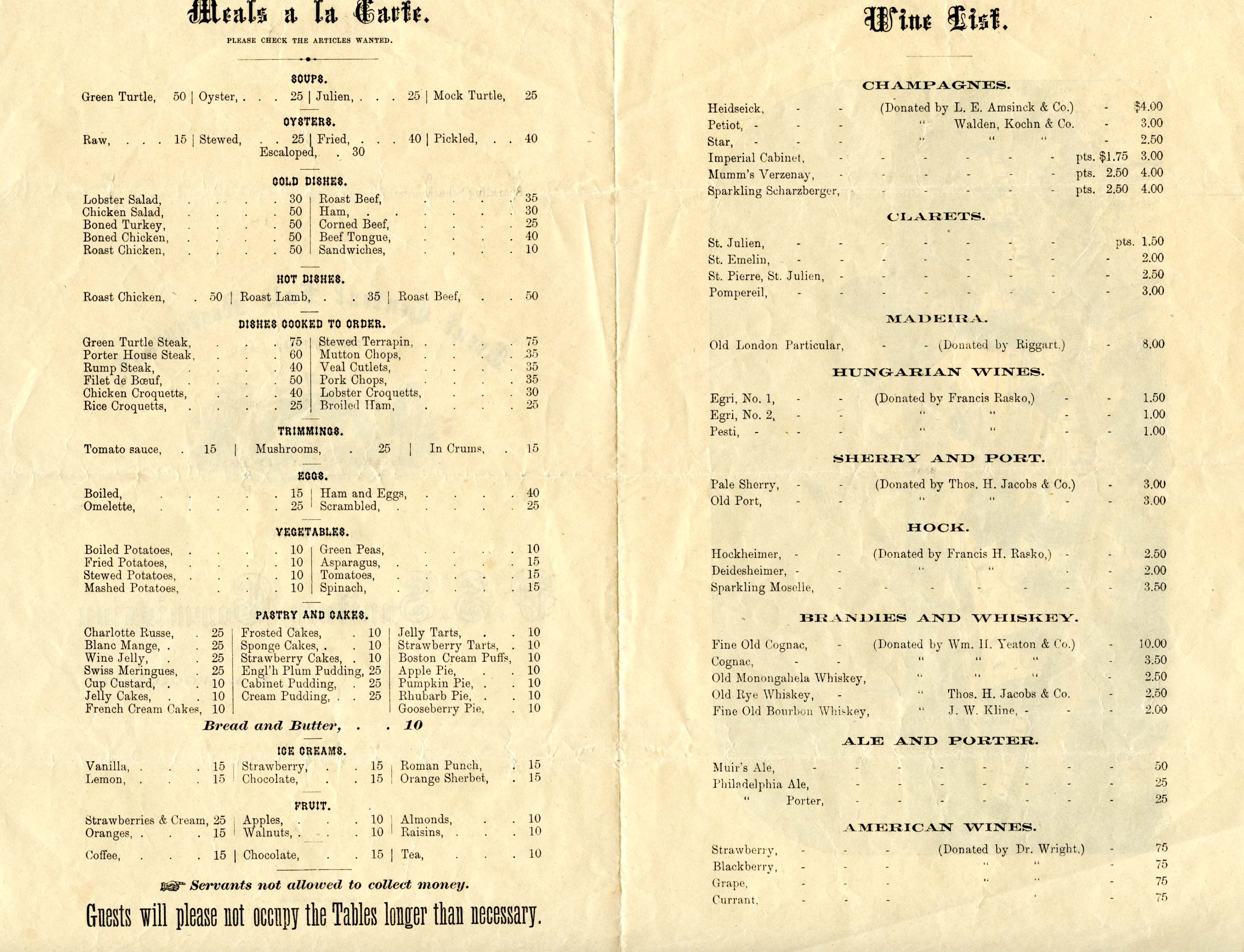
I called this color Celery Salad as all the color names in this repro collection come from the menu at the fundraising fairs during the Civil War.

Someone chopped a lot of celery for that event

The Metropolitan Fair in Manhattan was the largest fundraising fair of the Civil War, benefitting the Sanitary Commission, which maintained Union soldier's hospitals. There were many other Sanitary Fairs in cities throughout the North.


Winterthur Museum has a menu from an 1864 fair.


Fairs were a traditional, acceptable way for women to raise money.

Above is a picture of the New England Kitchen at the Brooklyn Fair in 1864.
Women dressed in old fashioned costumes and cooked over an open hearth in one of the most popular features at a number of Fairs. The dining rooms were also good fundraisers.

See the menu from the Winterthur Collection here:
http://museumblog.winterthur.org/files/2012/05/Photo-3-Great-Central-Fair-Rest-menu-1864.jpg

And read a lot more about the greens in 19th-century quilts here
http://barbarabrackman.blogspot.com/2011/07/green-calicoes-antique-prints.html
http://barbarabrackman.blogspot.com/2010/01/poison-green.html
http://barbarabrackman.blogspot.com/2011/07/green-calico-reproductions.html
http://barbarabrackman.blogspot.com/2010/10/faded-greens.html


We used a lot of the greens in the Metropolitan Fair Project.
Read more here:

Thursday, August 9, 2012

Show Off Piecing: Borders


Compared to Rose Trees seen in the last post on Show Off Piecing this pieced love apple is postively do-able.

The fruit is pieced; it looks like the stem and leaves are appliqued.
From the way the green is fading to brown I'd guess 1880-1910.

Here's another example---rounder. It's probably a little earlier, the quilting is closer, the green color is less fugitive and it has a border.

Is the border pieced too?
Pieced borders are the ultimate show-off piecing.

Dealer Laura Fisher sent a photo of a pieced rose from Tennessee with a swag border that also looks to be pieced. Notice that shape in the corners.

The dots are appliqued atop the swags pieced into the background. This mid-19th-century example is quilted with stuffed work (trapunto), another indication of a Tennessee quilt. Tennessee quilters did a LOT of stuffed work.

Here's a possible pieced border  from the Quilts of Tennessee files on the Quilt Index. Couldn't find a picture of the whole thing but here's the link:


And a similar quilt I saw about ten years ago in an antique shop.
The swags and even that loop in the corner were pieced into the background. Talk about a Show Off.

There's a tiny embroidery stitch of thread, once green that's faded to white, linking the bud here to the swags in the corners.

Most swags are appliqued like the one above. Sometimes these triple swags are pieced together and then appliqued down.
But that's not really showing off. To be a real show off you have to piece the whole border into the background.


I'd like to see this online auction quilt closer. Those are the type of buds that could be pieced in.
I can't even imagine the kind of pattern that was passed around hand to hand in the 1850s.

Another online auction photo. Those looped corners on a Whig Rose---the border may be all pieced. One clue---it doesn't sit flat.


 I'm not going to try it. So much can go wrong.

Monday, August 6, 2012

Small Things


Pineapple by Pam Mayfield
2012
Pam made this little quilt from some of last year's Civil War reproduction collection
1862: Battle Hymn.
She added a gray stripe for background. This is a little quilt, just 24" square.

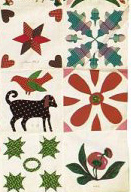
And Debbie St.Germain used the same line for the borders for this little piece. She distressed the background to show off the paisley quilting. See her pattern for this dog here:


Debbie's inspiration was this sampler/album quilt from New York. See more about the dogs here:


Debbie's a fan of pictorial applique. Pam noticed they think alike---even though they've never met. A gray stripe IS the perfect background.

Friday, August 3, 2012

Design a Block of the Month in BlockBase

My pattern software program BlockBase is back in print. It's a digital version of my old Encyclopedia of Pieced Quilt Patterns, which was a print version of a big box of index cards I kept in the 1970s and '80s.
Here's one of four drawers full of index cards.

Over 4,000 cards, each with a pattern sketch,
a name and the source.


Click on the box over in the left hand column to order BlockBase from Electric Quilt. They will pay the shipping right now.

The computer program includes over 4,300 patterns, all from published sources from 1836 to 1970. I use BlockBase in many ways but lately I have been doing a lot of block samplers with a theme. Last year I did a Block of the Week as a blog "Civil War Quilts." The theme was Civil War history and I tied a first-person account of the War's first year to a traditional block from BlockBase.
See it here: http://civilwarquilts.blogspot.com/


BlockBase has a Wildcard Search button which brings up any pattern name with a particular word. For the Civil War theme I typed in words like Union and North and South.

I used several of these patterns with Union in the name for the Civil War blog.
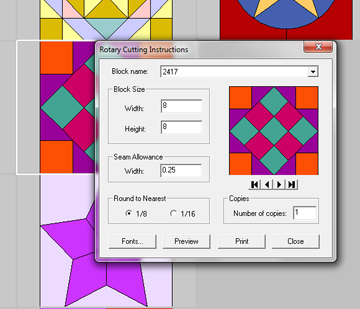
Once I found a block I liked I clicked on it and printed out a pattern.

This pattern was given the name Union Square in the Nancy Cabot column in the Chicago Tribune in the 1930s. I printed out the rotary cutting instructions for an 8" finished block and then put them on the blog post.
Here's the post:

Beginning September 1st I am going to do another Block of the Week. This year's theme is the Fight for Women's Rights so Wildcard words included choice, dream or girl.

I tried the word Grandmother and came up with 43 patterns with that word in the name. I selected Grandmother's Choice as the name for the blog and the logo.


Click here to see the blog---first block up on September 1st.
http://grandmotherschoice.blogspot.com/

I hesitate to tell you how easy this is in BlockBase because then you don't need a pattern designer. Anybody can work out their own theme quilts. Computers will put me out of work.

You might want to do the block of the month for your guild or your shop. Choose your state name. If it's California you have 19 blocks with that word in the name.


California---then there's Sacramento, Shasta, ocean, etc.

Any topic---how about birds
Here are a few of those with the word Bird in the name---and then you could search for geese, goose, sparrow and hen.

Here's a hint. I save those searches with the PrintScreen or screen capture key on my computer.  On my PC I hold down the Shift and the Ctrl buttons and then the PrtScrn key. I've made a copy of the entire screen. I save the screen image and copy it into an empty file. I use Photoshop but you can drop it into a new image in any picture program or a blank page in word.  I crop out what I don't need, give it a label and save it in my idea file.


Louise Townsend made the cover quilt from
blocks on the theme of "fairs"

Years ago I wrote articles for Quilters Newsletter on thematic designs like quilts for a wedding or for summer.  I'd have to spend a good deal of time reading through the paper alphabetic index in the back of my Encyclopedia of Pieced Quilt Patterns. Now I find twenty blocks in a few seconds---one reason I do a Block of the Week rather than a Block of the Month. Too many ideas to edit it down to twelve.