QUILTS & FABRIC: PAST & PRESENT


Monday, December 12, 2011

Free Patterns From Moda

Evening Mist by Sentimental Studios

Do you ever go to the free pattern page at Moda?
http://www.unitednotions.com/un_main.nsf/fp_quilting

You should bookmark the page and come back because we are always addding patterns.


Blush by Basic Gray

Here is how you find it:
Go to Moda's home page: http://www.unitednotions.com/un_main.nsf/main?openpage
You don't have to log in or register.

30s Playtime by Chloe's Closet
I'm picking out the more traditional ideas here but there's a lot of variety.

At the top menu line it says Fun Stuff. Click on it.
Among the menu items it says
Free Patterns---it's yellow here

Click on it

Click on Quilting Patterns and you will find many free patchwork patterns. It will say:

Simply click on an image below for more information about the pattern.

Click on the quilt and the picture appears at the top of the page. Click on this button near the large picture.

A PDF will open up in a separate window with all the information you need. Save the PDF to a folder you create labeled Free Moda Patterns.


Dominique II
You can follow many other trails here and wind up with lots of ideas.


Like the Verna Bag from Kate Spain. It's under Sewing Patterns.

Park Avenue from Three Sisters

Pashimina by Sentimental Studios

Friday, December 9, 2011

Morris & Company Anemone

"Anemone" is the largest print in my new Morris & Company collection.

It comes in six colorways in this line.


It represents a new direction for the firm of Morris & Company as designer John Henry Dearle took over the artistic management in the late 1890s. The Arts & Crafts aesthetic developed by William Morris had evolved into Art Nouveau with sinuous lines, stylized florals and a flatter look. 

Dearle was born in 1860, the year before William Morris designed his first textile. As the younger generation, he adapted the end-of-the-century style to Morris design. This particular print was drawn for wall paper and seems to be the perfect wall-covering for the Edwardian home.

It makes a great fabric too.

I notice that I have put a date of 1876 on the selvage edge of this print.
It can't be! Dearle was 16 and Art Nouveau was still in the future in 1876.
I can't actually find a specific date for this design in my notes but I am thinking I meant 1896, the year Dearle took over as Director of the firm.

So let's say late 1890s.

Take a marker and change that 7 in the selvage to a 9 when you get your fabric.


It makes a great border as in this project from Moda


And this one from Planted Seed.
See these designs in the PDF you can download at Moda
http://www.unitednotions.com/fcc_morris_and_company.pdf  

5 Yards in a Stickley Morris chair

Tuesday, December 6, 2011

Dutch Quilts

Reproduction quilt by Petra Prins
 from an antique quilt found in
An Noonan's A History of Dutch Quilts.

Somehow Americans have lost most memories of our Dutch heritage. Nineteenth-century writers focused on England when they wrote about the sources for American culture from holidays and foodways to needlework and quilts. It's time to explore the Dutch history of quilts and Petra Prins has a new book to guide us.

Treasures from Holland  has patterns for a dozen reproduction quilts based on Dutch antiques..


The publisher is the French QuiltMania and the instructions are in Dutch, French and English.

See more Quiltmania books here.


The cover quilt by Petra

She owns a quilt shop in Amsterdam called Den Haan & Wagenmakers, which sells wonderful reproduction fabrics.
http://denhaanenwagenmakers.blogspot.com/ 

Petra recently showed her quilts at an exhibition in Alsace. I found a post with pictures here at Journey of a Quilt Lover's blog:
 I first read about her quilts on Moda's Cutting Table blog. http://modafabrics.blogspot.com/2011/09/wonderful.html 
Petra's source for inspiration is An Moonen's book fromVan Gruting, Westervoort 2010.
Which is also in English as A History of Dutch Quilts

An's book is harder to find in the U.S. You might have to go to Amsterdam.
See a gallery of antique Dutch quilts at An's site
http://www.antiquetextile.info/dutchquilts.htm 


And if you think the Dutch influence on American culture is minor consider this man Sinter Klaas.
Happy St. Nicholas Day to everyone.

Saturday, December 3, 2011

Tree of Life Reproduction

Tree of Life
By Roseanne Smith

Roseanne Smith has been working on her appliqued center in the tree-of-life design for a new medallion. She's using my Lately Arrived From London reproductions from Moda. Here's how she did this. It's cut-out chintz or Broderie Perse.

I exaggerated the contrast here so you could see that she has appliqued the Seaflower print to a very similar plain-colored background.


The reverse
But she did not cut out every flower and leaf in the traditional fashion. You can see on the back here that she appliqued a large chunk of chintz to the plain colored background. She's cut out the backing so she doesn't have to applique through so many layers.


She cut a shape out of the plum-colored Seaflower print...

My mock-up gives you a rough idea.

...And appliqued that to the background. Then she added other flowers and leaves for more complicated foliage, making the tree more detailed. She added the traditional hillock (a range of small hills).


Brilliant I say!


Roseanne found a very close solid color on the shelf at her quilt shop. One source for solids is Moda's Basic line of Bella Solids
Click here to see the selection:


They are all numbered 9900. Shades 9900.18 or 9900.45 (over on the left on the color card here) look like they are close in color. Ask your shop owner if she has this color card any time you are looking for a match.

For more on Broderie Perse see December's War of 1812 posts, where it will be the featured technique for the month.

Sunday, November 27, 2011

Morris & Company Brother Rabbit

Brother Rabbit from my Moda collection
Morris & Company

"Brother Rabbit" was designed by William Morris in 1882. It's a monochrome print, quite small in scale (especially for a Morris print) but also finely detailed. This is one Morris pattern that was actually designed to be a cotton print.

Here's a magnified shot so you can see the detail although it's fuzzier in the photo than it is in the fabric.
Like many of Morris's designs, it's based on his observations in his garden. Birds and  rabbits hide in the vegetation.

For Morris & Company we colored it five ways. It reads as a neutral and will provide some light contrast to the darker, larger-scale prints.

Like many of Morris's designs the inspiration is the intricacy of medieval tapestry.


Rabbits are often seen hiding in the garden as in this detail from one of the Unicorn tapestries.


Br'er Rabbit from Joel Chandler Harris's Uncle Remus stories

There are references to this print as "Br'er Rabbit" and the idea that William Morris was inspired by the Uncle Remus stories in American folklore, yet a talking rabbit seems the antithesis of what he was trying to do with his emphasis on European medieval design.

So I am sticking with the name Brother Rabbit, it's patent registration name in 1882. I think it reflects the same kind of empathy for the garden's residents that inspired the "Strawberry Thief."


Plant enough in the garden so the birds and animals can share.

Friday, November 25, 2011

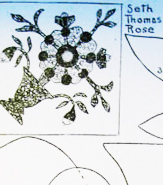
Seth Thomas Rose Quilt in Oregon


I was looking at WillyWonky's blog the other day and came across this picture---which immediately caught my eye as I myself had  just blogged about the pattern. The quilt is in a show in Salem, Oregon.
See my post here:
http://barbarabrackman.blogspot.com/2011/10/northern-lilysouthern-rose-block-8.html

The Oregon quilt is very close to the newspaper pattern published by Ruby McKim in 1929, showing a quilt made in the 1860s by Araminta Daniel Kreeger (1830-1875) who lived near Independence, Missouri in the middle of the 19th century.


The major difference is in the lower florals coming out of the vase.

The Oregon quilt is attributed to Adeline Brown Crawford (1821-1879) who traveled in one of the earliest Oregon-bound parties in 1842. She was one of six daughters of Gabriel and Elizabeth Robinson Brown, described in this post by Jim Tompkins: 

"Five of them of marriageable age when [they left] Arkansas. Known as the “Belles of Oregon” not for their beauty, but for their availability, three of them were the first emigrants to marry in Oregon (Adeline age 23, Polly age 16, and Cynthia age 14, each married men who were in the same emigration party as the Browns). They were said to be fair haired if not endowed with titian tresses. Is it any wonder that they were passionately courted, in an almost Eveless Eden."

Adeline may have brought the quilt with her from Arkansas but the style indicates it was probably made after 1842 and thus is an Oregon quilt. So it's unlikely to be the actual quilt that inspired Ruby McKim's "Seth Thomas Rose" in Independence, Missouri.  However, interesting details emerge in Adeline's story. The Brown family joined that 1842 overland party near Independence in Jackson County, where 13-year-old Araminta Daniel Kreeger lived. 

Adeline's quilt does cast doubt upon Ruby McKim's story that Araminta drew her pattern from a picture on a Seth Thomas clock. Could it be that she and Adeline Brown Crawford shared a pattern for a quilt with circles edging a central flower? Or is this pattern more common than I thought.

My version of the Seth Thomas Rose sewn by Susan Stiff

Treasures from the Trunk: Quilts and Their Makers After the Oregon Trail Journey, curated by Mary Bywater Cross is up until December 24, 2011 at the Wilamette Heritage Center in Salem, Oregon.


An important Oregon quilt on exhibit there is Elizabeth Ann Clark Kelly's ribbon quilt made from souvenir ribbons gathered at reunions of the pioneers who traveled to Oregon on the overland trails. It's on loan from the American Folk Art Museum.

See the WillyWonky blog post here with more pictures of the show:

http://archiver.rootsweb.ancestry.com/th/read/OREGON-TRAIL/2000-08/0967214820
Adeline met her husband Medorem Crawford on that 1842 trip. Read his journal of the trip here at Google Books:
And Jim Tomkins' web page here:
http://www.oregonpioneers.com/MotivationQuotes.htm

Sunday, November 20, 2011

Morris & Company Fabric is IN

The newest collection of William Morris reproduction prints from Moda is in a few shops already.
Click here on Moda's home page and see this lovely introduction slide.

This line uses shades echoing the natural dyes that were so important to William Morris's vision.

Blues from indigo


Burnt oranges from madder


And we also have some updated color schemes,
gray green with gray, shades of taupe for today's taste.


And a true black


Some shops already have the yardage.
Berrima Patchwork was the first to blog about it.

Click here to see the whole range at Moda:
Morris and Company

And click here to get the free project designed by Susan Stiff, a period fan block in an arts and crafts frame. http://www.unitednotions.com/fp_morris-and-company.pdf