QUILTS & FABRIC: PAST & PRESENT


Showing posts with label Wilene Smith. Show all posts

Monday, November 22, 2010

Double Wedding Rings


My Double Wedding Ring
by Keiko Goke

Judging by the blog postings, this wedding ring quilt by a Japanese artist was quite a hit at Quilt Market and Quilt Festival earlier this month. The color and the scale grabbed you as you walked by and the detail kept you there. 

It's always fun to look at an old pattern in a new way.

How old is the Double Wedding Ring pattern?

Here's the earliest date-inscribed wedding ring I've been able to find.
1932

We're all used to seeing the typical 1930-1960 examples, usually small scraps of prints contrasted with plain white background and four-patches of solid colors.


And sometimes with plain pastels in the background.

Quilt historians agree the design developed in the 1920s,
a variation on an older design with spiky pieces in the arcs,
something we call pickle dish today.

Tied wedding ring, fabrics look to be 1900-1925

But could the Wedding Ring be older than the 1920s?
There is a small subcategory of Wedding Rings made up in the fashionable colors of the 1900-1925 era---indigoes, cadet blues, turkey reds, shirtings and double pinks.

Alice sent in a photo of these blocks she found in an online auction.
How old?
The fabrics look 1900-1925.

Quilt historians also agree that the earliest published pattern yet found for the design is October 20, 1928 in Capper's Weekly.

Capper's Weekly sketch for the pattern, 1928, from Quilt History Tidbits

This quilt looks like it was made from the Capper's Weekly pattern.
Or was the Capper's pattern drawn from a quilt like this? 
Note the alternating darks and lights in the arcs. The background, now tan, was probably bright red at one time.


Another example with the high contrast stripes in the arcs.
I bet the background here was once red too.


My guess is that the pattern designers picked up on a pattern that was being passed around hand-to-hand, a design that might go back to the teens or the 1900-1910 decade.
At the end of the 1920s quilts underwent a design change and so did the Wedding Rings.
The high contrast striped arc lost importance.

From Deb Rowden's collection
Prints very much in the 1900-1920 styles but the arcs aren't dark next to light.

Double Wedding Ring pattern from
Hubert VerMehren's Des Moines pattern company in the early 1930s.


It was important that the arcs be scrappy in the 1930s examples.
High contrast was no longer valued. And the modern pastel and bright prints were a necessity.

See more about the history of the pattern on Wilene Smith's webpage Quilt History Tidbits. She's done most of the research on the design.

http://quilthistorytidbits--oldnewlydiscovered.yolasite.com/wedding-ring-designs.php

And see Leigh's Hart Cottage quilts. She's quite interested in the design too because the Wedding Ring is supposed to be part of the Underground Railroad Quilt Code, which would mean that the pattern should date back to the mid 19th century. It's just not a possibility.
http://hartcottagequilts.com/his7.htm

For related Double Wedding Rings click on the links below

Ann Champion's blog post
http://annchampion.com/?p=45

The James collection at IQSC
http://www.nebraskahistory.org/images/sites/mnh/patchwork_lives/822.jpg

American Folk Art Museum
http://www.folkartmuseum.org/?p=folk&t=images&id=4086

Friday, October 8, 2010

Not So Current Events


My friend Merikay sent a scrapbook page with a sketch of another Garfield's Monument pattern. See my post on this pattern on September 28th by clicking here: http://barbarabrackman.blogspot.com/2010/09/intepreting-old-patterns.html

This may be the original publication of the monument style block. Wilene Smith thinks it might be from Farm and Home in the early 1880s right after Garfield's assassination.
Note there isn't much information on how to make it. You wouldn't want to applique all those right angles but there are no seam lines. This might be why there are so many variations. Everyone drew it differently so they could stitch it. No two quilts seem to be done in the same pattern.


Merikay has just been to visit Garfield's Monument and sent vintage postcards along with the scrapbook page.

Garfield's Monument, Cleveland
The glass mosaic in the ceiling is on the left.
See an EQ exercise using a Garfield's Monument block:

This is the kind of thing we can spend hours on---and do.
But the point I wanted to make here is....

I noticed on the same scrapbook page two designs named for Dewey.
The Dewey Dream Quilt and the Dewey Quilt, a reference lost to many of us today.
(The Dewey Dream is in lower left corner; Dewey Quilt in top right corner above)


Admiral George Dewey (1837-1917) was known for winning a battle in the Spanish-American War in 1898. He certainly was a victor in the propaganda battle as my Encyclopedia of Pieced Quilt Patterns and the digital version BlockBase show 5 designs named for the Admiral or his wife.

Left to right:
Mrs. Dewey's Choice
The Dewey Block
The Dewey
Dewey's Victory
as well as my version of the Dewey Dream Quilt shown on the scrapbook page.

But on the scrapbook page I see there is another Dewey Quilt.


The Dewey Quilt
That is one wacky block.
It was easy to draw in EQ though. I realized it is based on the Maltese Cross construction.

With one line in every arm missing.
I just deleted those lines and recolored it.

And look how great it looks as an all-over pattern.

Pop test today:
Who was Admiral Dewey?
How fleeting is fame?


Monday, October 4, 2010

More Unknown Patterns

Leota sent this photo, telling me she couldn't find the pattern in my Encyclopedia of Pieced Quilt Patterns.
I couldn't find it in there either.
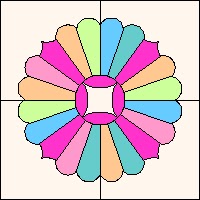
It looks like a simple fan from the 1930s or 1940s but the ends of the spokes are curved inward rather than curved outward.


Look at the corners where the blocks meet. The curved white shapes make a complex secondary pattern.


And Mary L. sent this one.
Should be on page 469: "8-Pointed Stars with points oriented up and down."
But it's not.


And here's the worst of all. I can't believe I can't find the design below.


Jessica sent this one. I couldn't find it in either my Encyclopedia of Pieced Patterns or Encyclopedia of Applique. It seems so common...but...

BREAKING NEWS:
On Tuesday the 5th, Tim writes to say that the pattern above IS in the Encyclopedia of Pieced Patterns. #3629.

It's drawn with the pointed blades a little short but that is it. Here's the BlockBase sketch. It was published by Hubert VerMerhren's pattern company (sometimes referred to as the Home Art pattern company)under the name Friendship Circle and also in Successful Farming magazine as Dresden Plate. Both were 1930s pattern sources. Thanks to Tim for looking in the right spot.

I am guessing that the top two designs came from the Laura Wheeler/Alice Brooks syndicated pattern column. The clues are the sophisticated geometrics that result in secondary patterning where the blocks meet. These look like the work of professional designers rather than quilters recording the folk art patterns they grew up with. That style is very typical of the Wheeler/Brooks columns in the 1930s. The column was so popular that I know I haven't indexed all their designs.


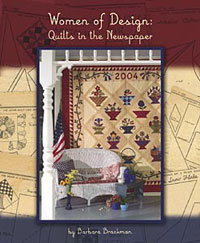
A few years ago I wrote a book called Women of Design: Quilts in the Newspaper. Here's some of what I wrote about this pattern source:

About 1933, a new quilt pattern feature began to appear in the Kansas City Star. Readers found smaller columns advertising patterns that could be ordered through the mail. A drawing of a patchwork quilt and a paragraph of description were followed by a last line reading “Send 10 cents for the pattern to The Kansas City Star, Needlecraft Dept., Kansas City, Mo.”

The Star forwarded orders to a pattern source in New York City that went by a number of official names. Quilt pattern collectors know little about this company, which was formed as Needlecraft Service in 1932. The name was changed to Reader Mail in 1944. Over the years, they’ve offered patterns for all kinds of needlework including crochet and clothing. Reader Mail is now located in Michigan and continues to offer syndicated advertisements in newspapers around the country. [It may be gone now.]

In some newspapers (their patterns appeared in hundreds of papers in the 1930s) the column ran under the names Laura Wheeler or Alice Brooks, fictional columnists who gave a personal touch to the feature. The Star patterns printed before World War II used no byline, so pattern collectors have learned to recognize the Needlecraft Service designs by their distinctive drawing style, which featured detailed calicoes in blocks drawn side by side to emphasize complex secondary designs.

Many readers were attracted enough by the lovely drawings and the innovative designs to invest their dime in “stamps or coin, coin preferred.” The pattern that arrived a week or so later included a detailed schematic drawing with suggested yardage on a sheet of tissue or newsprint about 15 by 20 inches.

These patterns were neither feature nor advertisement, but something called a “reader service feature.” Newspapers subscribed to the feature, knowing that readers, especially rural readers, enjoyed the opportunity to order fashion and crafts by mail. The paper and the pattern company shared those many dimes.

See more about this newspaper column in an August, 2009 post on this blog by clicking here:
http://barbarabrackman.blogspot.com/2009/08/laura-wheeler-patterns.html

I learned most of what I know about the Wheeler/Brooks syndicate from quilt historian Wilene Smith, who has started a new quilt history webpage called Quilt History Tidbits. Click here to see her page on Laura Wheeler and Alice Brooks.
http://quilthistorytidbits--oldnewlydiscovered.yolasite.com/laura-wheeler-and-alice-brooks.php
And bookmark the site. Fans of quilt history will love her detective work.
http://quilthistorytidbits--oldnewlydiscovered.yolasite.com/
For more information about Women of Design: Quilts in the Newspaper, click here:
https://www.pickledishstore.com/productDetail.php?PID=441


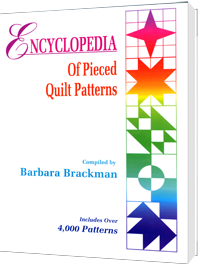
You can buy the Encyclopedia of Pieced Quilt Patterns from the EQ website which sells BlockBase, the digital version. The book version has OVER 4,000 PATTERNS. Just none of the above.
http://www.electricquilt.com/Shop/BlockBase/Encyclopedia.asp