QUILTS & FABRIC: PAST & PRESENT


Showing posts sorted by relevance for query coxcomb. Sort by date Show all posts

Tuesday, July 5, 2016

A Gawky Eagle and a Coxcomb

For the Fifth of July: an eagle with a wardrobe problem.


 Platform shoes?

1) Eagle medallion from the collection of Deb Grana and Sharon Waddell

You may have admired this medallion at last year's
Vermont Quilt Festival.


I have seen those shoes before.
#2               #3

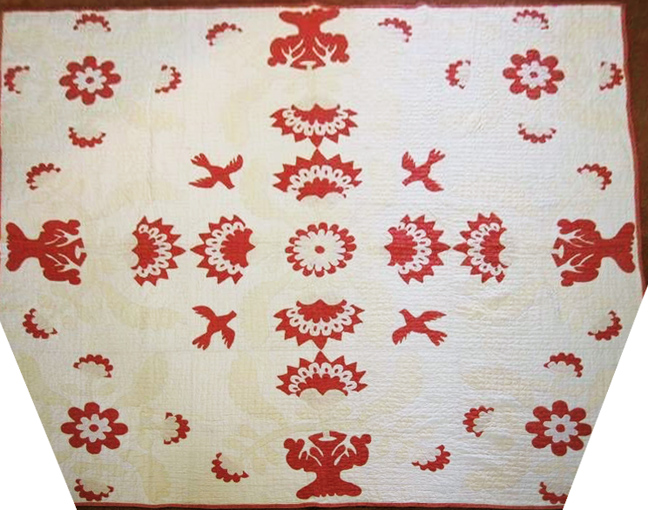
2) Note the eagles north and south in the borders of this
coxcomb quilt that Laura Fisher advertised in The Clarion in 1999.

3) A twin recently posted on eBay with four eagles.

4) A triplet sold at Cowan's Auctions in 2014

Eagle with reverse applique and anatomy difficulties.

Grana/Waddell feather (1)

All four quilts also have a feather with reverse applique.

In three quilts the feather is part of what we'd call a coxcomb, perhaps.
It's a relatively popular 19th-century applique design with a lot of variation.

But here it is with the same flourish to fill out the square block...

Some kind of vegetation with a reverse applique heart
A quilt from Stella Rubin  (pictured in a 1988 Quilt Engagement Calendar) with the same flourish
and the same bird as Number 2 above.


The pattern is indexed in my Encyclopedia of Applique. Variations are 43.7, cockscomb or coxcomb.


The Ladies Home Journal in 1908 called it The Olive Branch.

The pattern parts must have been passed around a good deal.
Add an eagle or not.

#43.78


See more about my Encyclopedia of Applique here:

Wednesday, January 24, 2018

Coxcomb with Birds


Years ago I was knocked out by this crib quilt on
a visit to Colonial Williamsburg.


Tulip Cross Crib Quilt 45-1/2" x 35-1/2"
Member of the Richter Family, Ripley County, Indiana.
Possibly Anna Richter in Sunman, Indiana 

A few months ago I saw another version of the same pattern in Julie Silber's stack of antique quilts for sale at the American Quilt Study Group in New Hampshire.


I took a picture and when I went back to look at the whole
thing it was gone. Sold to a happy collector.

I have photos of several quilts in the same pattern in a file. 

Here it is as a center medallion in a quilt documented
by the Indiana project, seen in Terre Haute. They thought it might
be 1850. From the picture with it's strong green and feather quilting
this seems possible.


I thought this quilt in Mary Koval's booth was the same
one but it's not. Similar corners and a border, but this
one's more delicate and missing some parts.


I mention the strong greens because several versions like this one sold at Cowan's Auctions were stitched with the fugitive greens so common after 1880. Those leaves and stems were probably once a dark green with a touch of blue but the early synthetic dyes faded badly. So I am guessing this one is after 1880.

From an online antique dealer

Same arrangement of the same blocks. It's not
the same quilt though. The green has faded more gray than brown in
this one.

Coxcomb 
International Quilt Study Center & Museum
#2007.038.010

Yet another example, same fading problem with the
greens (Turkey reds and double pinks are far faster.)

Fading to tan where it was folded and exposed to light.

The one above, fortunately, is dated: 1885
but that's all they know.

This one from an eBay auction has faded so
badly that the green is barely visible


The pale scallop on the left was once dark green I bet.

So what we have here is a regional pattern that seems to have been passed around from
1850 to about 1900. It was often the center of a nine-block applique quilt of three different designs. I'd guess that region was Indiana.

Ripley County is near the Ohio River
west of the state of Ohio.

Coxcomb with Birds
84" x 84", 1995
Look how nice the green is on this one. That's because it's
a recently done reproduction.

Anita Shackelford made it for her book
Coxcomb Variations.
I imagine you can find a pattern here
and make one of your own.
Anita owns the antique quilt she used for inspiration.

See the crib quilt at Colonial Williamsburg here: 
The caption gives us a good deal of information.
"According to Don Walters, the dealer who sold the quilt, the quilt can be attributed to Alma Richter. Another quilt in a similar pattern (in a private collection in the 1980s) was also said to be made by Alma Richter in 1854. A search of Ripley County, Indiana, records failed to locate an Alma Richter around that date. However, one Alma Richter, 1898-1984, had a German-born Grandmother who lived with her family in Ripley County, Indiana. The Grandmother Anna Richter was a widow who was born in Germany in 1814 and immigrated to the United States in 1841. Anna Richter may be the real maker of the quilt. It appears that the woman whose estate was sold in 1985, Alma, may have been mistakenly credited with making the quilt. It is unclear where the 1854 date came from."

Tuesday, July 19, 2016

I forgot something-the bird

Block signed by H. Coates perhaps.

Remember the post on this pattern,
a coxcomb variation (App Enc #43.78)?
The topic was technically the eagles in the border but I got distracted
by that little reverse applique heart in the flourish in the corner.
See the post here:

I found some more with that flourish....This one dated 1860.

Quilt made for Daniel Hitt Kincheloe Dix, a Methodist Circuit Rider.
 Date-inscribed 1860,
made in Western Virginia (now West Virginia). 
From the WV Project and the Quilt Index.

By Frances Gossett, Michigan Project

Attributed to Ellen Lewis Bruell Cash
1840-1880
Mcminn County Living Heritage Museum
Another Quilt Index Photo, this one from the Tennessee project.

Once I saw this Tennessee version I realized that if you wanted to fill up the
block you'd better add a bird in the corner opposite the flourish.

Three very similar quilts with very similar birds

Ad from Laura Fisher's shop in the Clarion in 1999

The 1988 Quilt Engagement Calendar pictured
this one from Stella Rubin's shop.

So if you were inclined to make this quilt you might
make do with this pattern above that I Photoshopped together.

Detail of Cranberries & Cardinals by Jean Stanclift

I also remembered we've done a book with a similar pattern in it. Jean has an antique quilt in this design and did a terrific interpretation of it.


There seems to be no end of the stuff you could add to the basic pattern.

The basic pattern. A Four Block from Buckboard Antiques.

Jean's border

But since it's Linda's birthday week let's focus on the birds.

Buy the book Cranberry Collection by me and Karla Menaugh with
Jean's quilt pattern in it here at my Etsy shop


Tuesday, May 29, 2018

Feather and Tulip Cross: An Abundance of Examples

Small quilt shown in 
Classic Crib Quilts and How to Make Them 
by Thomas. K. Woodard & Blanche Greenstein

I indexed the pattern in my Encyclopedia of Applique
with the 4+4 patterns. 
#19.35
Tulip Cross

The pattern was also in Safford & Bishop's book
 as Princess Feather and Tulip

The Princess Feather & Tulip pictured there is this one in the collection of the Henry Ford Museum,
made in Ohio by an unknown quiltmaker according to the caption.

I wish we had a 19th-century name for the pattern because  it was definitely a 19th-century item.

Date inscribed 1856 by Mary E. Byrod Fortenbaugh (1832-1929) 
Collection of the Illinois State Museum
Halifax, Dauphin County, Pennsylvania

The Museum has five quilts by Mary in their collection.
See all five by going to the Quilt Index and typing
Byrod in the top right search box.


Cover of Quilters Newsletter in 1997
It's a big block, usually seen as a four-block set.

Nice geometry, fills the square block well
The feather's curve helps.
This one may be late-19th century.

Although sometimes the feather is straight,
a variation. This one looks fairly recent.

Then we get into the variations:

Not necessarily a tulip


Quiltmakers could make the pattern simpler or more complex.

 Christina Meyers added a lot in the corners of each block. 
Date-inscribed 1860 in the collection of the
 International Quilt Study Center & Museum
# 2015_053_0001

Date-inscribed 1859 by Huldah Caroline Deat.
The red flower on the feather looks like a botanical Prince's 
Feather.

A sad old top with coxcomb instead of tulip,
Another pattern from mid to late 19th century.

Here's one earlier and in much better shape from Julie Silber's inventory.
Hard to say if the feathers are going north/south or on the diagonal here.

Another take is putting the curling feathers in the corners as in this
example by Christinia Hathaway
from the Connecticut Project.

Found in Connecticut but made in Ohio
Sunflowers and a Caesar's Crown for the center.
Moving the curving feather to the corners tends to compress the design.
 It fits into a smaller space.
This one is a nine-block.

A relative also from the Connecticut project.

  Feathers on the diagonal need a new number. write 19.36 in your copy of Encyclopedia of Applique.

Seen at Quilt Market in Chicago I believe


Here's the latest of the vintage examples.

Pastel prints with red blanket stitch,
strangely appealing.

No curve in this one

Louise Lynn from the Carlson Four Block Collection at the
 International Quilt Study Center & Museum
#2012_008_0005 

Also IQSC
This is a different pattern though. We are digressing.

If you'd like a pattern for the tulip cross crib quilt the 
Woodard & Greenstein book has one.
 Betty Jefferis won a prize for her machine appliqued
reproduction quilted by Mattie Troyer.

And here's another pattern option from the cover of Quilters Newsletter.
Print it 8" and double it for a 20" block.