QUILTS & FABRIC: PAST & PRESENT


Showing posts sorted by relevance for query charm quilt. Sort by date Show all posts

Friday, August 7, 2015

Charm Quilts: Not Everybody's a Fan

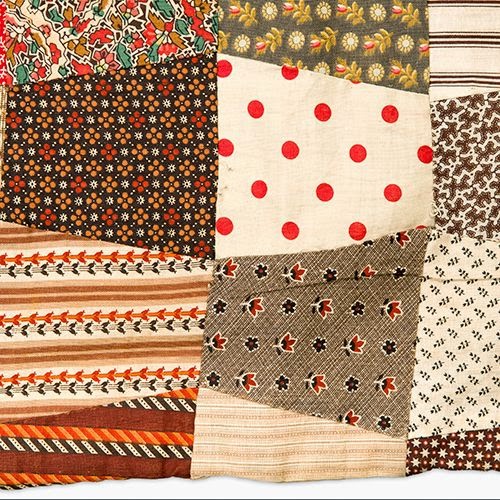
Detail of a charm quilt by Ruthie Stubbs
Bresler Collection, Mint Museum

In 1875 the reporter assigned to the Orleans County Fair in Barton, Vermont, checked out the needlework department, finding articles of...
"excellent workmanship and fine taste. The ornamental rather outdid, in number of articles, the useful; but there was a fair amount of carpeting, home-made cloth, stockings, mittens, quilts &c. "

Barton Vermont, mid-20th century

Among those useful articles:
"The charm quilt was present, this time, put in by Maria Marsh of No. Greensboro; No. of pieces 12,054."

As I've said before: "That's a lot of pieces!"


I think Maria might have miscalculated. Here's a charm quilt from about 1880. 

I calculated:
20 pieces in the single diamond rows. 20 x 23 rows = 460
35 pieces in the double diamonds rows. 35 x 23 = 805

Total: 1,265

That seems a typical  number for total pieces you see in the charm quilts of the 1870-1900 era. About 1000 to 1400.

About 600 pieces
Of course, larger patches will give you smaller numbers

And smaller pieces would give you larger numbers....

Balloon launch at a Vermont fair about 1900

Although I find them endlessly fascinating, the Vermont reporter seems to be a bit bored by charm quilts in 1875, implying there was always one on view at the fair. 

That 1875 reference to a charm quilt is not the earliest reference I found when I typed the words "charm quilt" into the search engine for the Library of Congress's newspaper website.

Here's a mention of the name from 1873:

"Newbury boasts one distinguished family. The father has a puff-ball, bigger than a bushel basket, and his eight-year-old daughter has made a charm quilt of 2,450 pieces, no two alike; she has also a string of over 1000 buttons, all different."

2,262 pieces without counting the border
About 1880

I feel pretty good about assigning the name "charm quilt" to the 1870s. But the style characterized by "many pieces, no two fabrics alike" seems older.

Are prints repeated in this mid-19th century quilt?
It doesn't seem to meet the criteria:
"All of the same size and shape, but each one of a different pattern..."

I found an 1843 reference to the style, but without the name. I have no citation and can't find the article again but here's what my fuzzy copy said:
"Female Ingenuity-Miss Jane Craigshead, a young lady of this borough, has recently completed a quilt, which for beauty and ingenuity exceeds any thing of the kind we have ever seen. It is composed of 6,541 pieces, all of the same size and shape, but each one of a different pattern. Any one can judge ... the work there is in it as well as of the patience of the lady who made it, from the fact that it was commenced years of ago, and has occupied the most of her xx moments ever since."...Harrisburg Chronicle
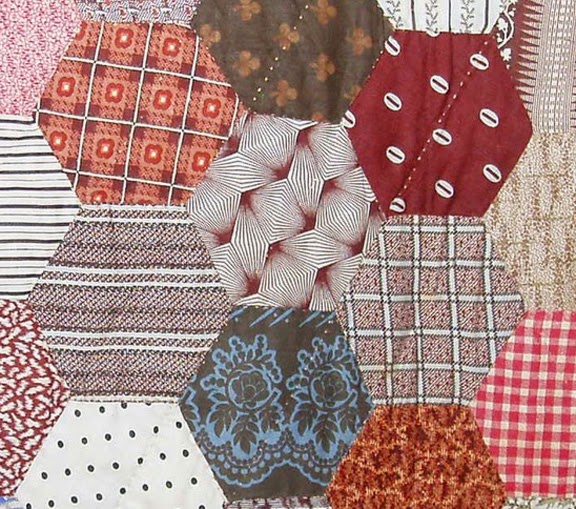
Hexagon quilts were quite a fad in the mid-19th-century
years. Perhaps Jane Craigshead's quilt looked similar
to this one from the Missouri Historical Society's collection---
but with no two pieces alike.

The 1843 story was apparently copied from the Pennsylvania newspaper. Other editors could use it as filler. The editor of the paper in which I found the quote, however, used it as a moral lesson.
"Our opinion is, that Miss Jane Craigshead has wasted years of the period of life most desirable and valuable in a most ridiculous manner, and that if she had been employed in the engagement of useful knowledge, not the performance of solitary female xx it would have been much more creditable to her than this xx xx of time and labor upon a patchwork bed quilt, worth about so much as any other which might be made in three or four weeks. We trust that the woman who xx xx xx time and the opportunity for improvement is entitled to reprobation and not to commendation. ...We ... hope they will find better employment for their time."
All the words aren't readable but you get the drift.

Don't waste your time when you could be learning how to ...clean house? darn socks? sew on buttons?


See other posts I've written on charm quilts:
http://civilwarquilts.blogspot.com/2015/05/1862-crib-quilt-doh.html
http://barbarabrackman.blogspot.com/2015/06/hattie-spragues-charm-quilt.html
http://barbarabrackman.blogspot.com/2014/11/thousand-pyramids-charm-quilt.html

Monday, June 1, 2015

Hattie Sprague's Charm Quilt

Top reported to have 1,676 pieces


In 1879, 21-year-old Hattie Sprague was busy at her sewing machine.

She entered numerous items At Sacramento 's California State Fair in September:
  • Two Java canvas tidies
  • Silk Embroidered picture
  • Dozen linen handkerchiefs
  • Two pieces of linen needlework
  • Patchwork quilt, machine quilted
  • Charm quilt, machine worked
Anonymous woman at a machine after 1860

For those who are not familiar with a charm quilt the Sacramento Union described it well in their account of the fair's needlework:

"Charm quilt, Miss Hattie E. Sprague, 1,053 pieces, no two alike."


The description is exactly what we think of as a charm quilt 120 years later.

Detail of a charm quilt from the Pat Nickols collection
at the Mingei Museum, California

Many pieces, no two alike.
We assume Hattie's quilt was made of a single template, but have no idea what it actually looked like.

Triangles?

Tumblers?


Charm quilts above are from the Pat Nickols collection.

I was hoping to find a picture of Hattie or her quilts but no such luck. I did find that she was California-born in 1858. Her parents Moses and Nancy Sprague came to Sacramento right after the gold rush and prospered as farmers, settling on land in "New Helvetia" the old Sutter land grant..


Hattie probably made her quilt at her father's Sacramento farm house,
which she eventually inherited. 
The address today would be the 2100 block of Fourth Avenue.

Four years after Hattie finished her charm quilt she married Hugh C. Jones in November, 1883. After being widowed she married Benjamin Franklin Walton, a Pennsylvanian who'd come to California in 1859. The second marriage took place in 1895.


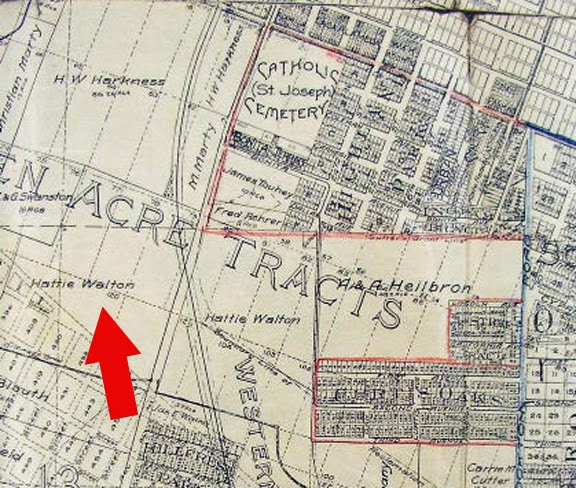
During the early 20th century Hattie Walton went to court to obtain the family farm, which her mother's executors hoped to divert to other relatives. She won the land, which she sold to developers of Curtis Park in 1909.
She died on July 4, 1936. I could find no records of any descendants. 

Hexagon charm quilt

A whole lot of half-square triangles.
Very few quilters achieved the goal of no two pieces alike.


Friday, April 1, 2016

Charm Quilts and Odd Fellows

A charm quilt from 1870-1900, a single diamond
shape. The goal was no two pieces alike.

Third Time's A Charm
28" x 36"
405 Pieces
I just finished binding this hand pieced, hand quilted
charm quilt. There are duplicate pieces, but
I didn't intend for that to happen.


I've been keeping track of names for charm quilts in which every piece of fabric is different (or at least one attempts the idea.)

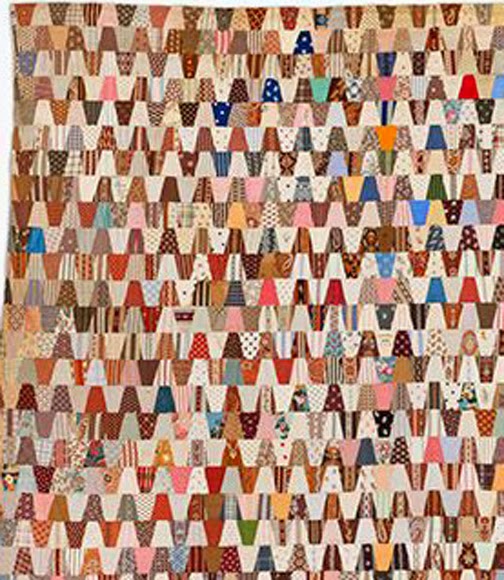
Tumbler shape, quilt top from 1920-1940 perhaps

As I said in an earlier post I feel confident that the name Charm Quilt was in use in the 1870s.
http://barbarabrackman.blogspot.com/2015/08/charm-quilts-not-everybodys-fan.html

Here in 1878 is a reference to 8-year-old Myrtie Benjamin winning 50 cents for a charm quilt at the fair in Montpelier, Vermont.


But the idea of specifically choosing fabrics with no repeats is decades older. I recently found a reference in 1837 to Lucy J. Bowler's entries in the Massachusetts Charitable Mechanics Association Fair. She entered two. "In one, every square is a different style."


That might refer to a sampler in which the blocks are different patchwork patterns, but it could refer to fabrics.

From the Pat L. Nickols collection at the Mingei Museum
Estimated date: 1870-1900


I've been finding  period names other than "charm" for the idea. One name is Odd Fellows as in the above 1876 explanation in the Christian Monitor. The author suggests a diamond for use in "one kind of patchwork known as Beggars quilt,' or having no two pieces alike they call it 'Odd Fellows.'"

 I'm guessing that a Beggar's quilt here is a scrap quilt and an Odd Fellows is a charm quilt.
.


Mrs. John Middleworth of Detroit won a prize with an "Odd Fellow's quilt patch work" in the 1856 Michigan Agricultural Fair.


I've found variations on the Odd Fellow's name
Below Harriet Stanley won a prize in 1853 in Washington City in the Mechanics Fair with her Odd Fellows' delight.


But because there are no pictures we have no idea what these Odd Fellow's quilts might look like.

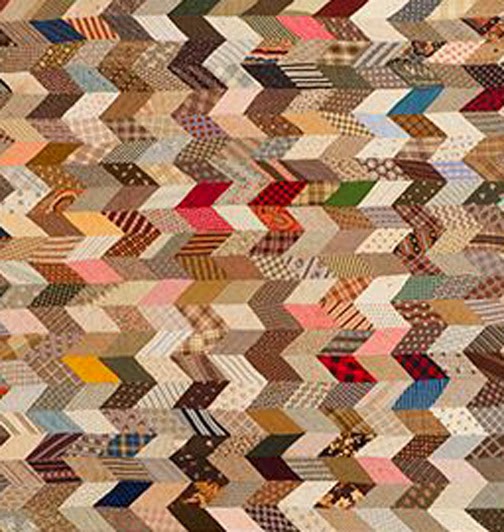
This is in my Encyclopedia of Pieced Quilts Patterns as #147-
Herringbone or ZigZag.

I've been sorting pictures and names for tessellated designs, the kind of pattern used for charm quilts.
My latest way of keeping track of them is using Pinterest pages
sorted by BlockBase numbers.


See my Pinterest page for Tumbler shapes here:

I think this is the third time
I've done triangles.
There are many other possibilities.

Monday, November 3, 2014

Thousand Pyramids Charm Quilt

Thousand Pyramids Charm quilt and Dorothy Barker

I recently got out an old reproduction quilt and spread it over Dot's love seat.

I made the triangle quilt in the early 1990s and it's been folded up
too long. I thought I'd lay it out for a week or two to get out the wrinkles
and then refold it.


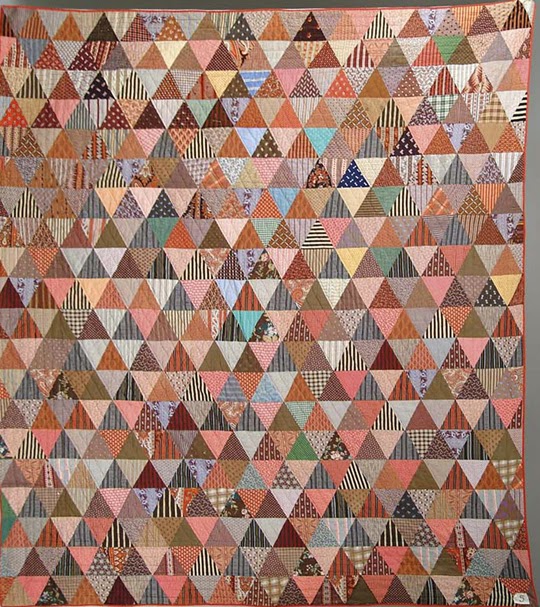
The base of the finished triangles on this one measures 2". They are isoceles triangles,
with the base shorter than the side lengths.

I had made my mother-in-law a bed-size, charm quilt like this and
I made a smaller one for me with the leftovers 


This was before I was working with Moda to design reproductions so the darks and lights were from my scrapbag, prints not really marketed at the time as reproductions. I overdyed the really bright white shirting prints with tan Rit Dye to tone them down. I was looking for madder reds and browns, pinks and shirting prints.

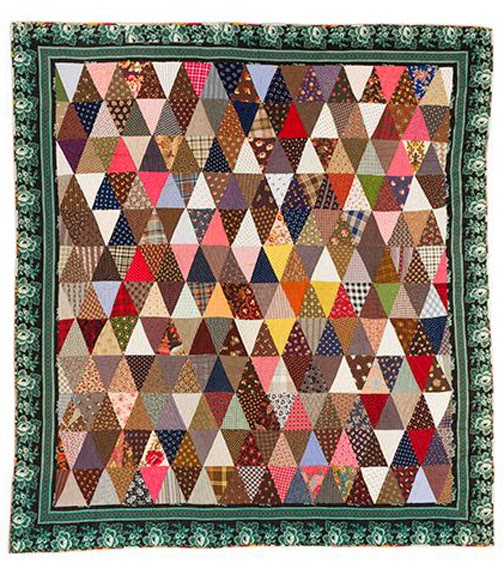
Sort of like this one from about 1870-1890

I remember that I was frustrated in piecing this because the differences in the measurements on the sides were hard to see and I was always attaching a base to a side and having to rip. 

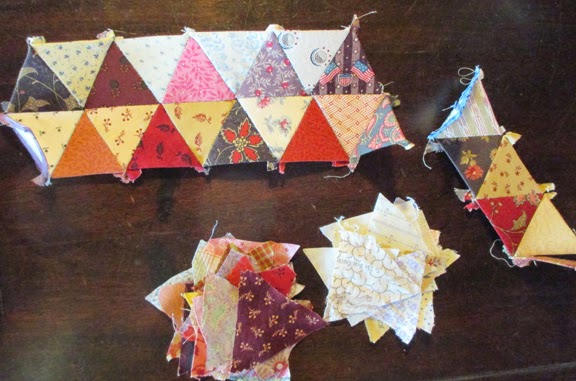
I have been looking for a paper piecing project that is NOT hexagons. I think I'll make another one of these with my own Moda reproductions. But I will use equilateral triangles, in which all the angles are 60 degrees and all the sides are the same length.

I looked that pattern up in my BlockBase program and
saw that it is #111a with several names.

I like Joseph's Coat from the Joseph Doyle Company about 1910 and Thousand Pyramids from Ruth Finley's 1929 quilt book.

You can buy paper piecing patterns for equilateral triangles already cut. If you want to cut your own: Paper Pieces gives you a free equilateral triangle grid to print out. Click on this link and scroll down.


I fooled around with their grid: Enlarged it 110% and fit it onto an 8x11 sheet which I printed on index paper.

Click on this image and Save it to a JPG file or a Word file.
Print it out on an 8-1/2 x 11" sheet of heavy paper.
The triangles measure 2" on each of the 3 sides.

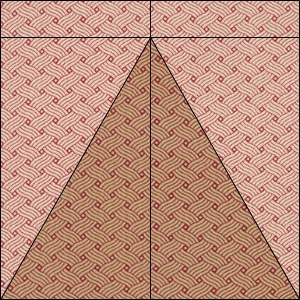
If you want to stitch triangles without paper templates here's how to cut
an equilateral triangle from a charm pack.


 I have a Charm Pack (5" squares) of my Richmond Reds reproduction line from Moda.

Cutting equilateral triangles from 
Moda Charm Pack Squares:


Begin with a 5" square.
Press the square in half so you
have a fold line down the middle.

Cut a strip off the top 5/8" wide.
Cut a line from the center top of the fabric 
to the exact corner on either side.
Your triangle will be 5" on all three sides.


You are ready to make a charm quilt with no two pieces alike.
The larger triangles really show off the prints.

Charm quilt from the 1870-1900 period

Quilt about 1880-1920 from the Nickols Collection
at the Mingei Museum.

You might be better off aiming for a charming quilt with duplicate prints. It's the
scrappy look that is so appealing. 

The quilt above looks like it was begun on the top left side
with madder browns popular in the 1870-1890 period and finished in
the lower right with blues and grays popular in the 1890-1920 period. 
Don't dawdle too long. Taste could change.


Charming quilt from 1930-1960 with the triangles shaded in diagonal rows.


Here's an updated look from Carla at Grace & Favour blog who used a Cherry Christmas charm pack
by Aneela Hoey from a few years ago. (Carla's look to be isosceles triangles---(longer sides, shorter base) They still work.
http://carla-graceandfavour.blogspot.com/2012/11/a-cherry-christmas-quilt.html

Here are links to more on the mysteries of the equilateral triangle:

Cutting with a 60 degree ruler from Diary of a Quilter:
http://www.diaryofaquilter.com/2013/12/ive-been-playing-with-60-degree-or.html
Cutting with a  regular grid ruler from Fresh Lemon Quilts:
http://www.freshlemonsquilts.com/?p=2132

Thousand Pyramids from about 1880-1920

I'm making progress in just a few days. And I found I still have some scraps
left over from the first project over 20 years ago.

You have to be nuts to save scraps that small.


So I was browsing the web after writing the above and I see somebody
at Atelier Bep had the same idea using my Richmond Reds. And she's finished already.