QUILTS & FABRIC: PAST & PRESENT


Sunday, September 19, 2021

Losing Linda Eaton


The world of antique textiles lost a great scholar with the death of
Linda Eaton last month. Since 1991 she'd been at the Winterthur Museum, first as textile
conservator and recently retired as textile curator and director of collections.

One of her many accomplishments was updating her predecessor Florence
Montgomery's classic Printed Textiles with new information and color photography.

She curated many exhibits there and published
several books, catalogs and articles.


She was so smart and so thorough---and so generous with her knowledge.
She also taught at the University of Delaware where her students must be lamenting
their loss after Linda's battle with cancer.


A list of some of her exhibits and accompanying seminars with links to get a glimpse of her work:
Note: None of the links are working today. Try a web search for the title of the show.

Quilts in a Material World

Needles and Haystacks: Pastoral Imagery in American Needlework

With Cunning Needle: Four Centuries of Embroidery
    https://enfilade18thc.com/2011/09/23/winterthur-exhibition-conference-with-cunning-needle/

The Diligent Needle: Instrument of Profit, Pleasure, and Ornament

Embroidery: The Language of Art

Betsy Ross: The Life Behind the Legend (with Marla Miller)

Treasures on Trial: The Art and Science of Detecting Fakes

Erica Wilson: A Life in Stitches (with Ann Hillaker)
https://www.winterthur.org/erica-wilson-a-life-in-stitches/

Costuming The Crown

Read more about Linda:

Wednesday, September 15, 2021

Flora Delanica #12: Canada Lily

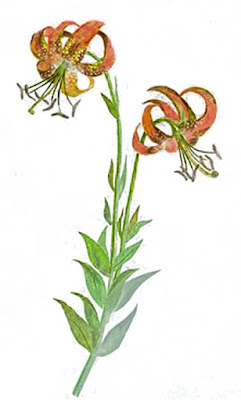
Flora Delanica Block #12 Canada Lily or Tiger Lily
(Lilium Canadense) by Becky Brown.
 Our twelfth and last block recalls Mary Delany's last years.

Mary Granville Delany by John Opie 1782
with added lilies.
National Portrait Gallery

Mary is often remembered with this portrait painted when she was in her eighties. She'd probably prefer you think of her as thirty, the interior age she may have viewed herself. As a fellow old lady I'd guess she was surprised every morning to see that elderly face in the mirror.

A miniature of Mary in her young womanhood

Tiger Lily by Nancy Phillips in wools

With her peers long gone in her last decade Mary cultivated friendships with a younger generation, including the Queen, the royal family and novelist Frances Burney who served as Queen Charlotte's "Second Keeper of the Robes." Fanny in her thirties had a hard time dealing with the court (a bit dull) and the royal temperaments (can we say crazy?) but she enjoyed Mary Delany's company, recording a visit to her apartment at Windsor, "entirely hung round with pictures of her own painting, & Ornaments of her own designing, partly from the antique & partly fanciful."
Frances Burney (1752-1840) painted by Edward Francis Burney
in the 1780s. National Portrait Gallery

Fanny was reminded of her own grandmother. Mary, she observed, appeared "remarkably upright."
"I had heard of her being blind. Blind, however, she is certainly is not for she neither [was] led about the room nor seems at any loss how to move....the fine perception, however, by which she painted, drew, cut out, worked & Read, is wholly dimmed."
Portrait of Mary Delany in the 1780s by John Hoppner
Collection of the Victoria & Albert Museum

That hat, literally the height of fashion, may have looked
dashing on Fanny and Georgiana the Duchess of Devonshire
but....


A blue plaque on St. Alban's Street near the entrance to 
Windsor Castle recalls Mary and Fanny.

Detail of Becky's beautiful lilies

With our last block we have to say goodbye to Mary Delany. I, for one, am as sad as her friends were 250 years ago. We can leave her with praise quoted by an editor of her letters in the 1930s who tells us that Dubliner Edmund Burke declared her "not only the woman of fashion of the present age, but she was the highest bred woman in the world, and the woman of fashion of all ages."

Lilium Canadense


The Block
#12 Canada Lily or Tiger Lily


Applique on the diagonal to a square cut 10-1/2" or on the vertical center of a rectangle cut 9-1/2" x 12-1/2".


One Way to Print the Pattern:

Create a word file or a new empty JPG file that is 8-1/2" x 11".
Click on the image above.
Right click on it and save it to your file.
Print that file out 8-1/2" x 11". Note the inch square block for reference.
Adjust the printed page size if necessary.
A little Photoshopping

Becky has set her 12 flowers with alternating pieced X's and
added applique.

First there is a pieced border.

And she's working on an outer applique.
Spectacular!


I let fabrics do most of the work and added dots
with a fabric marker.

Nancy stitched French knots!
Here's her finished Flora Delanica.

Nancy Phillips's wool applique quilted by 
Virginia Longarm of Goochland, Virginia.

A Little More Mary Delany


Ranunculus Asiaticus, a variety. Persian Buttercup. Collection of the British Museum.

Here's my finished top with 13 blocks (added an extra in center lower row.)

Further Reading & Viewing


Fanny Burney's view of the court of George III and Charlotte is a window into one of the ultimate dysfunctional families. Read Claire Harman's Fanny Burney: A Biography.

Many editions of Fanny's diary and letters have been published. A preview of a 1905 edition:
https://www.google.com/books/edition/Diary_and_Letters_of_Madame_D_Arblay_177/f4fpE_luaQcC?hl=en&gbpv=1&bsq=delany

Friday, September 10, 2021

Schoolhouse History for AccuQuilt


Pam & Erica do a live broadcast for AccuQuilt and they asked me
to help them launch their new die for the cutting machines:
Schoolhouse.


Click here to see a link to the hour-long show on the Schoolhouse die: 

They asked me for a little history of the pattern

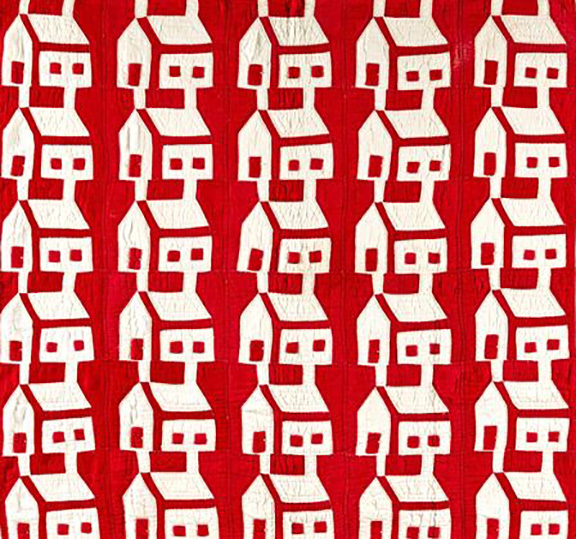
Houses were certainly popular, here are a few from BlockBase+. The name Schoolhouse comes from Ruth Finley in her 1929 book although other pattern sources had published variations on the block as far back as about 1890.

Ruth was not fond of the pattern and included a photo in her chapter on the "Decline of Handcraft." She was in a pessimistic mood as she finished her book in 1929, not realizing the explosion of interest in quiltmaking (and fine handwork) that would follow in the 1930s.


We disagree!

I had more pictures than Erica & Pam could show....


Most from online auctions and dating about 1890-1940


A Little White Schoolhouse from Joanna Rose's collection of
red & white quilts.

Maggie Malone's collection

From the Iowa Project and the Quilt Index

One can always create a neighborhood:
Possibly from Joanna Rose's collection.

Add the names of the local householders

Cindy Rennels's inventory, dated 1897
Each block has a name between the chimneys


Doyle Antiques Auction
Add a railroad and the cemetery.
It's a village.

Or maybe you live in the country all by yourself.

Monday, September 6, 2021

Mariner's Compass Quilts #3: Creating Style


Blocks from a quilt associated with Sarah Morrell
some dated 1842-1843.
Museum of American Folk Art

Album quilt associated with Quaker Ella Maria Deacon (1811-1894)
Burlington County, New Jersey, Blocks dated 1841-1842
Art Institute of Chicago
Read the inscriptions here:

The previous two posts looked at the design we call Mariner's Compass, its various names and how to make a pattern by folding paper. The quilt above, one of the earliest dated album samplers, has many circular designs probably obtained by paper folding. The majority of the place names and signatures are from New Jersey.

American patchwork didn't have a good deal of pattern variety until 1840. The fashion for creating album or friendship quilts with each block an individual design seems to have began about 1842, based on the dated examples. 

Album quilt associated with Charlotte Ware Gillingham Hancock
Blocks dated 1842-1843
Philadelphia Museum of Art

The fashion seems to have begun in the Delaware Valley---in Philadelphia and New Jersey towns along the Delaware River among Quakers. Several quilts dated 1842-1844 have place names there.

Years ago I made a map of dated quilts with place names both single pattern (dots) and album samplers (stars) in the years 1840-1844. This sampler maps shows two clusters in the Delaware Valley and Baltimore. (Now I'm a little skeptical on the dates of those pre-1844 Baltimore samplers.)

The whole idea of album sampler quilts with their amazing variety of pieced, appliqued and cut-out chintz blocks seems to have developed in the Trenton/Philadelphia area in the early 1840s.

In the later 1840s the fashion spread 

Ten years after the fad began
the women in the Delaware Valley
seem to have been over it.

Pennock Family album, 1842-1843
Chester County Historical Society

Sarah Wistar Pennock's star based on ten points
 in the Pennock quilt, pieced over paper templates
Thanks to Sandra Starley for taking and posting such
great detail photos when she visited the Chester County Museum.

Where did these feats of stitching and geometry come from (aside from the Delaware Valley?)

My guess is ladies' academies. The Delaware Valley was THE place to send your girl to school whether she walked a few Philadelphia blocks to classes or was packed off from Virginia to board in Burlington, New Jersey.

Mississippian Varina Howell (1826-1906)
boarded at a French school in Philadelphia
in the early 1840s. She went home to marry
Jefferson Davis in 1845.
 
School girls and their teachers?

I wonder if  these album blocks and the quilt style they created were a product of clever teachers who combined sewing, drawing, and mathematics lessons with the young woman's desire for a strong friendship circle, leaving a durable legacy.


I did not originate this idea. In 1986 Tandy Hersh gave a paper at an AQSG seminar on the Pennock quilt and I have not forgotten it. She concluded that girls schooled at Quaker academies "would have developed the skills necessary to design and sew intricate blocks in a quilt and do the ink art work and penmanship found on the quilt." She also noted that the skill levels in inking and stitching on the Pennock quilt varied.

Collection of Colonial Williamsburg
Generations of Pennock women in an 1870 portrait

The Pennock "family members had the opportunity to study under English sewing teachers and respected mathematics and calligraphy instructors in the Society of Friends' Pennsylvania schools."

Philadelphia Museum of Art
Block from quilt dated 1842-1843, attributed to Philadelphia Quaker
Charlotte Ware Gillingham Hancock (1822-1883)

Art Institute of Chicago
Blocks from the Ella Maria Deacon quilt.
Burlington County, New Jersey, Blocks dated 1841-1842

Two blocks based on six divisions in a quilt (1842) in Sandra Starley's collection.

Isabella L. Pennock
1842

Did 72-year-old Sarah Wistar Pennock create the complex 
patchwork pattern, stitch it or ink the block with its Whig 
imagery of a log cabin and a cider barrel. A granddaughter or two may 
have collaborated on the block with her name on it.

The history of women's education before the Civil War is overlooked but it seems that these early sampler album quilts tell us a good deal about what was happening in classrooms the early 1840s in Pennsylvania and New Jersey. And it's certainly no wonder that the fashion for album quilts spread so far so fast.

New York's Rutgers Female Institute, 1848

Read Tandy Hersh's paper on the Pennock quilt here:

And that's the end of this 3-post series.