QUILTS & FABRIC: PAST & PRESENT


Friday, March 3, 2023

Silk Eagle Quilt # 4 : To the White House?

Sometimes a rather elaborate fabrication springs from a fact. We find no evidence that the eagle quilt had any association with Elizabeth Keckley but was it associated with her friend and client Mary Todd Lincoln?

A theory: The silk quilt that won prizes for Ann Mary Crittenden Coleman was indeed in Mary Lincoln's possession for a time. In those 60+ trunks and boxes she carried around in her widowhood there are mentions of quilts.

Long suffering son Robert put up with her traveling hoard for many years. He met her at a train station in Pennsylvania in 1868:  "Robert was with us at the depot & was shocked at so much baggage."

Woven Marseilles quilt in imitation of French style
handwork.

In the baggage might have been a Marseilles quilt she bought in Springfield in 1853 (a white work bedcover woven to look as if it were quilted) according to research into her shopping from the Lincoln Home Museum in Springfield. She also mentioned gift quilts made as White House gifts in the trunks, encouraging daughter-in-law Mary Harlan Lincoln to help herself to any bedding she came across in the boxes, etc. left in Chicago.

Mary Harlan Lincoln (1846-1937), 
Robert's wife with two of their children.

Like other presidential families the Lincolns were given quilts, including one well-documented eagle bedcover from Martha Ann Partlow Allen Barlow (1822-1902) of Oregon. (No picture remains but descriptions exist.) Mary Lincoln loaned (not gave) this quilt to an 1866 fair for a veterans' charity according to widely copied newspaper articles.

1866
This eagle quilt probably then went back in a trunk.

http://civilwarquilts.blogspot.com/2017/10/martha-ann-barlows-quilt-for-lincoln.html

The silk eagle quilt???

Senator John J. Crittenden was a member the House of Representatives during the first years of the Lincoln presidency and my first guess was he might have presented daughter Ann Mary's masterwork to the Lincolns as a similar kind of tribute. But a little digging into the connections between the Lincolns and the Crittendens revealed a remarkable association. 

Mary Ann Todd (born in 1818) and Ann Mary Crittenden (born 1813) were both members of Kentucky's self-declared elite families in Lexington and Frankfort (the state capitol.) Mary Ann's widowed father Robert Smith Todd married second wife Elizabeth Humphreys Todd in 1828. 

Composite picture of Robert Smith Todd (1791 - 1849) and
second wife Elizabeth "Betsey" Humphreys Todd (1801-1874)

Betsey was close friends with Ann Mary's father's second wife Maria Knox Innes Todd---so close that Betsey asked Maria to be her bridal attendant, according to Mary Lincoln biographer Jean H. Baker. John J. Crittenden, Maria's fiancé was the male attendant at Robert's second marriage.

Maria Knox Innes Todd Crittenden (1796-1851)
& John Jordan Crittenden (1787-1863)

These families were close. Their daughters (15 and 10 when their fathers remarried) may have been friends --- although one has to remember that Mary Ann Todd grew to despise her stepmother Elizabeth Humphreys Todd. Ann Mary and her own stepmother Maria seem to have had a better relationship.

Kent State University Label

Did Mary Lincoln hold on to Ann Mary Crittenden's Kentucky quilt for a while and after her death did it wind up in Ohio where Ruth Finley found it at an antique shop with a fragmentary Lincoln connection?

Collection Kent State University Museum

It's a hypothesis about an intriguing relationship between two Lexington belles of the 1830s.

See another quilt with a connection to Maria Knox Crittenden at this post. Maria was also friends with Lucretia Hart Clay, Henry Clay's wife.

http://barbarabrackman.blogspot.com/2016/10/henry-clay-quilt-2-by-lucretia-hart-clay.html

And the research on Mary Lincoln's shopping for the Springfield house.

http://npshistory.com/publications/liho/hfr.pdf

Thursday, March 2, 2023

Silk Eagle Quilt #3: To Medina, Ohio


Ruth Ebright Finley (1884-1955)

Portrait of Ruth Finley for her publicity tour in 1929 from widely printed feature by Hortense Saunders for the Newspaper Enterprise Association syndicate. 

We have been discussing an eagle medallion silk quilt that once belonged to Finley.

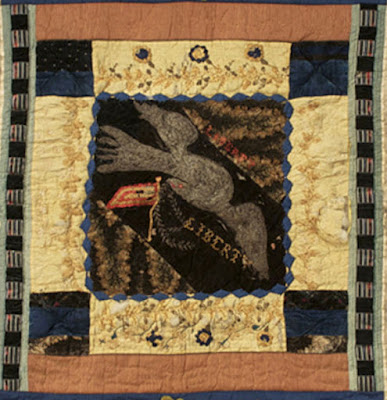
The eagle in the center of the quilt under discussion
was embroidered in silver thread that's tarnished.

As we've seen, our basic source on the eagle quilt's Lincoln/Keckley connection is Ruth Finley, not I am afraid, a reliable source. Finley was a journalist, not a historian. She was a great press agent for herself and her books, giving numerous newspaper interviews as she traveled to lecture. 

The Unseen Guest communicated through
the Finleys (Darby & Joan's) Ouija Board.

She was also, in my opinion, delusional if not just suggestible. She believed she was a skilled psychic medium, publishing an anonymous book with her husband about revelations from her Ouija board.

Saturday Evening Post cover by Norman Rockwell, 1920

 My guess is that if she had a strong hunch something was true---it was true.
 
I addressed Ruth Finley’s historical inaccuracies in a biographical introduction to a paperback edition her family and I published with EPM in 1991. (My quotes in purple.)
"Finley’s basic fallacy is her underlying premise that the ’art of quilt-making in America was as highly developed in 1750 as in 1850.’ Because she believed this to be true, she did not believe that styles changed. Therefore, she dated many quilts incorrectly and mistakenly attributed the origins of many quilts, patterns, and customs to dates far earlier than they actually were.

In the 1929 book Finley tells us: This pieced Pine Tree
 "originated in Massachusetts along with the Pine Tree Shilling 
& the Pine Tree Flag [circa 1650]....[both] gone 
but 'The Pine Tree' quilt remains.

"Our current, wider view of the history of quilts enables us to see that the pieced tree designs developed in the second half of the 19th century, rather than in Colonial times; and that the red, white and green applique quilts she ascribes to the years before and after the Revolution are more likely to date from the mid- to the late-19th century.
Colonial crazy quilt origins in a story from the Minneapolis Star
and Ruth Finley in 1950

“Her stories of customs such as freedom quilts prior to 1825 and bridal hope chests containing a baker’s dozen quilts have not been corroborated by later research…..She twice described…her theory that crazy quilts of ‘shapeless scraps’ were the beginning of pattern development….Contemporary quilt historian Virginia Gunn has given us insight into Finley’s thinking, noting that her concept of pattern evolution parallels thought about Darwinian evolution. If in nature shapeless amoebas evolved into complex organisms, surely quilt patterns developed from the crazy patch through simple one-patch shapes to complex pieced designs.”
We must consider the source for the Lincoln/Keckley thread of ownership. We have no reliable link to the Lincolns or to Elizabeth Keckley, only references to the collection of Ruth Finley and then antique dealer Ross Trump.

Hard-to-read newsprint of the earliest mention I've yet found of Finley discussing the Lincoln/Keckley quilt: "Real Lincoln Quilt...pieced of tea gowns belonging to the President's wife....presented to the First Lady by its maker, Elizabeth Keckley, a slave who later became the most fashionable dressmaker in Washington."


Without corroboration for Finley's Lincoln/Keckley story we can look at the quilt itself for clues to  origins and provenance. The silk medallion could have been made any time from about 1840 to the end of the century, decades when such extravaganzas were a fashion. As there is no “crazy patchwork” in it we might guess it was not made after 1880 when random-shaped silk scraps were all the rage. But that omission isn't much of a clue.

Three outer borders on the eagle quilt

We see style clues that help us guess where it might have been made, particularly in the style of embroidered and mosaic patchwork borders around the central eagle. Kentucky women from about 1840 into the 20th century were well-known for their elaborate show quilts, prizewinners at Kentucky fairs where the prizes were sometimes $100, like the premium Ann Mary Crittenden Coleman won in 1849, equivalent to about $4,000 today.

Report on the 1852 Kentucky State Fair

Eliza Haskins won $25 for her silk quilt. Calico quilt won Mrs. Womack only $15, an award not to be sneezed at: Kentucky fairs encouraged exceptionalism with high value prizes. Mrs. Womack took home about $500 in today's money.

Eliza Farris Haskins was quite a competitor. Detail
of her later crazy quilt with typical linear embroidered
borders and corded edge, quite typical of Kentucky's best.
Was this embroidery purchased? 

Kentuckians' use of those embroidered borders must have won them many premiums at home and at fairs in other states where they knocked out more conventional silk mosaics, etc.  

Corner of Eliza Farris Haskins's late-19th-c crazy,
in the collection of the Kentucky Historical Society

Another end-of-the-century crazy from the Kentucky Historical Society
by Glovina Vertrees Wrather of Hardin County, Kentucky.

The museum has many of her household items:


Tassels in the corners in the Kent State quilt appear to have been detached and re-stitched inside the fringe. Quilters elsewhere may have finished their silk quilts with tassels but the look is generally a good clue to a Kentucky quilt. Do note that the tassel is bleeding in this older photo. I would bet the quilt has been conserved and some of the bleeding cleaned.

Considering a Kentucky origin, we recall that Mary Todd Lincoln was a Kentuckian, raised in affluence in Lexington until she went west to Illinois as a young woman about 1840. 

Elizabeth in the 1870s. She had to go back to
sewing dresses in New York after the "Old Clothing Sale" disaster.
It seems that Elizabeth spelled her married name Keckly while
most sources spell it Keckley today.

Elizabeth, the supposed quiltmaker, who lived in Virginia, North Carolina and Missouri before moving to Washington City, apparently had no Kentucky connections.

The ragged flag 
Was the eagle quilt a gift from an affluent Kentucky family to Mary Todd Lincoln in the White House?  She undoubtedly received a few quilts as did First Lady Julia Grant in the 1870s.

 Julia Grant worrying about storing 
gift quilts in the 1870s White House

And wouldn't a famous Kentucky quilt shown at the 1851 Crystal Palace exhibition have been an excellent tribute to a First Lady who enjoyed attention?

I have no answers except to say that I loved the story of Mrs. Keckley and all those dress scraps. But unlike Ruth Finley I cannot will things to be true. Even amateur historians like me want corroborating evidence.

Read professional historian Dr. Virginia Gunn's 1993 paper "From Myth to Maturity: The Evolution of Quilt Scholarship  for the American Quilt Study Group's journal Uncoverings 13:

Ruth Ebright Finley is buried in Ohio with her husband's family:

Tomorrow: More about the Crittenden/Lincoln connection.

Wednesday, March 1, 2023

Silk Eagle Quilt #2 From Washington?


Kent State University Collection

Yesterday we looked at this silk quilt with an eagle in the center, which fits a description of a famous Kentucky quilt shown at several state fairs and chosen to represent the U.S. at the 1851 world exhibition in London.


Description of quilt shown at the Fair.

Cooper-Hewitt Collection
Embroidered souvenir of the 1851 Crystal Palace exhibit

Many of you will say "I have seen that eagle quilt before!" You have indeed. It's in the collection of Kent State University where it is attributed to Mary Todd Lincoln's dressmaker, Elizabeth Keckley, said to have been made of Mary's White House dresses during the 5 years Elizabeth's studio dressed the First Lady.

Elizabeth Hobbs Keckley or Keckly
(She spelled it Keckly.)


The quilt attributed to a former slave has become an American icon, with much meaning seen in
the eagle embroidered in the center over an American flag and the word "Liberty." I loved the story as I am quite a fan of Elizabeth Keckley and her tale as an independent and successful woman.


Elizabeth Keckley left a lot of information about herself, particularly in the 1868 book Behind the Scenes: Or, Thirty Years a Slave and Four Years in the White House.

We shall discuss the book in part 5 this week.

Ever since the eagle quilt surfaced with the story that Elizabeth Keckley stitched it of Mary Lincoln's dress scraps I have been looking for corroboration. It was given to Kent State University in 1994 by Ross Trump in memory of his mother, Helen May Watts Trump (1894-1959.) 


The 1950 census found Ross and his mother living together in Medina County, Ohio. Ross is listed as an antique dealer. We find many references to his expertise and his business in Ohio newspapers over the years.

1978 Lecture on quilts

Ross also handled estate sales. Of particular interest is one he arranged for the Bissell-Ebright-Dague family of Medina in January, 1967.


I myself worked with that family in the early 1990s when we issued a new edition of Ruth Finley's book Old Patchwork Quilts and the Women Who Made Them. 

From a 1967 feature story on the Bissell/Ebright/Dague sale in the Medina Gazette.

Ohioan Julia Bissell (1850-1933) married Leonidas Strickland Ebright and had two daughters, both writers. Ruth Ebright Finley had no children so her sister Mary Ebright Dague's heirs held the copyright to the book. The Dagues still had a few quilts from Ruth's collection, which we photographed. Not this one, however.

Ruth Ebright Finley (1884-1955)
Ruth was born in Ohio, became a journalist in Akron & Cleveland
and moved to Long Island, New York later in life.
She spent time in Ohio with her sister and friend Ross Trump.

For her 1995 Uncoverings paper "Ruth Finley and the Colonial Revival Era." 
Ricky Clark interviewed Ross Trump and his partner Edson J. Brown in 1994.


Ricky's caption for the Lincoln Quilt

What we have here is a Lincoln/Keckley association as told by Ruth Finley to her friend Ross Trump.

Ross Trump's estate sale in 2020. He & Edson had quite a collection.

Ross told Ricky Clark that Ruth and sister Mary went antiquing with him and other collectors in Ohio. We do not know where she found the silk eagle quilt.

For corroboration of the connection, we can first look at Elizabeth Keckley's account of her life---In that book she mentions the word quilt only once and that is in reference to a quilted detail in clothing. Nowhere does she discuss patchwork or silk scraps. 

Embroidery was labor intensive. How many stitchers
worked on borders for White House clothing?

Embroidered strip from the quilt

Mary Todd Lincoln in an embroidered dress 1861

Elizabeth was the head of an important dressmaking firm. She seems to have designed and fitted the clothing for Washington celebrities. She must have had quite a workroom of seamstresses keeping up with Mary Lincoln and her fashion rivals. 

Mary gets an idea.

Actual needle use is rarely mentioned during the highpoint of Elizabeth's career in the war but here Lizzie is sitting with her friend and client and Lizzie is sewing. She noted she did not see the First Lady sewing during her White House years.


Mary and Elizabeth had a terrible falling out after the Civil War. Both in financial distress they cooperated in a venture to sell the clothes the Keckley workshop and others had made for the widow but the sale was viewed as terribly déclassé by the press.

Mary's self-pitying letters were published in the appendix to her book. (See Part 5 here for Elizabeth's denial she had anything to do with publishing those letters.) A list of items sold and not sold at "The Old Clothes Sale" is also in there. No quilt or bedding mentioned.

What little money raised was also a source of contention between them but Elizabeth's autobiography telling frankly of White House years enraged Mary (as well it might.)

Elizabeth Hobbs Keckley (1818-1907) & Mary Todd Lincoln (1818-1882)

Tomorrow: Why is the eagle quilt associated with the two women above?

Read much more about the ill-fated wardrobe sale:
http://americanpast.blogspot.com/2013/04/mary-lincoln-in-new-york_23.html

Read Elizabeth Keckley's book, Behind the scenes; or, Thirty years a slave, and four years in the White house by clicking here:
http://books.google.com/books?id=0UsIAAAAQAAJ&printsec=frontcover&dq=elizabeth+keckley&hl=en&sa=X&ei=IusvT9PrK6GW2AX2t8WGDw&ved=0CDYQ6AEwAA#v=onepage&q=elizabeth%20keckley&f=false
But do remember she denied she wrote it.