QUILTS & FABRIC: PAST & PRESENT


Thursday, April 21, 2022

Milestones in Textile History: Richard Peek Gets An Idea


Imaginary sack featuring Richard Kimbrough Peek (1892-1962),
 the man who thought up selling commodity sacks in pastel colors to
appeal to home-sewing housewives.

Depending on who is telling the story you get a different story but here's one tale about Richard Peek's idea:

This story tells us Peek saw cretonne chair covers 
(furniture-scale prints) in Wichita.

One should always be wary of advertising as history, but it IS a good story. Jean Libman Block (not Black as it says above) wrote a feature about Peek's idea for Coronet magazine in November, 1946. The story was syndicated to newspapers the same month. Block tells us the stroke of genius was "gaily printed sacks" but that is confusing if not an error. Peek's idea was dyed plain-colored sacks---not dress-print sacks.


The issue

Peek's idea (probably in 1936 rather than 1937) was that decorative feed sacks might be a profitable marketing innovation.
The Percy Kent Company had been making textile container bags for years.
They opened a Kansas City branch where Peek and his brothers were in charge,
eventually owning the Kansas City Percy Kent enterprise.

As head of a large container company Richard Peek likely was familiar with Gingham Girl novelty  sacks that had been sold for a decade or so.

 Gingham Girl flour packaged in fabric printed with a small check pattern.

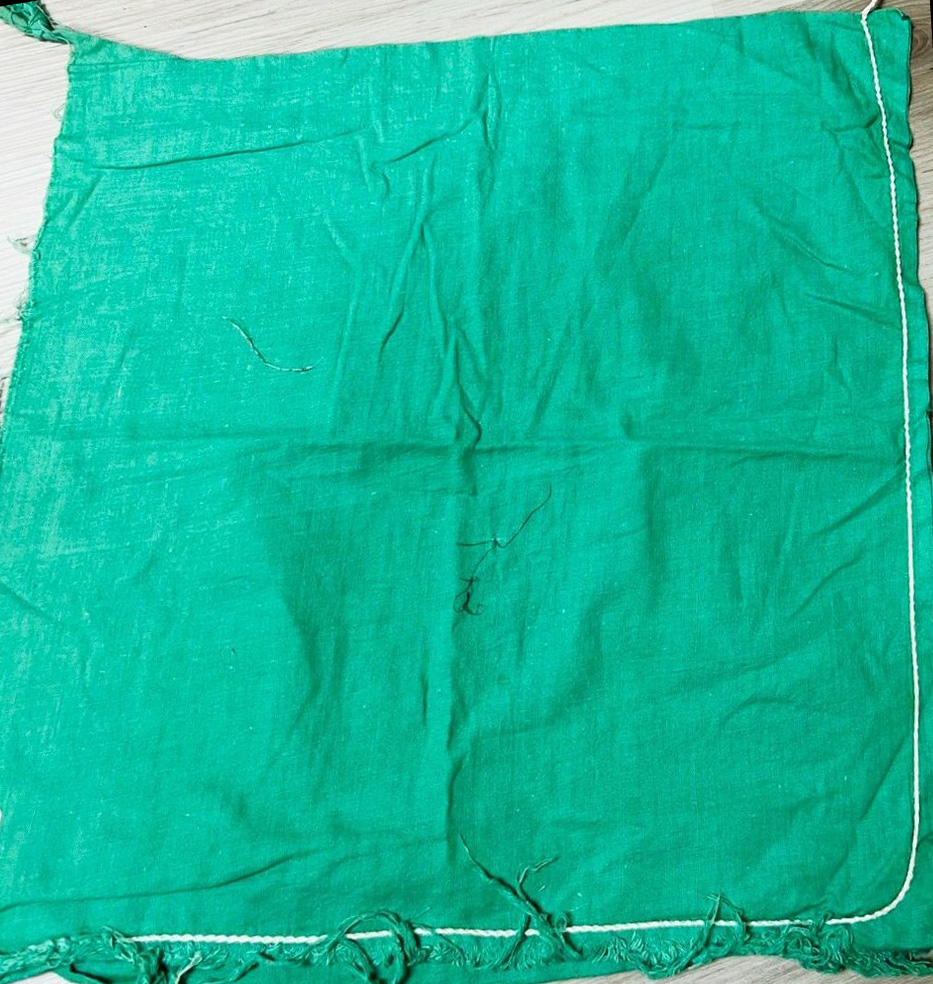
It occurred to him that sacking dyed in the new pastel colors would be appealing. These new dyes were a 1930s innovation in themselves, pale colors that didn't wash out.
Peek's  Good Idea
One of the very popular new colors was this light blue-green called Nile Green at the time.

During the Great Depression in the mid-1930s the latest cotton technology was color-fast pastel solids. It took a few more years for the dyes and dyeing technology to develop to the point that allowed textile mills to print bright, colorfast figures on yardage---the "dress prints" we associate with "feedsack."

Many people who love feedsack prints and their related style of mid-century dress prints are sure the Peeks and Percy Kent were printing florals and small-scale figures in 1936 during the Great Depression. What's more: their grandmothers told them they had to wear underwear made of feedsacks because money was so scarce in the 1930s.

Satire ala Minnie Pearl....


And indeed those girls (and boys) probably did have to wear rather embarrassing undergarments but NOT recycled from dress-print sacks until after 1938. Frugal mothers for several generations had recycled white sacks (some home-dyed with packaged dyes.) After 1937 they might have used pastel commercially-dyed sacks.

Events took a technological turn about 1939.

1939 Altadena, California

The girls are wearing dresses they have made of dress-print sacking. Pretty impressive
for 7th graders.

From the Altadena Historical Society

When you study reliably dated information about recycling dress-print sacks
you find this fashion fad occurred after 1938, more a result of World War II
 fabric shortages than Depression poverty.

Earliest ad so far I've found for "Dres-Print Sax", Coshocton, Ohio, July 1939

September 1, 1939---WW2 commences

The U.S. did not enter the war until 1941 but support for Allies meant channeling fabric and textiles to overseas war efforts. The luxury of inexpensive, varied, fashionable prints became a memory in the 1940s.

More about Richard Peek's good idea:

A few of Gloria Nixon's collection of  Percy Kent bags.
There were supposedly 11 different colorways.



March, 1937 ad in the Kansas City Star

The pastel flour containers they called Tint-Sax were a profitable innovation at Percy Kent in Kansas City. In the ad above the Staley Mills are selling scraps from the bags as luncheon napkins.

Something home stitchers made too in recycling the solid pastels.

Embroidered cocktail napkins. 

Early ad for "flour sack, all colors" October, 1938, Kerrville, Texas.
Penney's was apparently selling clean, empty, colored, plain sacks.

Percy Kent's customer was not the housewife. It was the flour or feed mill like Staley. The bag manufacturer's target audience was commodity companies that used textile packaging---flour mills, sugar packagers, feed processors, fertilizer packers.

The "You" here is not the housewife but the flour mill owner.
Percy Kent advertised widely in mill trade periodicals; this ad with a striped
print sack from the 1940s or '50s.

Collection of the Johnson County (Kansas) Museum
Staley feed sacks in dress prints, probably manufactured by Percy Kent.

One of Percy Kent's biggest customers was Staley Milling Company of St. Louis and Kansas City. Staley packaged their many animal feeds in Percy Kent dress-print sacking.

Staley specialized in hog feed. Pig Mama was a brand name.
Marketing you might not have imagined: Pig trading cards from Staley.

Sunday, April 17, 2022

Which Harriet Dishong?

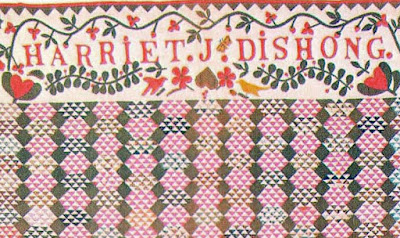
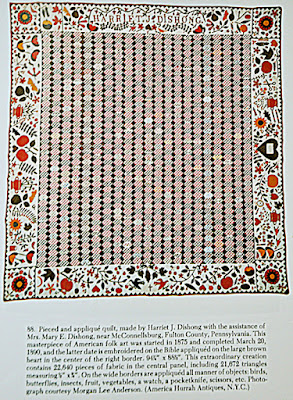
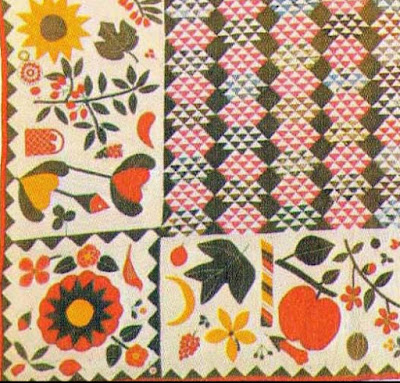
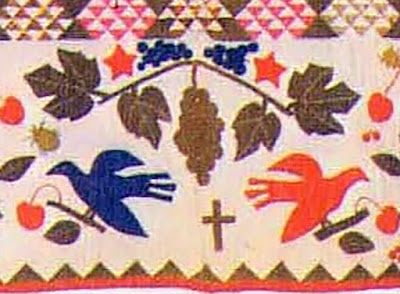
Harriet J. Dishong created a most extraordinary Ocean Waves quilt,
pictured many years ago in a Quilt Engagement Calendar when
it was in the inventory of the New York shop America Hurrah.


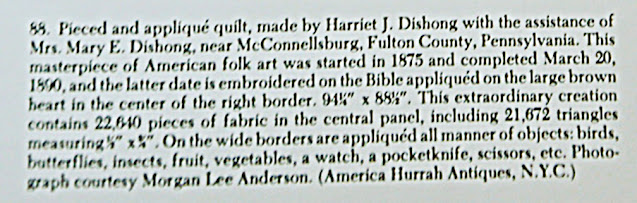
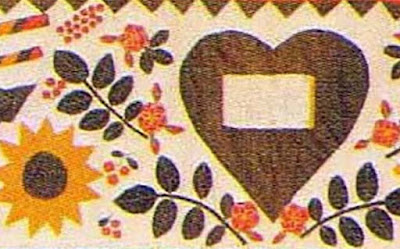
From the caption we learn it was made by Harriet J. Dishong (whose name is at the top) with help from sister Mrs. Mary E. Dishong in Fulton County, Pennsylvania. It is dated March 20, 1890 in a Bible pictured in a heart in the border.


Someone counted 21,672 triangles in the Ocean Wave blocks, each
1/2" x 3/4". It's about 88" wide by 95" long. The quilt was begun in 1875
according to captions.

I had looked around for more about Harriet and Mary but my files were rather confusing. With more available on the internet now perhaps I could tell you more about the Dishongs.

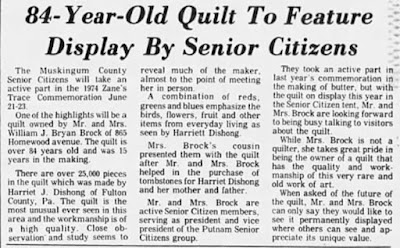
I did find a mention of the quilt when it was still in the
hands of the extended family in Zanesville, Ohio in 1974.
Mrs. William J. Bryan Brock was given the quilt by a cousin.


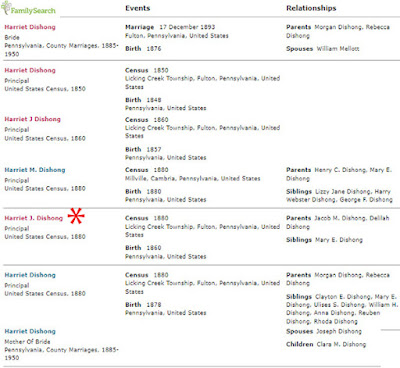
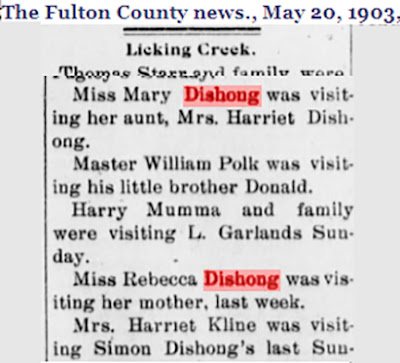
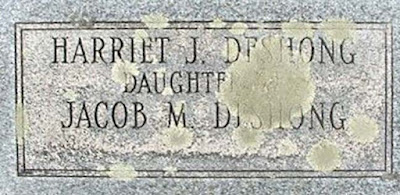
Unfortunately there are several Harriet Dishongs (DeShong) in Fulton County.


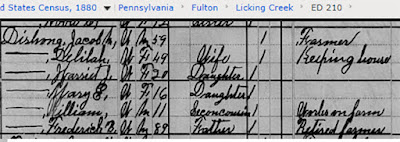
My favorite candidate is the Harriet J. Dishong born 1860 to Delilah & Jacob Dishong who has one sister, Miss Mary E. Dishong. Harriet would have been about 15 when the quilt was begun; 30 when finished. Mary was about 4 years younger.

The 1880 census shows both young women living at home on the farm.


Harriet was a very popular name in 19th-c-America, as was Mary. Mary actually married a man named John Dishong so she is Mary Dishong Dishong. She died in 1916. Harriet lost both her mother and her sister that year.


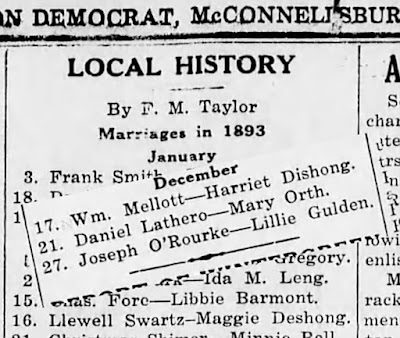
In 1893 a 17-year-old Harriet Dishong married William Mellott
but that's not her, too young. Harriet J. never married.


Harriet J. Dishong (Deshong) lived until 1920. Born in 1840 she was 80 when she died, but few records of 19th-century women's ages were accurate. And spelling was rather free-form. She was described as "the last surviving member" of her family, although Mary had two boys who lived into the late 20th century.

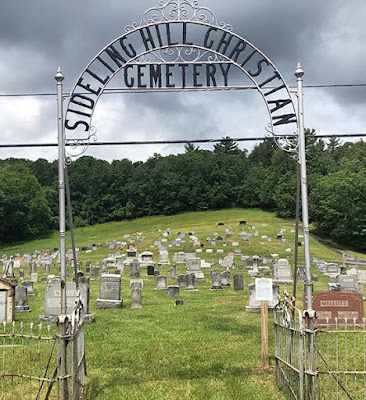
She and Mary are buried in the Sideling Hill Christian Church Cemetery in Sipes Mill, Fulton County.


I was going to write about the Dishongs' experiences in the Civil War, but I realized I had already written about the Daihls in neighboring Franklin County. Their war must have been similar. See a post here:

Wednesday, April 13, 2022

Accuquilt's Goose Tracks Die


A familiar pattern

Quite popular with quilters and pattern companies.


Accuquilt asked me to talk about their cutting die for Goose Tracks yesterday.


Block dated 1900
Goose Tracks was published as a name for the nine-patch by the
Ladies' Art Company in the 1890s. 

That St. Louis pattern company often copied designs from other periodicals.

Maybe redrafting this one from the Hearth & Home group
of magazines, gathered in a catalog under the name of Clara Stone.

Accuquilt asked me to do a few minutes of quilt pattern history to celebrate the return of the Goose Tracks die. My first question: How Old Is The Pattern? It seems like a classic going back to the mid-19th century when quilters were exploring new ideas in geometry, the kind of pattern that got handed around before commercial companies began selling and naming patterns.

The National Museum of American History has
an example that the family thought made 1850-1875.
I doubt it's that old though. Fabrics & set style look post 1880.

Goose Tracks, fabrics look to date from 1900-1925.

When I looked at quilts and blocks that actually had dates on them and examined the fabrics in the many quilts I'd seen I was surprised to find that the design is not one of those mid-century classics.

The oldest I've found with a date actually on it:
1889

Aunt Amy's Sampler, Mary Etherington's Country Threads
A sampler dated 1898 with the block along the right edge in the center.

Apparently the design is not something passed around in the folk tradition
quilter to quilter, but a product of the commercial pattern network that developed
in the 1880s.

Popular from about 1890 till today.

So if you have always wanted to make one but have been a bit put off
by those tricky parallelograms in the corners the die cut pattern pieces
are the perfect solution.


Then all you have to do is decide on color and set.


The pattern certainly caught on.

From the late Laura Fisher's inventory.

About 1900 in a zig-zag set


They'll show you many design possibilities here: