QUILTS & FABRIC: PAST & PRESENT


Wednesday, October 6, 2021

1893 World's Columbian Exposition #4: Martha Erskine Ricks's Coffee Tree Quilt


 Agricultural states indulged in a fashion
for constructing elaborate displays of
 corn and fruit for the 1893 Chicago Fair.

Monumental sculpture of dried prunes

We have found, as noted in recent posts, few published mentions of quilts displayed at the 1893 Columbian Exposition. Some examples must have been lost in the records of individual state and country displays with their attention to agriculture, manufacturing and commerce.


But here's an exception: Hubert Howe Bancroft in his Book of the Fair gives a sentence to a quilt displayed in Liberia's exhibit in the Agricultural Building. Liberia is an African state founded in the 1820s by American Colonizers who encouraged freed American slaves to move back to Africa.
 
Martha Ann Erskine Ricks (1817?-1901)
Wood engraving from a cabinet card photograph 1892

The mention of the quilt is remarkable as is Martha's story.

Martha Erskine sailed to Liberia with her Tennessee family in the winter of 1830. Father George Erskine had been both a slave and a Presbyterian minister, freed in 1817 by the Tennessee General Assembly. He spent years saving earnings from lecturing and preaching to buy his family and passage to Liberia for wife Hagar, her mother Martha Gains and eight children ranging from 30 to 7 years old. African diseases were too often disaster for American travelers and most of the Erskines soon died of fever, leaving only Martha and brother Hopkins Erskine to survive into adulthood.


Biography of Martha's family by Nemata Amelia Ibitayo Blyden
 from her 2019 book African-Americans and Africa

Library of Congress
Brother Hopkins W. Erskine (1820-) photographed in
 1866 while on a U.S. recruiting trip for Liberian immigration.
Hopkins became a Presbyterian minister like his father and was active
in Liberian politics.

Library of Congress
Watercolor of the Liberian Senate in the 1850s by 
Robert K. Griffin

According to the University of Virginia, Martha emigrated with husband Zion or Sion Harris (1811-1854), also an emancipated Tennessean. He is listed as a passenger with the family arriving on the Brig Liberia in the capitol Monrovia on February 17, 1830.

After he was killed by a lightning strike she married Henry Ricks. They farmed in Clay-Ashland along the Atlantic coast, a town named for Senator Henry Clay. Henry Ricks's brother, coffee planter Moses U. Ricks of Clay-Ashland is remembered today for his financial gift to establish the Baptist Zodokai Mission school, now known as the Ricks Institute. The Rickses seem to have been prosperous farmers.

Martha Ricks portrait from the University of Virginia.
Two photos of Martha show elegant clothing with
hand-stitched detail, her own work?

Martha's story is persistently tied with her Coffee Tree quilt and the tale that she had a great desire to meet Queen Victoria and how she presented the Queen with the quilt in the summer of 1892, the first we hear of it. 


Martha told a reporter for the Pall Mall Gazette about the quilt in July, 1892.

Newspaper articles sentimentalize her goal, telling us she was subject to ridicule in Clay Ashland and saved her pennies to get to England and achieve that goal. 


The Gazette reporter committed many egregious sins including bigotry and a complete misunderstanding of Martha and her life in Liberia, type casting her as a primitive. Of course, that is what his London readers wanted to read. Accuracy was not a priority.

Liberians at a picnic lunch in the "wilds of Africa," 1890s at a 
missionary school from David A Day Scrapbook
William L.Clements Library, University of Michigan

Rather than a primitive Martha seems rather skillful in the ways of diplomacy and publicity, enlisting the Liberian Minister Edward Wilmot Blyden to obtain an audience with the Royal Family. In London she stayed with Jane Rose Waring Roberts, widow of Liberia's first Black president Joseph Jenkins Roberts. Jane, born a Virginian, settled in London after her husband's death in 1876.

Jane Rose Waring Roberts 1819-1914
From Harry Johnston's Liberia, 1906

Daily Graphic
The Queen and Martha. (I've been told never to try to shake
hands with the Queen---advice I hope to need someday.)
But the reporter told us the Queen shook hands with Martha.

We learn she met with several members of the Royal Family in July, 1892 and they invited her over to the palace (her "house") for a meal. (Unlikely.)  In her journals Queen Victoria did mention meeting Martha, describing her as short (they may have seen eye-to-eye, a novelty for the Queen who was under 5 foot tall) "Very black with a kind face." No mention of quilt or tea.

Martha at 75
Cabinet card photo in the collection of Britain's
 National Portrait Gallery
This portrait, a commercial photo, does not seem to 
reflect a naïve old lady from the backcounty. These
cards of a celebrity were sold.

Daily Graphic, July 23, 1892, page 110

Historian Jan Marsh speculates that the public relations blitz may have been "assisted by the equivalent of the Palace's press department, as the Graphic newspaper was allowed to send illustrator Reginald Cleaver to record the event, his image of the Court looking on as Ricks and Victoria shook hands being printed on the front page of the Daily Graphic." Or it may have been the Liberian minister doing his job and calling attention to his country.

Queen Victoria, quite a needlewoman herself, received many quilts as gifts with their whereabouts generally unknown. The Ricks/Victoria gift is lost. We know what the quilt looked like (if  newspaper accounts are accurate) as Martha described it to the Gazette reporter. It was satin (silk or cotton we don't know), appliqued with a coffee tree and red and green berries. The border was passion flowers. A man was depicted gathering the beans.

Library of Congress
Liberian Coffee Trees in the 1890s
The Ricks made their living in coffee.


Celeste-Marie Bernier found a similar description in the Youth's Companion telling us that the green coffee bush was being harvested by a green man.

Did the palace send Martha's quilt back to Liberia to be included in the Chicago Fair exhibit the following spring? Or was that display a copy Martha made of the royal gift?

Coffee tree quilt at the 1895 Cotton States Exhibition in Atlanta

She apparently made two quilts and the second one was photographed. This copy of the Queen's gift was acquired by Henry McNeal Turner, a Methodist missionary who visited Liberia in 1891, 1893 and 1895. It's thought this second quilt was a gift for Turner.
 
Henry McNeal Turner (1834-1915) in 1900, New York Public Library
A Georgia resident, he was a bishop in the AME church.

In 1895 Turner organized a display of his Liberian artifacts for the Atlanta exposition, The Cotton States Exhibition, which commissioned a separate Negro Building to show the work of Africans and African-Americans.


In 1896 the B.W. Kilburn Company published a series of stereocard photos taken at the Atlanta expo,
including several of the exhibits by Africans and African-Americans. The photo below from the Library of Congress collection looks like Turner's Liberian display.
 
Unknown man sitting before a textile with a sign. 
"Uncivilized African Exhibits.
Hands Off"

The sign is rather distasteful (we can't change 1890's culture 130 years later) but maybe Turner was indulging in irony. This must be Martha Ricks's Coffee Tree quilt #2, but I don't see the figure of the man picking the coffee beans so she may have modified the design on the second piece.

We can guess that the second quilt was also the one shown in the Liberian exhibit at the 1893 Chicago World's Fair, probably loaned by Bishop Turner.

Quilters in Caldwell, Liberia have interpreted Martha's Coffee Tree Quilt


Martha's intriguing quilt and the heart-warming story of a needlewoman determined to meet Queen Victoria has been told many times. I first read it in an article by Cuesta Benberry in Quilters' Newsletter magazine in 1987.


Kyra E. Hicks has made it widely available in her children's book Martha Ann's Quilt for Queen Victoria. Read more of Kyra's writing about Martha here:

In 2017 the BBC World Service broadcast a radio documentary about Martha Ricks.

A few other references:
Nemata Amelia Ibitayo Blyden, African Americans & Africa: A New History. She's also written about Martha's niece Anna Erskine.

Celeste-Marie Bernier, Stick to the Skin: African American and Black British Art, 2019

Catherine Higgs, Barbara A. Moss, Earline Rae Ferguson, Stepping Forward: Black Women in Africa and the Americas 
https://www.google.com/books/edition/Stepping_Forward/Dd00m5JrFhMC?hl=en&gbpv=1&bsq=erskine

And here's the 1830 list of Liberian emigrants mentioning the Erskine family:
http://ccharity.com/contents/roll-emigrants-have-been-sent-colony-liberia-western-africa/emigrants-to-liberia-ship-lists/brigliberia1830/
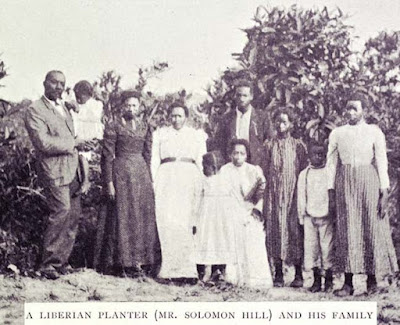
Martha's peers in Liberia from a 1906 book on the country

Tomorrow: A quilt style inspired by the Fair.

Tuesday, October 5, 2021

1893 World's Columbian Exposition: #3 The Columbian Celebration Quilt


Anna Lee Merritt, sketch for a tribute to needlework mural
for the Women's Building at the 1893 Fair (mural now lost.)
Everything for the temporary exhibits was rather transitory.

Looking through records and accounts of the 1893 fair we see mention of intriguing needlework items--- among them something that sounds spectacular: The 'Columbian Celebration Quilt'

In the center an "American shield:  I can just imagine it.

 ...13 stars and spreading palm branches with...

The American Eagle

Appliqued eagle from the Fennimore Museum in New York

... bordered by strips featuring the the arms of Illinois (the state seal)...

(More eagles)

... and that of Spain" 


Bordered with corn plants....(?)

Laura Fisher Quilts
A pot of green corn?
... and cotton and stars.

A cotton boll

An extravaganza of applique (or is it embroidery?) 

The description above is from a London paper in March, 1893, which terms the corn "maize" (corn in England means wheat, rather confusing to us Americans.)

Imaginary the appliqued Columbian Celebration quilt will have to remain because it really isn't a quilt. Like maize/corn there is a translation problem. The New York Times explained it:

"Included is a spread, or quilt as it is called over there, which
is called the Columbian celebration quilt."

Oh, it's a bedspread. 

And here it is, a woven cotton spread from Barlow & Jones of Manchester, England
a cotton mill that processed cotton from spinning yarn to finished products.

(Toilet covers are not what they seem either.)

The centre---palm fronds. Cornstalks and cotton bolls in
the first border.

The photo of the "quilt" is from this fair souvenir book.

Which also showed The Empire Quilt, a companion piece.

Manufacturers like cotton mills designed impressive exhibits for
the international and national expositions, hoping to win medals
that could be used in advertising.. 

Well, that Columbian bedspread could provide inspiration for an appliquéd medallion.

What looks to be a souvenir bedspread

Tomorrow: A fair display of a quilt by an American-born Liberian.


Monday, October 4, 2021

1893 Columbian Exposition: Quilts #2: A 16th-Century Quilt


Crazy Quilt in the Illinois State Museum collection.

For Episode #6 of our Six Know-It-Alls: Six Quilts last August Merikay Waldvogel showed us a pretty fabulous crazy quilt with connections to the 1893 World's Fair in Chicago, the World's Columbian Exposition, celebrating Columbus during a time when empires were to be celebrated.

The Episode: https://vimeo.com/ondemand/bedrugstocrazyquilts

This prompted me to look at my files of quilts shown at that fair--- a confusing bunch of information, much of which is questionable as you will see over the next few days. One story tells of a quilt displayed there allegedly made by Mary Queen of Scots who died in 1587--- a 16th-century quilt in the possession of John Bidlake who lived in Osnabrock, North Dakota. It was shown in the North Dakota building.


 I've found no pictures but above is a description from a souvenir publication describing an embroidered piece (a quilt in British terminology might not be quite what Americans would describe) done in silk thread on red, black and green silk, apparently embroidered portrait faces.

Panel from the Oxburgh Hangings,
Mary Queen of Scots and Elizabeth Talbot, Countess of Shrewsbury
 Museum no. T.33AA-1955.
© Victoria and Albert Museum, London

Marie Webster's 1915 book Quilts is one source for information about the Queen's needlework

"Mary, Queen of Scots, was devoted to the needle and was expert in its use. It is said that while in France she learned lace making and embroidery. Many wall hangings, bed draperies, bedcovers, and house linens are the work of her skillful fingers, or were made under her personal direction. A number of examples of her work are now owned by the Duke of Devonshire....As a solace during long days of loneliness, Queen Mary found consolation in her needle, as [Pg 41]have many women of lower degree before and since her unhappy time....The Earl of Shrewsbury was her custodian, and his wife, the countess, often sat and sewed with the unfortunate queen, both making pastime of their needlework."
The description of the needlework above sounds reasonable for Mary's time and Bidlake was born in England. We do know the Queen embroidered in her imprisonment. The Victoria & Albert Museum owns several of her embroideries, which appear to be slips, small pieces then attached to larger textiles.


Slip attributed to Mary, "A CAT"
© Victoria and Albert Museum, London

Another description of the Queen's quilt from the Irish Standard Times of Minneapolis describes a faded yellow floral quilt (no portraits mentioned) with blooming roses.


In this summer, 1893 article the quilt's owner was given as Senator Bidlake's mother, an English immigrant. (Bidlake was for two years a South Dakota state senator.) The quilt was said to have been handed down to the eldest daughter of each generation. The 1900 census from Minneapolis tells us the next owner would be Helen Harriett Bidlake, born in 1886 and about 7 during the fair. 

We learn the piece was displayed in a case in the North Dakota state building
with contemporary needlework from North Dakota citizens.

From Shepp's World's Fair Photographed

Here's something we'd like to know more about: "In one of the glass cases is a beautiful silk...[quilt] the work of the Indian children" at the Standing Rock Reservation.


What ever happened to the Bidlake's family textile with its royal attribution? And how reliable an authority was John Bidlake? I couldn't find out much about him but what I did does not inspire faith in the family tale.


First of all Bidlake had a huge financial interest in that fair,
managing the concessions in the mile-long Midway, a carnival strip.

Bidlake's Midway with Ferris's innovative wheel ride.
Using a family textile as a draw to fair exhibits would
have paid off for Bidlake.

Second, he doesn't seem to have been a model of integrity.

The Bidlake family of Hereford, England--- Harriet Sarah Rhind (1829-1906), husband Henry Bidlake, three sons including John (1858-1917), W. Henry (1865-1923) and a daughter Mary Cecelia--- moved to Canada where the father and one son died. They then moved to North Dakota in 1881 and the boys  married sisters (?) Helen and Margaret Fleming while Mary Cecelia married William Fleming. They were all in the hardware business in Osnabrock in the '80s. John was elected state senator from South Dakota (real residency apparently not required.) He lost re-election in 1889 and then we find him in big business at the Columbian Exposition.

After the fair (we assume he made a good amount of money on the Midway) Grover Cleveland's administration appointed him counsel to Barranquilla, Colombia, a port on the Caribbean where John & Helen relocated. Helen became ill and they returned to Osnabrock. While John was on a ship back to Barranquila Helen died at 40 in 1901.


In South America he fell for 16-year-old Maria Gutierrez. They married and lived in New York City where he was active in "financial circles" until the Panic of 1907 when after losing all his money (and probably other's too) he again left for South America.

1907

In 1914 Maria Bidlake filed for divorce alleging he'd deserted her and daughter Lolita and was living with a woman named Mercedes in South America. After leaving the Consul position in Colombia he obtained the exclusive rights to asphalt mining there and remained until his death in 1917. Lolita and presumably her mother moved to Los Angeles.

Osnabrock about the time the Colonel left for good.

If John held on to the "Mary Queen of Scots quilt" it's unlikely to have survived those domestic debacles with its story intact. But it may have continued in his mother's possession. Harriett Rhind Bidlake moved to Seattle with son Henry and his family where she died in 1906. 

Marriage Record
Family Search

Then again John's daughter Helen Harriett Bidlake may have kept the quilt. She married Roberto  Murphy y Morgan in Mexico City in 1908. They also wound up in Seattle. The 1940 census found a divorced Helen Murphy and her daughter another Helen, born in 1915, in Seattle.


Another possible line of descent is John's sister Mary Cecelia Bidlake Fleming. She was indeed the eldest daughter of Harriett Rhind Bidlake, but aside from her marriage to William Fleming in Osnabrock I don't see much mention of her. 

And speaking of mention---not one word about that quilt or its connection to Mary Queen of Scots after the 1893 Fair. Was it all fair publicity? And yet.... it's a textile one might keep an eye out for in Osnabrock, North Dakota and Seattle, Washington.

Some helpful Findagrave pages:
Tomorrow: A "Columbian Celebration Quilt"

Sunday, October 3, 2021

1893 Columbian Exhibition #1: Crazy Quilts


Pillow dated 1893 by Mrs. A Sickafoose, Lyons, Iowa
from the Joyce Gross collection at the Dolph Briscoe Center, University of Texas

As I recall seeing this in Joyce's collection years ago, the pillow came in a wooden box addressed to Mrs. Sickafoose with a ribbon or award of some kind from the 1893 World's Columbian Exposition.


Lyons is a town on the Mississippi River, part of Clinton, Iowa. The maker there may be Mrs. Albert Sickafoose, Catherine, 35 in the 1895 Iowa Census.

Chicago held a huge international exhibition in 1893 on Lake Michigan.

The List
See the article here at the Quilt Index:

I listed the pillow as one of seven quilts reputed to have been shown at the 1893 expo in an article I wrote 40 years ago for Uncoverings 1981, the papers of the American Quilt Study Group, the first research I published on quilts shown at World's Fairs. Merikay Waldvogel and I followed that up with a book Patchwork Souvenirs of the 1933 World's Fair. The quilts at the later exposition were better documented and I gave up on looking for 1893 quilts because there was so little reliable information. 

Illinois Historical Society 

Merikay reminded me of the 1893 fair in a recent episode of our Six Know It Alls, showing this
one that certainly has some association with the fair. We found out quite a bit about it and determined
it was not shown there but finished after the event.

What else could I find out about quilts at the Columbian Exposition now that I had old newspapers, genealogy and digital collections files at my fingertips? I thought I'd post all week on topic.

Emma Green Bull's crazy quilt in the collection of the Utah
Historical Society came with the story that it was exhibited at the 1893
Columbian Exposition in Chicago.

It's currently on display in Salt Lake City

Emma Green Bull (1828-1895)
from the Utah Historical Quarterly

Emma Green was born in England and emigrated to Salt Lake City, Utah after her conversion to Mormonism. There she married Joseph Bull, a printer, in October, 1858. They had at least two sons Joseph II and Daniel.

1880 Census
The Bulls were prosperous it would seem. The 1880 census finds them living adjacent to son Joseph
also in the printing trade.
 
Emma at top left with Joseph and unnamed women.
Family Search

History of Salt Lake City

"She was...the pioneer professional dress maker of the city."

As is often the case, the impressive quilt was made by a woman in the fabric business---in this case a well-respected dressmaker.

Statue of Brigham Young outside the Utah Building in Chicago
with a delegation from the state. The building was funded by women's groups.

How reliable is the story that Emma's quilt went to the fair? We can find no confirmation, a typical follow-up to most quilt stories from that fair. For Emma's the 1894 publication Utah at the World's Columbia Exposition mentions no quilts but we might guess that the Utah exhibit in its own building in Chicago included her quilt (and others,) items not valued enough to mention. 

Demonstrating weaving inside the Utah building.


In 1894 the same Utah-themed crazy quilt may be the item that won Emma a special prize, a gold medal at the Utah State Fair. It would be easy for a family story to confuse a state fair medal with a prize at an international exhibition. Perhaps the crazy quilt never saw the world's fair.

See a short article on the symbolism in Emma's quilt:
Paste this into your browser:

https://wchsutah.org/documents/utah-historical-quarterlies-v86n4.pdf

Crazy quilts were at the height of their popularity in the early 1890s so we should not be surprised to find them associated with the fair as exemplars of the excellence and refinement of women's work, although not everyone agreed:


A transcription of a later meeting about art exhibits includes this critique by a Mrs. Wolcott (probably Henrietta L. T Wolcott of Massachusetts) who thought there were entirely too many crazy quilts shown at the Columbian Exposition---evidence that several must have been shown.

Familiar enough to become a metaphor in the Holton, Kansas
Tribune in 1894.

Crazy quilts were shown but not mentioned in the records--- a puzzle for the quilt historian. More tomorrow on a quilt attributed to Mary Queen of Scots at the Fair.