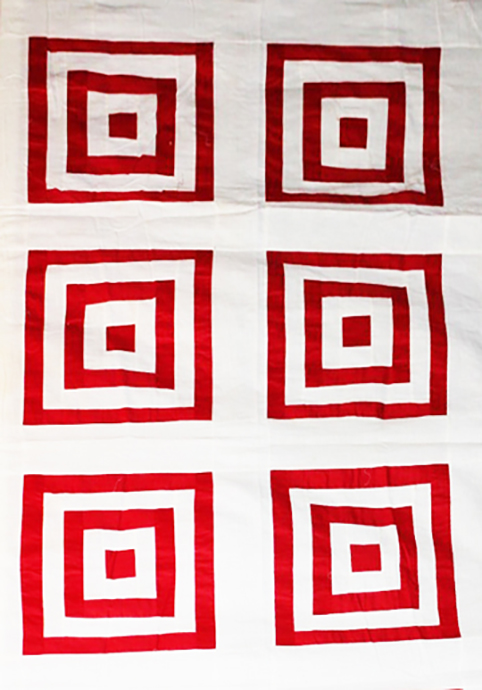
https://www.thehenryford.org/collections-and-research/digital-collections/search-results#advancedSearch=1&tab=artifact-results&s.0.in=keywords&s.0.for=Mitchell,%20Jane%20Whitehead&years=0-0&perPage=10&pageNum=1&sortBy=relevance
My experience with fabrics that early is pretty limited but I was inspired to organize my links to a valuable digital resource--- a group of late-18th-century swatchbooks in four American museums: Colonial Williamsburg, Winterthur, Metropolitan Museum of Art and the Cooper Hewitt. 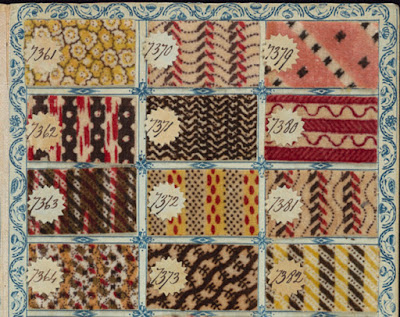
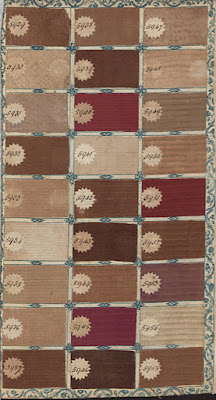
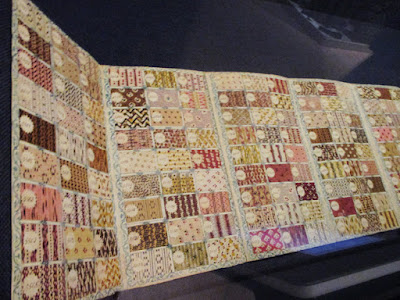
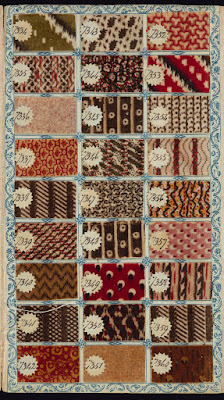
The Cooper-Hewitt/Smithsonian owns a bound book of many pages, some solid color and textured but several pages of prints. It's dated 1784.
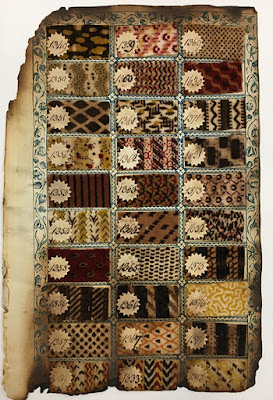

These documents are rather distinctive not only because they are dated in the 1780s but also the page design of a blue vines links them. The mill might have ordered blank books printed and bound and then glued in swatches as they produced them, each with a four or five digit number.

The Winterthur's book dated 1783 is full of textured
and plain weave solid cottons---no prints.

A few years ago Colonial Williamsburg displayed their fold-out dated 1783.


As is the Metropolitan Museum of Art's, which looks to have been damaged in a fire.


I wouldn't be surprised if the pockets were as early as the 1780s and I also wouldn't be surprised to find out the maker had access to a similar swatch book and ripped out a few samples.

 Colonial Williamsburg's 1783 page includes florals with dotted grounds, rather clumsily used, but it
isn't until printers figured out metal engraving techniques in the early 19th century that these fancy grounds became more graceful.

Putting together the information from all four museums we can draw a few conclusions about who issued the samples.

The Cooper-Hewitt's book has no information about the mill or the agent that was the source.


But both the Winterthur and Colonial Williamsburg identify the source as Thomas Smith of Manchester England.


The Metropolitan Museum of Art's damaged book acquired in 1985 still has an inscription though: 

I have not been able to find out much about Thomas Smith of Manchester. The source may have been a cotton mill or an agent---a sales rep.
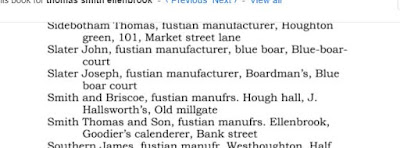
Thomas Smith and Son are listed as fustian manufacturers (linen/cotton combination fabrics) in Ellenbrook about ten miles west of Manchester.

A list of Calico Printers in the late teens---25 years or so after the books' dates---includes Thomas Smith of Cannon Street in the town of Colne, 35 miles north of Manchester.

These may be the same Smiths---it's a common name. Other Smiths in the English textile business included Benjamin and Joseph. Joseph had a nephew named Thomas Smith, born in 1799, born after these sample books, but he may be linked to the right Smith family as his biography at a Christie's auction indicates.


The initials might indicate rather that JHM was Jane Hewlett Mitchell (1769-1794) of Long Island which further dates them to before 1820.

One can imagine that the small bit of clothing belonging to a mourned 24-year-old mother might be saved for generations.

Detail of a pocket
A few squares in the pockets are also quite distinctive, particularly the stripes. I found similar inventive stripes in these swatch books dated 1783 and 1784.

A square from the pockets with stripes of circular shapes laid atop a book
dated 1783 in the Colonial Williamsburg collections. All the fabrics
are block printed, I assume.

Dyes include many madder reds and browns with some
mustardy yellows that may be from quercitron dye.

Two striped squares from the pockets and two pages from
the Cooper-Hewitt's 1784 book. Striped calicoes seem to
have been the fashion.
I wouldn't be surprised if the pockets were as early as the 1780s and I also wouldn't be surprised to find out the maker had access to a similar swatch book and ripped out a few samples.

The pockets also include scraps of some floral trail prints.
Note the two along the top here that have a background
of small dots.

isn't until printers figured out metal engraving techniques in the early 19th century that these fancy grounds became more graceful.

The Cooper-Hewitt's bound book is dated 1784
and inscribed Ex F or H B---
Perhaps a member of the Bridgham family who
had something to do with the donation in 1950.


The same signature on both books.

Samuel Greg or Grey, Manchester, 14th August 1784.


Two dates, same handwriting.
Was it a mill?

A 1781 Manchester directory
Thomas Smith and Son are listed as fustian manufacturers (linen/cotton combination fabrics) in Ellenbrook about ten miles west of Manchester.


Colne
"He spent a large part of each year between 1819 and 1827 in the United States, based primarily in Charleston, the main cotton exporting port, and occasionally in New York, buying cotton and extending the business which dealt largely in the long fibre cotton of the Carolina Sea Islands. Returning to England he left Joseph Smith & Bros. joining a new firm, Benjamin Smith & Sons, which had offices in Liverpool. He continued in the Lancashire cotton business, the 'pace making industry of the Industrial Revolution', until his retirement in 1850."
Read more about his American travels:
And what about Samuel Greg? The cataloguer at the Met read his last name as Grey but the owner of one of Britain's largest textile mills was Samuel Greg.

Samuel Greg (1758-1834), ivory miniature
in the collection of the National Trust
His Quarry Bank Mill in Styall, Cheshire opened in 1783,
is now a museum.
Perhaps the fabric came from Quarry Bank and Thomas Smith was an agent. All very mysterious.


A look at these samples has helped us with the date on the pair of pockets at the top of the page. the original cataloguing gave an estimated date of "circa 1820" but I'd guess 1780-1800 as a twenty year span.

Each of the pair has cross-stitched initials
J h M. The catalog indicates they belonged to
Jane Whitehead Mitchell.
The initials might indicate rather that JHM was Jane Hewlett Mitchell (1769-1794) of Long Island which further dates them to before 1820.

"Jane, wife of William Mitchell & daughter of George & Susan Hewlett,
d. 23 Mar 1794, age 24 yrs, 10 mos, 11 dys."
See the swatch book pages at the four museums at these links:
Colonial Williamsburg:
Cooper-Hewitt
Metropolitan
Winterthur
Larsdatter has compiled a useful list of links to 18th-century sample books.
More Miscellanea:
The Gregs at Quarry Bank Mill are the subject of several dramas and documentaries:

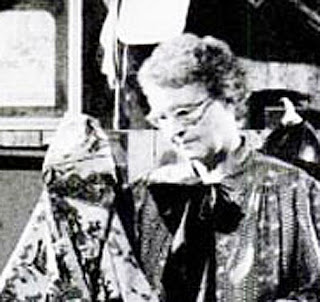
Grace Hartshorn Westerfield (1885-1974)
The donor of Colonial Williamsburg's sample book was collector Grace Hartshorn Westerfield. See a post on her here:
And the donor of the Cooper-Hewitt's in 1950 was Mrs. Samuel W. Bridgham (or maybe she donated the money to buy it.) The book may have been in her husband's family.

I have a quilt from the 1860s that once belonged to a Samuel W. Bridgham with a connection to the Cooper-Hewitt. I'll have to pursue this link.
Here's a post on that Samuel W.B.