QUILTS & FABRIC: PAST & PRESENT


Thursday, February 14, 2019

Friendship Knot of Mystery

An interesting if miscellaneous quilt pattern.
This top from an online auction.

Here's the block.
Diamonds with a wedding ring like curve.

It's a variation of this one.

BlockBase #4047

A complex repeat (and complex piecing)

BlockBase tells me the pattern was published under two
different names in the mid-20th century.
Friendship Knot from the Laura Wheeler/Alice Brooks syndicate
and Friendship Wreath from Lockport Batting.

From Mary Koval's inventory

Despite the complexity many stitchers tackled it.

Project & the Quilt Index.

The block forms half a star with 4 diamonds. The lower
star points extend into wedding ring curves---4 pieces per durve.

Probably inspired by the Hands All Around antique
that Ruth Finley showed in her 1929 book.

Hands All Around variation
 BlockBase #4044 from the Arizona Project & the Quilt Index.
See a post about the older design #4044 here:

I'd say the version at the top of the page was someone's individual drawing
(3 shapes per arc; 2 diamonds instead of 4)

Except I have more photos of the variation with 2 diamonds than the Laura Wheeler design

I'm going to have to number this one BlockBase #4047.5

Jesse Earl Childers from the West Virginia
Project & the Quilt Index.

Again from the West Virginia project.

My BlockBase drawing for #4047 isn't that accurate so I am not going to give you a pattern.
But there are plenty of patterns for the design with 4 diamonds out there on the internet.

From a Field Guide to Quilts

Mary Holmes Fisk, St. Lawrence County, NY
The mystery design---
Has anyone ever seen it published before 1970.
It must have been!

Monday, February 11, 2019

Charleston Chintz: Cheetah Patterned Vase

Album chintz quilt with names 
from the Selye  & Burgess families in Charleston

Glorian Sipman and I have been collecting photos of quilts with this cheetah-patterned vase. Above: detail of a chintz album in her collection with dates 1850-1859.

Between us we've found five examples and they are all from Charleston, South Carolina.Four are in date-inscribed quilts from 1848-1859---relatively late for chintz applique.

The best picture of the print is probably in the Susan Ladson McPherson chintz applique quilt in the National Museum of American History. 

See the whole quilt here:

Quilt attributed to Mary Lucy Sandiford Barnes, 1854
Charleston Museum Collection

The vase in this album quilt has a bouquet of four large flowers and some blue leaves (the yellow overdye may have disappeared OR they were always blue rather than green?)


I've been unable to find records of a Susan Ladson McPherson or
Mary Lucy Sandiford Barnes in Charleston.

Detail, a quilt block from an album from the family of Mary V. Yeadon,
Dated 1848-1849, Charleston & Greenville.
International Quilt Study Center & Museum


The vase in the Yeadon family quilt has a larger bouquet. You can see there are seams parallel to the sides of the vase. The seamstress has stitched a rectangle of white to either side and appliqued more flowers.
See more about Mary Marion Yeadon here:
https://civilwarquilts.blogspot.com/2018/09/marion-family-quilts-in-carolinas-low.html 

Album dated 1848-1850

A small photo but here's the vase in one of the Carolina quilts
researched by Sharon Pinka for her AQSG paper in Uncoverings 2013,
"Lowcountry Chintz: The Townsend/Pope Quilt Legacy".


UPDATE; A sixth Charleston chintz, this one from the Marion family of the Berkeley County lowcountry dated 1847-1848 in the MESDA collection.
https://mesda.org/item/collections/album-quilt/1209/

The trimmed vase


The block in Glorian's collection also has seams revealing
 a narrow strip with additional flowers added.

I wonder if this strip was not cut from a floral stripe...

Something like this from an English frame quilt.

Collection of the Museum of Fine Arts Boston

These chintzes alternating wide and narrow stripes are typical of a style that has been associated with Portugal, manufactured by the British textile industry in the early-19th century for Portugal and its South American colonies.


 Charleston seems to have enjoyed a good trade in 
English exported cottons not seen in more northern ports.

The stripes often alternated exotic animals, birds or florals with fancy vases and ewers.

Collection of the Victoria and Albert Museum

Three of our five examples have a butterfly floating near the vase, so I am looking for a vase stripe with an alternate stripe of butterflies.

See posts on Portuguese stripes here:
Click on older posts to see the series of seven posts.

I noticed Mary Jenkins at red_alfreda has been working on a chintz
quilt with a reproduction of the cheetah vase.
Here's her Instagram page:

Saturday, February 9, 2019

Stars in Her Crown #6: Louise, Marquise of Lorne

Stars in Her Crown #6: Louise, Marquise of 
Lorne by Denniele Bohannon


Princess Louisa Caroline Alberta (1848-1939) was named for Prince Albert's mother who'd died when he was a child. She's the new baby in season 3 of the PBS series Victoria.

Louise's greeting drawn in her teens in 1863

When Louise was 19 years old the Queen described her to eldest daughter Vicky, writing she "had a wonderful talent for art...She is in some things very clever....but she is very odd, dreadfully contradictory, very indiscreet and from that, making mischief very frequently."


Louise is remembered as the most rebellious of the royal nine and she seems to have been the most successful at thwarting her mother's plans. Louise was permitted to attend the Kensington National Art Training School in 1863. Talented in watercolor painting like her mother and sisters she wanted to be a sculptor (a field that remains unconventional for women.) Her chosen field was stone cutting.


Louise completed this monument to the Queen on the grounds of 
Kensington Palace in 1893. 

Louise's portrait of younger brother Leopold, 1869

Spinning flax

Like her Great-Aunt Sophia the unmarried Louise was rumored to have given birth to a secret child, son of her brother's tutor.

Photograph celebrating Louise's marriage to John Campbell  (1845-1915)

Royal princesses were not supposed to marry their mother's subjects, even aristocrats due to be dukes, but Louise flouted tradition by marrying the very wealthy Scot John Campbell, Marquess of Lorne, in 1871 when she was in her early twenties. They shared an interest in the arts that united them all their lives. Some sources refer to one child, an unnamed son who died on the day he was born in 1872.

The Royal Family in 1887 by Lauritz Tuxen

The childless Lornes were the only royal offspring who did not contribute to the squeeze at family reunions. Before Victoria died she counted 70 grandchildren and great-grandchildren.

John was appointed Governor General of Canada from 1878 to 1883. Louise and he were popular figures in America, founding the Royal Canadian Academy of Arts and the National Gallery. Lake Louise is named for her as is the province of Alberta. She christened the city of Regina (Latin for Queen) after her mother.

Staffordshire Figures of the Lornes

Their marriage was unconventional if at times contentious. She returned alone to England after three years in Canada. The Marquess is thought to have been gay; she had affairs, notably with sculptor Sir Joseph Edgar Boehm (1834-1890) who is supposed to have died in her arms.

Louise and Boehm

In 1900 Lorne became 9th Duke of Argyll, inheriting his family's properties in Scotland. Their last home was Rosneath Castle where he was raised. He died in 1914 and she was brokenhearted after 43 years of marriage. "My loneliness without the duke is quite terrible."

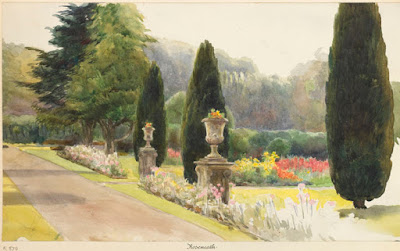
Rosneath by Louise, Royal Collection Trust

Embroidered album cover

Many of her sketches, drawings, watercolors are in albums at the Royal Collection Trust site
but apparently few of her papers are available, leading to much speculation about their contents.


The Dowager Duchess of Argyll lived until the eve of World War II, dying in 1939. She spent her later life in charitable works and doing needlework, it is said.

Louise's footstool in the Royal Collection Trust

The Block

#6 Louise by Mark Lauer

The larger pattern is for a 12" Block; the smaller for an 8" Block.


To Print:
Create a word file or an empty JPG file.
Click on the image above.
Right click on it and save it to your file.
Print that file 8-1/2" x 11". Check to be sure the inch square box measures 1".
You'll need 4 copies if you are going to piece it over paper foundations.


The block is constructed in triangles—-Triangles are flipped and pieced into squares, four to a block. Each pattern includes paper foundations for 8” & 12” blocks, which you can also use for template piecing. Add a 1/4” seam allowance when you cut the fabric using the templates.
In Block #6 the triangles are identical except four are flipped over.
And those four have a different color for Points A & B, to give a shaded effect to the star points.
Becky shaded hers quite differently. 

#6 Louise by Becky Brown
She added an extra pinwheel in the center.

Textile of the Week

The Powerhouse Museum in Sidney owns a piece of small-scale stripe
celebrating Queen Victoria's 1897 Diamond Jubilee: Shamrocks,
roses and thistles for Ireland, England and Scotland.


Louise offers us a good deal of gossip about royal indiscretions:

Read a Book (or three) a Week
Lucinda Hawksley, The Mystery of Princess Louise 

Jehanne Wake, Princess Louise: Queen Victoria's Unconventional Daughter 

Robert M. Stamp, Royal Rebels: Princess Louise and the Marquis of Lorne