QUILTS & FABRIC: PAST & PRESENT


Saturday, November 5, 2016

Sets for Hexagon Blocks

Nancy's thinking of setting her Morris Hexathon blocks all-over with dark triangles.
Love the Strawberry Thief border.

This is the set that Becky and Ilyse are using too. See a post here:
http://barbarabrackman.blogspot.com/2016/09/morris-hexathon-sets-in-black-and-white.html

Here's a link to the instructions for the official set----is anyone going to use it?
http://barbarabrackman.blogspot.com/2016/04/morris-hexathon-introduction.html

Ilyse Moore has 61 hexies in her almost finished
project, which is titled "My Summer Obsession."
She is thinking about what goes in the corners.

Vintage hexie blocks set with striped triangles.

Deb Strain's Be Creative
If you shade things carefully the triangles
can dominate as stars.

In this vintage silk string hexagon, the maker
used black triangles and emphasized the stars
by using a medium purple diamond.

Minnie Meyers
Arizona Project

You can set the hexagon blocks with just the 60 degree diamond, an idea popular in the mid-20th century. I found several of these where the blocks are stacked with diamonds  on the Quilt Index.


And several for sale


Great quilt from the sixties maybe,
plain hexagons, pink & lime green diamonds.

If the hexagons are all the same pattern it's
 easier to get a coordinated look
but it works with samplers too.

Park Bench from Jaybird Quilts
The diamonds are twice the triangle.

You could set the sampler of hexagons in an all-over pattern, hexagon to hexagon.

As the Las Colcheras Quilt Guild did in their raffle quilt last year.

Koi by Bruce Seeds

Candied Hexagons by Ann Tenthy
with patterns from Ink LIngo

Liza Prior Lucy

Homage, another group raffle quilt with hexies set side by side
by the Springwood Community Quilt Show

They also popped some chintz hexagons in there to good effect.

Lucy Kingwell's pattern Smitten

The advantage to working with 60 degrees is that you can integrate diamonds, hexagons and triangles of various sizes as in this version of Smitten by Mickey & April at the Sweetwater Cotton Shop.

Peaceful Constellations by Mary Huey

Hex and Next by Jill from Fun with Barb. 


Thursday, November 3, 2016

Appliqued Squirrel Borders

Quilt date-inscribed 1841 (quilt 1)
A squirrel and a peacock

 I found pictures of four quilts from the early 1840s with squirrels in the border corners.

Quilt date-inscribed 1843 (quilt 2)
Same squirrel.

Same squirrel, same peacock, 1841 (Quilt # 3)

A little additional reverse applique. (Quilt #4)
Similar block too.

Same quiltmaker?
One might think so but 
three of them are signed and dated by different women.

Pictures of the quilts:

Quilt #1
signed Eliza Conklin, dated 1841.
Private collection.

Quilt #2 signed Eleanor Robison 1843, sold by Old Hope Antiques.

 Quilt #3 by Sally Conklin, 1841.
James Collection. International Quilt Study Center and Museum.
1997.007.0876

Quilt #4 is from the Quilt Index,
Documented in the North Carolina project. 
No signature. Attributed to New York by the family.
Red and green applique.

Three cross-stitch signatures to match the color in the prints.

"Eliza Conklin  Claverac[k] June the 14 1841" (#1)

"Elenor A Robifon
Auguft 8th 1843" (#2)
(Elenor was old fashioned enough to use an F instead of an S)

One might think the red quilts are the same quilt in different photos but there are two:
one signed Sally Conklin (#3) and one signed Eliza Conklin (#1)

They are distinguishable in photos mainly due to the damage to the Turkey red print. Eliza's is worn more across the center where it was probably folded. Sally's has a large area of fabric loss in a sashing strip that Eliza's doesn't have. Sally's looks to be in slightly better shape than Eliza's.


IQSC explains Turkey red's "Inherent Vice" in an online exhibit featuring this quilt.

The Conklin family has been trying to figure out who these Conklins are.
Helen Middleton writes on a genealogy board:
"I have Eliza's Conklin's quilt which is the exact pattern (Oakleaf pattern with squirrel border) dated June 24, 1841, Claverack... I am not sure of Eliza's lineage. When I first started to research Eliza and Sally's quilts (both dated 1841) I thought for sure they had to be sister quilts. I thought I had found the family: Eliza and Sally Conklin, daughters of Benjamin and Mercy (Comfort) Conklin. However, my original premise did not hold up. I found a reference that Eliza (born Jan. 25, 1811) married William Monington Thomas and had a child named Sallie M. Thomas, born May 1831...."
She is running into a lot of dead ends.
I am letting the family figure out these mysteries of genealogy. 

My question: Where did the patterns come from?

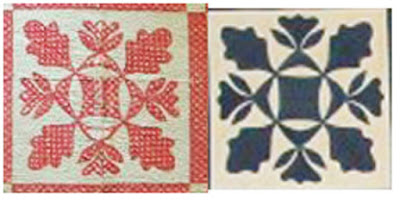
#1 and # 2
Three of the quilts show similar two-color blocks, a variation of Encyclopedia of Applique #17,
what is generally called an Oak Leaf and Reel.
What makes them unusual is the little tulip flower at the top and sides.

Quilt #4 is missing the flower but has the leaves.

The similar borders are what make them remarkable.
The squirrels.....

The peacocks with top knots...

#2--some with a little added embroidery.

#4 has peacocks but different vegetation

Well yatta, yatta, yatta, you might say. There are many sets of similar quilts.

Why is it important? It's the dates.1841 and 1843 are the early years of classic American applique style (two color, calico print, block-style, conventional applique with botanical appliqued borders). It's not just that these quilts are so similar, it's that few quilts that look like this survive with those early 1840 dates on them.

#1

We can compare them to some very different styles dated in the same years.

Quilt for Mr. & Mrs. Dandy dated 1841 from Bordentown, New Jersey

Quilt by Charlotte Gillingham Hancock dated 1842-1843,
Philadelphia
Philadelphia Museum of Art

Quilt signed ELH, 1839
Shelburne Museum Collection

Quilt from the Larison family, dated 1841,
Hunterdon County, New Jersey
International Quilt Study Center and Museum.
#2002.007.0001

Quilt by Abby Palmer, Maine, dated 1841
Museum of Fine Arts, Boston.

A Conklin genealogy thread:
http://archiver.rootsweb.ancestry.com/th/read/CONKLIN/2010-11/1290270555

How did the squirrel quilts come to look so different from the other quilts at the time? And so the same?

Tuesday, November 1, 2016

A Quilt for Henry Clay in 1845

Hexagon quilt on a bed at Ashland
the Henry Clay home in Lexington, Kentucky. Photo, 1978.


In 1845, the Richmond Enquirer made an editorial note of the "habit Whig ladies have of giving Mr. Clay bed clothes! How they tuck him up!"

The comment was inspired by news of another quilt for the Hon. Henry Clay, "made by Mrs. Ann Warner, Harford County, MD, now in her 94th year, she did it all with her own hands in six weeks."

Ann Warner's quilt may have been a feat of the needle but it was also a prodigious achievement in public relations work. Many newspapers carried stories in the fall of 1845, a few months after Clay's Presidential rival James K. Polk had taken office.


"Present to Mr. Clay
We saw yesterday at the residence of Mr. Romulus R. Griffith in this city a counterpane made by Mrs. Ann Warner....It is a beautiful article both as a specimen of fine needlework and in respect to the taste displayed in the arrangement of the numberless pieces of which it is composed. In the centre of it is the following inscription: 
To the Honorable Henry Clay
The Orator, Patriot and Philanthropist
In token of admiration of his genius and his virtues, is presented this piece of needle-work, by Mrs. Ann Warner, Executed by her own hands, in the 93rd year of her age. Baltimore, 1845.


The quilt had also been shown at Mr. Butcher's home on Charles Street in Baltimore, September, 1845. James H. Merriweather of Cincinnati delivered it to Clay who wrote a thank you letter to Ann Warner on November 16th thanking her for the "very tasteful and comfortable Counterpane," but sadly she had passed on the day before.

Is Ann Warner's quilt with its "numberless pieces" at Ashland?

An old postcard


Henry Clay on the right in the yard at Ashland.
This house was torn down after Clay's death in 1852 and a replica built.

Ashland from a postcard about 1910.