QUILTS & FABRIC: PAST & PRESENT


Friday, September 9, 2011

Sash and Block Designs

I've been thinking about good ways to show off the large prints in the Lately Arrived from London yardage. I found a file I've been keeping of antique quilts with unpieced blocks. The blocks are plain, the sashing is pieced. In my Encyclopedia of Pieced Quilt Patterns I called the format Sash & Block patterns.


Here a spiky triangle is pieced between unpieced Turkey red blocks.
Looks to be about 1900-1925 by the gray prints in it.

Here's another one that shows off Turkey red blocks with a sash of squares, probably turn of the 20th century.


The most common pieced sash between the plain blocks is a double sawtooth or flying geese. Again the sashing here looks to be about 1900-1925. The plain gray fabric may have been more colorful once.

This one framing double pink squares looks a little older-maybe 1860-1890.

Here's one from about 1880-1900 with flying geese triangles.

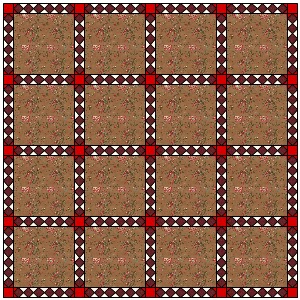
Below are EQ7 designs using a 12" finished square and the colors and prints in the Lately Arrived from London collection. For all of these cut the focus prints into squares 12-1/2"


The spiky triangle looks good if you alternate the colors in the unpieced blocks and rotate the strips to match. The red cornerstone squares are cut 2-1/2".
To cut the triangles cut 2-3/4" strips and then cut triangles as shown in this EQ diagram.


The side triangles in each strip can be cut like the above diagram.
The strip with the squares makes a star in the intersections if you color the triangles around the red cornerstone squares red to match.

For the squares cut 1-7/8" squares
For the larger triangles cut squares 2-1/4" and slice each into quarters with 2 diagonal cuts.
For the smaller triangles cut square 1-7/8" and slice each into 2 triangles with one diagonal cut.


A single sawtooth row between squares. 
Cut squares 2-7/8" and slice in half diagonally to piece into 2" sawtooth squares.
Cut cornerstone squares 2-1/2".


Use two rows of sawtooth to get this look. Rotate the strips of geese to get a balanced shading in the sashing.


Or make 12" finished strips of flying geese. Your cornerstones need to finish to 4" square if you use a wider sash, so cut plain cornerstone squares 4-1/2".

These geese form a 12" x 4" finished sashing.
Cut small triangles by cutting squares 2-7/8" and slicing in half diagonally to make 2 triangles.
Cut large triangles by cutting squares 5-1/4" and slicing each into quarters with 2 diagonal cuts.


One way to vary the look
is to set the squares and sashing on the diagonal.

These designs that highlight a large print would also be great with William Morris fabric as well as chintzes.

This print will be in my next William Morris reproduction line coming out in the fall. Click here to see more about Morris & Company.

See a post from last year for more about Sash and Block designs.

UPDATE. Robin at SolsticeStudio sent a link to her blog
Check out August 17 and 19th for her version of one of these quilts.
I don't know why the links to the specific posts won't work but scroll down to see a terrific quilt.

Thursday, September 8, 2011

Washington Earthquake


Dolley Madison to her sister, December 22, 1811:

"We had another shock of Earth Quake on Wednesday Night & Thursday Morg."

The Lady President felt the aftershocks of the New Madrid earthquake south of Saint Louis, which was hundreds of miles away.

Aftershocks went on through March, 1812.

Read more first person accounts at this web site.
http://www.ceri.memphis.edu/compendium/eyewitness/index.html 


Tuesday, September 6, 2011

Block Mystery

BlockBase #2065

UPDATE: Karan notes I have mixed some apples in with the oranges here. The block above is #2128 published as Double X #4 from the Ladies Art Company about 1890.

And Wilene notes the whole post is Wrong, wrong, wrong:
She says:
"This design has a long published history beginning as Unnamed in Farm and Fireside, March 1, 1897; then Edith's Choice in Hearth and Home, July 1896, and as Broken Dish the following month. Also again Unnamed in The Family published in Springfield, Ohio, October 1913; Cup and Saucer in Farm and Home, March 1, 1915; as unnamed friendship quilt in Oklahoma Farmer Stockman, ca. 1915-1920; Corn and Beans in Comfort, April 1923; Double X in Woman's World, April 1925; Sugar Bowl in Rural New Yorker, ca. 1930-1937; Wild Ducks in a June 1932 pamphlet from Needlecraft Supply in Chicago; Double X's by Nancy Cabot, April 10, 1935. All these have the square in the corner."

Here's a pattern that was quite popular about 1900-1920

This is a different block--note the corners are squares here, triangles above and below.

The block was often made up in blue and white.


A typical set of blocks in indigo blues

Other colors popular at the time were also used.

It's a rather odd construction, a square inside a square inside a square and then a strip of squares and triangles along the outside.

You don't find it any earlier than 1890 or so, the decade when these blue, gray and red quilts were so popular---also the decade when magazines began publishing quilt patterns. But I've never been able to find any published reference to it in the years when the design was fashionable.

This top may have been made between 1925 and 1950.

In 1930 Needlecraft Magazine published the design as Broken Dishes and in 1938 the Kansas City Star,
called it The Chinese Block Quilt. So it was published at least twice, according to my Encyclopedia of Pieced Quilt Patterns, but by the thirties new fad patterns had appeared and no one was very interested in making it anymore.

The mystery: How was it passed around in the 1890-1925 years if it wasn't published?
 It was certainly popular enough. If you do an online search in the Quilt Index for the Chinese Block you find 15 different examples all made in that era (ignore the one dated 1865---it's misdated.)
Click here and type Chinese Block in the "Pattern Name" box and then search.

And the other mystery: What did the women who made it call it?


Here's a variation without the squares in the corners.
 No published source or name for the pattern.

If you were looking to make a reproduction from the 1900-1920 period this would be a great design.

Rotary cutting instructions for a 12" finished block from BlockBase


A - Cut 4 blue squares 2-1/2"
B - Cut 4 light and 4 blue squares 2-7/8". Cut each in half with a single cut to make 2 triangles. You need 8 light and 8 blue triangles.
C - Cut 4 light rectangles 4-1/2" x 2-1/2"
D - Cut 2 blue squares 4-7/8". Cut each in half with a single cut to make 2 triangles. You need 4 blue triangles.
E - Cut 1 blue square 4-1/2"
F - Cut 1 light square 5-1/4". Cut into 4 triangles with 2 diagonal cuts. You need 4 triangles.

For setting ideas look at the variations at the Quilt Index. The blocks are usually set with sashing or alternate blocks rather than side by side.


I found this photo online in the 2004 records of the Iowa-Illinois Quilt Study Group.
 With its lime green and Turkey red color scheme it might be late 19th century.

The biggest mystery here is why didn't I notice the detail of the corners in the blocks. All I can say is
Nevermind.


Sunday, September 4, 2011

Reproduction Patterns

Hay Bale by Edyta Sitar at Laundry Basket Quilts
Here are a few wonderful reproduction quilt patterns available now.

Farmers' Market by Edyta Sitar at Laundry Basket Quilts

If you are thinking of a mid-19th-century reproduction, say a Civil-War-era quilt, you might choose one of these block quilts.

Wedding Sampler by Di Ford


Drayton Hall by Di Ford

Earlier inspiration for say 1812- or Jane-Austen-era reproductions would include medallions.

The Burnt Quilt by Di Ford


Phebe Warner by Di Ford

Netherfield Park by Megan Carroll


The English Basket Quilt by Corliss Searcy

I found many of these patterns at Corliss's Australian shop Threadbear. Click here:
See more of Edyta's Laundry Basket Quilts here

You can buy kits for some of these quilts but you can train your fabric eye and learn a lot about quilt history by buying the pattern and then collecting the reproductions.


Thursday, September 1, 2011

Quilts 1812 Blog

Reproduction quilt, a collaboration between Barbara Brackman,
Terry Thompson and Lissa Alexander

2012 is the anniversary of the War of 1812---a good excuse to make a quilt.


I've been getting questions about what reproduction quilts from that era might look like, so I decided to start a separate blog. It won't be a block of the month (block samplers hadn't been invented yet in 1812.) But once a month I'll post pattern and technique information for an authentic design.


Mockup with Hewson reproduction panel

I've been reading about people who lived through that war.

Unknown fashionable woman about 1800
I'm having a good time trying to figure out war strategies and battles but mostly enjoying the scandals and gossip. Even after 200 years the gossip is still fun.


Rejected idea for U.S. Great Seal

The first chapter is up today. Look for a post on the first of the month through the end of 2012. And I'll occasionally post other pertinent style and fabric information.


Game Birds
Imported chintz, about 1815
Book mark this link.
http://quilt1812warandpiecing.blogspot.com/

Take a trip back to 1812.


I added Judy Severson's reproduction quilt
Seaflower to a vintage peace poster.
Subscribe by email.
And I'll put a box in the left hand column here so you can click on it periodically.
By the end of the 2012 you and I will know a lot more about the Battle of Bladensburg, Betsy Bonaparte and---way more important---early American quilts.

Betsy Bonaparte, a triple portrait by Gilbert Stuart, 1804.

Wednesday, August 31, 2011

Civil War Reunion: Just Squares

Roseanne Smith has finished a top made from the Civil War Reunion collection that's been in quilt shops for a few months. 
Ladies' Auxiliary
Roseanne Smith
74" x 88"
The quilt has a really rich madder tone, very much in keeping with the colors used in the Civil War era. For the Civil War Reunion theme we are calling it Ladies' Auxiliary, remembering all the women's groups that kept the memory of the war alive for generations.


Women's group dedicating a memorial at Gettysburg about 1930.
Photo from the Library of Congress.

Roseanne started with small packets of 2-1/2" squares we handed out at fall market last year. She added more squares cut from 2-1/2" Jelly Roll strips and some white prints from her stash.

Here's a block, 5 x 5. Twenty-five squares finishing to 2"  = a 10" finished block.
I see she didn't like this arrangement though and reversed the shading so there are more lights than darks in her finished quilt blocks (13 lights, 12 darks per square). There are 20 blocks.

She set it with the plum colorway of the two large prints.


The paisley (8187-17)  is called Women's Relief Corps.
She cut these 10-1/2" squares for alternate blocks.

The stripe (8186-17) is called Decoration Day.
She cut the stripe 9-1/4" and mitered the border.

Diagram drawn in EQ7.

I'm afraid a lot of the big prints are already sold out.
But we'll have another Civil War reproduction in shops early next year. Look for 1862 Battle Hymn in January, 2012.


Next year's line will recall the 150th anniversary of the War's first full year, the year Julia Ward Howe published The Battle Hymn of the Republic. Muted colors recall the mood of mourning and prints are named for battles in that very sad year when North and South realized the War might drag on and on.

See a preview of 1862 Battle Hymn here. The sales reps should be bringing it around to shops for pre-orders any day.