QUILTS & FABRIC: PAST & PRESENT


Showing posts with label 1862 Battle Hymn. Show all posts

Monday, August 6, 2012

Small Things


Pineapple by Pam Mayfield
2012
Pam made this little quilt from some of last year's Civil War reproduction collection
1862: Battle Hymn.
She added a gray stripe for background. This is a little quilt, just 24" square.

And Debbie St.Germain used the same line for the borders for this little piece. She distressed the background to show off the paisley quilting. See her pattern for this dog here:


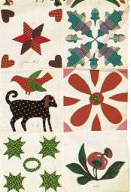
Debbie's inspiration was this sampler/album quilt from New York. See more about the dogs here:


Debbie's a fan of pictorial applique. Pam noticed they think alike---even though they've never met. A gray stripe IS the perfect background.

Thursday, February 9, 2012

Corinth for 1862 Battle Hymn

Corinth is named for Corinth, Mississippi, site of an 1862 battle.
 The print is #8222 in my latest Civil War reproduction collection, 1862 Battle Hymn.
Doesn't it look like a cotton boll?


Here's the document print.
 I found it in a swatch book in the Moda library. It's got to be later than the Civil War because of that wine-red background, a color you really don't see until the 1880s, but this is a very symbolic fabric collection so I thought we could use it.

It reminded me of these white on dark prints
that were quite popular right before the Civil War.

Top from about 1850 (the center square is a reproduction print)

You could classify them as floral trails. They often have white stems. 
Two Civil War-era floral trail reproductions.
 We tone down the white in the reproductions.

So we have it in Farragut blue (a navy blue)

and Stonewall Gray - a taupe

From the Library of Congress collection

Corinth, "the Crossroads of the Confederacy," was at the junction of two important rail lines, an important location over which the armies fought for years.

Corinth from the Library of Congress
The Tishomingo Hotel shown here near the tracks became a hospital. Click here to read Confederate nurse Kate Cumming's recollection of her first day as a nurse in that building. 

The Union took control of the town in the 1862 battle and Corinth became a refuge for many escaped slaves.

The Corinth Contraband Camp memorializes those newly free people.


This pattern Railroad Crossing or Rambler is a good one for an authentic reproduction quilt. Click here for a free pattern:

Here's Roseanne Smith's reproduction using my Civil War Reunion line. This collection is more subdued. Adding a white or ivory contrast would be effective and authentic.

Another option: The Cotton Boll block. See a pattern for an 8" square block here:

Monday, January 30, 2012

Document Print & Reproduction

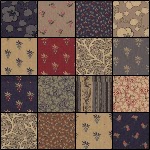
The 10" Layer Cakes
The featured print in the 1862 Battle Hymn repro collection is a large paisley that forms a serpentine stripe.

I called it Yorktown after an 1862 battle site. It comes in 5 colorways.


Battle of Yorktown from Harper's Weekly

The document print (the source) was in a swatchbook.
We had just enough to figure out the repeat and it works in a really graceful fashion.

The document print was shades of a steel blue with accents of a true black and a pinkish tan, color combinations you wouldn't really see during the Civil War. I thought the swatchbook was about 1880. You can see in the swatch book above the paisley a very bright floral done in the new dyes developing about 1880---NOT Civil War.
The print itself seemed quite appropriate for a Civil War memorial if it was recolored in shades more like natural dyes. In the reproduction collection we did several in madder-style reds and browns, and one subdued navy blue. It's dated on the reproduction selvage as 1870-1890.

It's going to make some terrific borders.

Bettina Havig sent me a snapshot of her first border in her Hewson medallion. She cut a single stripe out and appliqued it. I told her she's a genius.

Tuesday, January 24, 2012

150 Years Ago in the Civil War

Julia Ward Howe published the
Battle Hymn of the Republic in 1862

2012 is the 150th anniversary of the second year of the Civil War, the second of five years. This year's reproduction print collection 1862 Battle Hymn, commemorates events of that year when Americans realized that the Confederates were not to be intimidated or easily subdued, that Union armies needed training and leadership and that Civil War meant battles in the front yard.

A family stunned by the nearby Battle of Cedar Mountain, 1862
Detail of a photo from the Library of Congress
  

Julia Ward Howe wrote new words to the song that Union soldiers sang as they marched. Her Battle Hymn of the Republic was published in the February, 1862 issue of the Atlantic Monthly, to become an American classic.

Read more about Julia Ward Howe's Battle Hymn in this post on my 2011 Civil War blog


Timothy H. O'Sullivan photographed the Virginia family outside their house where a Confederate General died. They happened to be in the way when the battle broke out.

Behind them broken furniture, trees and fences.


Hampton Roads
Each of the 8 prints in the reproduction collection is named for a battle from that year.

Shiloh

Corinth

Chantilly

Cedar Mountain

Yorktown

Memphis

Valverde

See a gallery of pictures from 1862 in the Library of Congress by clicking here:
http://www.loc.gov/rr/print/list/picamer/paCw1862.html

And keep up with the New York Times's Disunion blog that records the year 1862 in short essays:

Wednesday, January 18, 2012

Checkered Past: Free Pattern


From the new 1862: Battle Hymn collection.
The Battle of Hampton Roads in 1862 involved ironclad ships.
The print is called Hampton Roads, the colorway Merrimack Blue.
 The Merrimack was an ironclad ship.

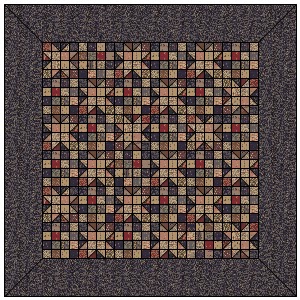
Here's an EQ mockup of Checkered Past
Click on the PDF for a free pattern for this quilt for my Civil War reproduction collection 1862 Battle Hymn.

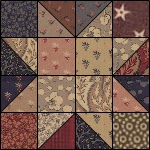
It makes use of 2 alternating blocks

The checkerboards are pieced of 2-1/2" squares, so it's suitable for a Jellyrolls of strips.
The star points require bigger pieces but I bet you have some scraps around.


The medium-sized print Hampton Roads would make a good border.

This print reminded me of the rivers along the Virginia coast.


Hancy Reynolds


The PDF pattern is free---not copyright so you can print it or link to the PDF to share it on your own blogs, in guilds. I encourage shopowners to give it to customers.
Hancy Pitcairn Reynolds is the face of this reproduction collection. She was born in Massachusetts and lived in Illinois and Iowa. The war touched her as it did every American. Her daughter's husband was a Union soldier who survived. Her granddaughter married a man whose father died as a prisoner in South Carolina. She's my friend Bobbi Finley's many-times greatgrandmother. We love the name Hancy and think her portrait captures the spirit of women who lived through the war.

Thursday, January 12, 2012

Every Civil War Reproduction Line Needs a Neat Stripe

Narrow stripes, known as neats in the fabric industry,
were a fashion necessity after 1860 or so.


Like this madder-style stripe in my newest Civil War reproduction collection for Moda.
1862 Battle Hymn is in shops in the precuts including Fat Quarter Packs.

This particular stripe comes in five colorways

I named the prints after Civil War battles from 150 years ago.
The neat stripe is called Cedar Mountain.


This colorway with it's madder reds and dulled oranges is named Culpepper Peach.

The navy blue at left is Farragut Blue and the lighter, steel blue Merrimack Blue.


There are two neutral (what we might called taupe) colorways---on the left Stonewall Gray and in front Sharpsburg Tan.
The blues and the neutrals are rather subdued, evocative of the national mood in 1862 when everyone began to realize that the War would be a long and horrible conflict.


Roseanne Smith has some 2-1/2" Jellyroll strips and some 10" Layer Cakes. She's been busy with the neat stripe in the peach colorway.


She loves to miter
I could see a whole quilt out of scrappy nine-patches with mitered frames.

I'll post more about the prints, colors and themes in 1862 Battle Hymn. The yardage should be out any day.

Read more about stripes in the mid-19th-century at this post of mine a few years ago:
http://barbarabrackman.blogspot.com/2010/01/stripes-in-civil-war-homefront.html