QUILTS & FABRIC: PAST & PRESENT


Sunday, November 8, 2009

Prussian Blue


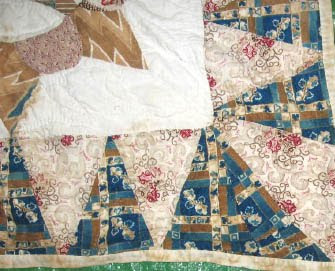
Detail of a cotton print that can be classified as a printed plaid, a stripe and a rainbow print. Estimated date: 1840-1860

Over the past few years I've been saving photos of Prussian blue prints like the one above from online auctions. I'm especially interested in quilts with dates inscribed on them. I have quite a few details of Prussian blue prints in quilts inscribed from 1846 to 1868. See below for photos in order of date.
Prussian blue is a dye process. It's also a bright royal blue color produced by that dye, often combined with a buff or tan. The blues are printed in various styles including brilliant rainbow or fondu prints, double blues, plaids and stripes.


Looking at these 9 examples (I didn't see any earlier or later) I can conclude that distinctive rainbow prints, large scale plaids and stripes in Prussian blue were quite the fashion from the mid 1840s to the 1860s, as were the blue and buff combination prints.


When I make these lists of dated quilts I usually throw out the earliest and the latest examples. The earliest example may have been misdated later by someone other than the maker and the lastest example may have been old fabric or blocks put together later. The list is then 7 quilts from 1846 to 1858, twelve years of a fad. The information helps in dating quilts with these fabrics, which to be safe I would say tend to date from 1840 to 1860.

I corroborated these dates by looking in the catalogs of Baltimore album quilts, which include a lot of Prussian blue rainbow prints. I didn't find any Baltimore albums with the graduated blue prints outside this date range.

Note the dates are below each photo.


1846


1846


1848


1848

1850


1853


1855


1858
1868


Friday, November 6, 2009

The Polka Dot Club

"The Polka Dot Club, Larned, Kansas"


I've always had a thing for polkadots. Terry Thompson gave me this photo for Christmas a few years ago. I'd guess it's about 1900.

My sister restrained me from buying a polka dot couch once, probably a good thing, but nobody can stop me from buying dotted fabric. Here's a snapshot of a quilt I made for a 4 year old. Every print is a dot.

The other day my cousin sent me a scan of a photo of her mother, the most glamorous woman I personally knew as a kid. I don't think the ladies of Larned would ask my Aunt to join their Polka Dot Club. But I think I'd rather be in hers.


My Aunt Kay in 1945
(She appears to be camping out.)


Wednesday, November 4, 2009

Civil War Uniforms or Not

There are a few questions I'm asked on a regular basis. One FAQ (frequently asked question) concerns wool comforters made from Civil War uniforms. A typical query might read like the description of the quilt above from an eBay posting a few months ago.

" This is a very nice old quilt that I am told is a Mourning Quilt. The quilt measures 90” x 70” and is extremely heavy. The top is made of pieces of men's clothing. Some of the pieces are said to be pieces of a uniform worn in the civil war."

The bidding started on that quilt at $37 which seems a reasonable price for a nicely embroidered comforter in good shape.

Not so reasonably priced are similar quilts purchased for $450 or more, purported to be pieced of Civil War uniforms. The writer who's paid this amount wants to know if I can confirm a Civil War provenance. And what is the quilt worth?

I don't do appraisals but I can usually confirm that the buyer has been taken.


These embroidered, tied wool quilts are very common. I did a search on eBay in late October and found 13 examples for sale that day with bidding ranging from $9.99 for a top to $285 (for a crib-size). They varied in skill level, detail and condition, but all were squares and/or rectangles of subdued wools.


Many were embroidered and some were finished with ties on the top.


It's easy to see why one might think these are Civil War uniforms. The fabrics are so often blue and gray.


Here are a few things to remember when considering a quilt supposedly made of Civil War uniforms.

1. Without some strong family history or other corroboration, the story is very likely to be false.

2. If there is strong evidence, consult an expert on Civil War uniforms rather than a quilt expert, as most of us are not experts on army uniforms.

3. While many Union soldiers wore uniforms of some consistent design and fabric in navy blue, Confederates wore diverse clothing of diverse fabrics, from butternut brown to Confederate "gray" to everyday clothing.

4. Confederate gray is not what we would call gray, which is a colorless pale shade of black. The Confederate uniforms I have see are what I would call blue, a pale blue wool. I have seen only a few, but the pictures here look to be made of wool fabric woven of blue and white warps and wefts, the kind of cloth we still call jeans. The dark blue yarn (probably dyed with indigo or Prussian blue) crossed with a white yarn gives a pale blue effect.


The comforters in question were made about 1890-1930, often from wool samples torn from sample books. See a book below.


Saturday, October 24, 2009

Buff and Blue Number 2


Julie from Tennessee sent photos of a quilt signed "E. Prouty" that she bought in upstate New York several years ago. She was confused by information in my Encyclopedia of Pieced Quilt Patterns where I indexed the design as "California Rose," indicating it was published about 1898 in the Ladies Art Company's catalog of quilt patterns. The fabrics looked much older than 1898 to her.

Her question is a good one and illustrates the problems with indexing patterns because the names were only published after 1885 or so, 100 years after Americans started making patchwork quilts. Quilts in some designs were made directly from those turn-of-the-last-century patterns and publications, but quilts in other designs were made much earlier than their first published reference.
Julie's quilt is one of those older patterns passed around hand-to-hand before magazines and catalogs began to sell how-to patterns. The fabrics are the blue-and-buff prints in rainbow or fondu (shaded) style that were so fashionable in the 1840s and '50s for clothing and patchwork.

Although it's hard to date quilts from photographs, this high-style color palette was popular in the mid-19th century rather than at the end. She's right in thinking it's older than 1898. As far as a name: My Encyclopedia and BlockBase, its digitized version, show many rather romantic names and variations. Some are pieced and then appliqued to a square, which looks to be the case with Julie's quilt. Others are completely pieced as in the block on the right below.

There is no "correct" name for quilt patterns because names were so often set in print decades after the quilts were made. We have no idea what E. Prouty called her quilt, and Julie can call it what she likes.

The fabrics are a showcase of 1840-60 prints with quite a few rainbow prints and many bright Prussian blue plaids, stripes and eccentric prints. Do note the brown stains next to some of the blue and buff prints. I have seen this kind of brown color echoing blue patches before. It may be a form of dye migration.

If you'd like to read more about Buff and Blue prints see my posting for August 8, 2009 by clicking here:
http://barbarabrackman.blogspot.com/2009/08/buff-and-blue.html
I will be eMailing a subscription newsletter The Quilt Detective: Prints Color & Dyes this winter. You can read the first issue, which has to do with Prussian blues, as a free sample, by clicking here:
For subscription information click here:
If you'd like to make a block in the Victoria's/Caesar's Crown, Strawberry design you can print templates any size in my BlockBase computer program for PCs. The many variations are numbered from 3625 to 3665. For more information on BlockBase from Electric Quilt click here:

Friday, October 16, 2009

Berries

The birds have been happy in Kansas lately as there is so much fruit to eat. It's easy to see how 19th-century applique artists were inspired to make lots of little circles.


Flowering Almond or Poinsettia, estimated date 1850-1870

And it's not hard to see why 21st-century applique artists continue to stitch berries, cherries and grapes to their quilts. The more the merrier.


Cranberries & Cardinals by Jean Stanclift, quilted by Lori Kukuk, 2004.


Fat Quarter Folk Dance by Karla Menaugh, 2002.


Patterns for Jean's and Karla's quilts are in two Sunflower Pattern Co-operative books.

Jean's is from Cranberry Collection, which is available from Pickledish.com the Star Books website.
Click here: http://pickledish.kcstar.com/?q=node/246

Karla's is from Fat Quarter Fancy Work, which you can find at Quilters Warehouse. Click here for their page on our Sunflower Pattern Co-operative designs.

Thursday, October 8, 2009

Washington Lily

The view from the hotel in San Jose

I attended the American Quilt Study Group's annual seminar in San Jose last week, a real treat for quilt historians. It's so much fun to talk to old friends who have the same interests. Most of us have terrific visual memories. We never forget a quilt pattern (although we occasionally forget each other's names). Among the best is Kathy Sullivan from North Carolina, who was quick to identify the inspiration for the "Star Flower" design in the center of our new Juniper and Mistletoe sampler book. She'd seen a photo of a quilt made in a similar pattern, which she'd thought was so quirky that it must have been an original design.

"Festival of Trees" by Karla Menaugh from Juniper & Mistletoe, "Star Flower" in the center

Applique floral from about 1925

I'd seen another quilt in the design, one in the collection of the International Quilt Festival Collection in Houston. Both are related to a pattern published in Comfort magazine in April, 1923.

Tree of Life Variation (Washington Lily) from the International Quilt Festival Collection

Several years ago I did a newsletter about 20th-century quilt pattern sources and below is a photocopy of a page featuring the original clipping on the lower left, an applique design sent to the magazine by Matilda Miller of Olympia, Washington. It was published as Washington Lily Quilt Design, named for her home state. The magazine advised a color scheme of a dark blue vase, green stems and leaves, pink for the lilies and yellow centers.


I took out the vase and changed the "Washington Lily" design a little to make it more like a tree for our "forest of applique".


I would imagine the old quilt with the shrimp-colored sashing once had red sashing and flowers. The blue vase, so similar to the magazine pattern, makes me think the quilt below was inspired by the magazine and made after 1923 when dyes were very unreliable. The unknown maker exercised her creativity in alternating buds with flowers.


Of course--- this quilt might have been the inspiration for the Comfort pattern. Which came first? Chicken or egg? Quilt or quilt pattern?

This year I am doing another subscription eMail newsletter. The topic will be Prints, Color & Dyes, with discussions about color such as why and when the reds fade to shrimp pink and the greens to khaki as above. It starts November 8th. Click here for more information about the Quilt Detective for 2009-2010:


And for more about Karla Menaugh's and my sampler book, Juniper & Mistletoe: A Forest of Applique, click here:


Friday, October 2, 2009

Kansas City Museum Findings


Last week I gave a lecture for the Kansas City Museum about their silk star quilt which was donated with a medal inscribed "Awarded to Mrs. Gilbert Smith for an Emblematic Quilt 1853" by the American Institute New York. The family believed that the medal was from what is considered America's First World's Fair, the Crystal Palace exhibit in 1853.


Detail of a flag in Mrs. Smith's quilt. She embroidered all the stars with a satin stitch in gold thread (more the color of the picture at the top). She also couched down a silver cord. The blue silk has held it's color while the red has faded to peach.


My major questions were:
1) Was the quilt exhibited and awarded a prize at our first world's fair?
2) Who was Mrs. Gilbert Smith?


I found fairly easily that there were two New York City fairs in 1853, the new international fair at the Crystal Palace, and a smaller annual exhibit of American products put on by the American Institute founded in 1828. At their month-long exhibits every October "were displayed the finest products of agriculture and manufacturing, the newest types of machinery, the most recent contributions of inventive genius." Below is a claustrophic people mover from the 1867 fair.


Mrs. Smith's medal seems to be from that 1853 event, but would an organization dedicated to American science and industry display a quilt? Then I remembered a picture I'd seen years ago, an interior painting of the 1845 American Institute Fair.


American Institute Fair at Niblo's Garden by B. J. Harrison, about 1845. Collection of the Museum of the City of New York.

Apparently they showed quilts. The balcony seems to be hung with quilts on both sides of the room.

And then I remembered (it's good I remember things eventually) that I had a whole file on the winners in the quilt category at those annual fairs, which I had copied from their annual publication Transactions of the American Institute. At the top of the list from 1853 under "Needlework, Embroidery and Fancy Articles" is "Mrs. Gilbert Smith, 209 Monroe Street, for an emblematic quilt, silver medal." I also found her prize listed in an October 1853 issue of the New York Daily Times.

So the answer to my first question is that the quilt was not exhibited and awarded a prize at the 1853 Crystal Palace exhibit, but rather won a silver medal at one of a long series of American Insitute fairs. In 1853 three quilts were awarded diplomas and Mrs. Smith a medal at that smaller fair. There was no gold medal.

I haven't found the answer to my second question. I'd like to know Mrs. Smith's first name but her husband's name is too common to be of much help. The 1820 New York state census lists 12 Gilbert Smiths. The 1860 census counts 42 with nine Gilbert Smiths living in the City.

And now I have another question. This is obviously not Mrs. Smith's first quilt. Where are her other quilts?

The Kansas City Museum has two locations. Their major building Corinthian Hall is undergoing a renovation right now. For more information click here: http://unionstation.org/KansasCityMuseum/museuminfo.html


Photograph of the 1867 American Institute Fair from the Collection of the Library of Congress.