QUILTS & FABRIC: PAST & PRESENT


Showing posts with label dating a quilt. Show all posts

Saturday, June 26, 2010

Clues in an Old Quilt


Becky writes from Virginia:  
Yesterday a friend blew me away with an OLD quilt she recently got from her sister. There is NO history - only that her sister's Mother-in-law was an antique dealer (many years ago). Seeing and touching quilts like these always makes me hold my breath while I try to absorb as much of it as I can. And I ALWAYS wish the maker had signed and dated her work. I got my camera for some really quick pictures.


Becky's got a good eye. Several clues made her think this quilt was really old. (In the quilt business I guess we say anything older than 1840 is REALLY OLD.) One clue to a pre-1860 quilt is the fringed edge. In my book Clues in the Calico I said this on page 121:
Fringe is another early edge treatment and one that correlates well with a specific period of time. Of 20 fringed quilts in the database [of 1000 date-inscribed quilts] 19 were dated 1860 or earlier, indicating that fringe (especially a white fringe----knitted, knotted, woven or crocheted) is a strong clue to a pre-Civil War quilt.


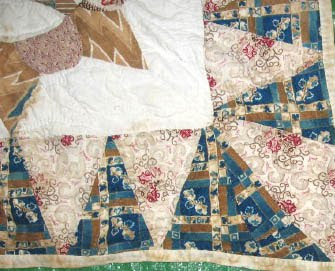
The fabric doesn't give us much information. Plain white cotton offers no clues. The blue print with the white floral sprig could be an indigo print, a dye used over such a long time period that it offers no clues. But the blue and buff stripe is helpful. It may be colored with the Prussian blue dye process developed about 1815. Buff and blue prints were quite popular in the 1840s and 1850s in the U.S. but they were available earlier.

Read more about Prussian blue in the sample copy of my digital newsletter The Quilt Detective by clicking here:
http://www.barbarabrackman.com/1%20Prussian%20Blue.pdf

When we are dating old quilts we use comparative dating, that is we compare the fabric in question to similar fabrics we have seen before. The blue strip is so unusual I have very few similar fabrics in my memory bank.

The quilting pattern doesn't offer too many clues. Double lines in a grid as in the blue floral are indicative of the 19th century, but we knew that any way. The closeness of the parallel lines in the striped border is a weak clue to the 19th century too. 20th-century quilters tended to use wider spaces between their lines.


Using the Prussian blue/buff stripe, the heavy quilting and the fringe as our best evidence, I would guess 1820 as an early date and 1860 as the latest date.

It may be older and date to about 1800-1860.  I wish I had more examples of that blue and buff print for comparison.

More about clues in the pattern in the next post.


Sunday, November 8, 2009

Prussian Blue


Detail of a cotton print that can be classified as a printed plaid, a stripe and a rainbow print. Estimated date: 1840-1860

Over the past few years I've been saving photos of Prussian blue prints like the one above from online auctions. I'm especially interested in quilts with dates inscribed on them. I have quite a few details of Prussian blue prints in quilts inscribed from 1846 to 1868. See below for photos in order of date.
Prussian blue is a dye process. It's also a bright royal blue color produced by that dye, often combined with a buff or tan. The blues are printed in various styles including brilliant rainbow or fondu prints, double blues, plaids and stripes.


Looking at these 9 examples (I didn't see any earlier or later) I can conclude that distinctive rainbow prints, large scale plaids and stripes in Prussian blue were quite the fashion from the mid 1840s to the 1860s, as were the blue and buff combination prints.


When I make these lists of dated quilts I usually throw out the earliest and the latest examples. The earliest example may have been misdated later by someone other than the maker and the lastest example may have been old fabric or blocks put together later. The list is then 7 quilts from 1846 to 1858, twelve years of a fad. The information helps in dating quilts with these fabrics, which to be safe I would say tend to date from 1840 to 1860.

I corroborated these dates by looking in the catalogs of Baltimore album quilts, which include a lot of Prussian blue rainbow prints. I didn't find any Baltimore albums with the graduated blue prints outside this date range.

Note the dates are below each photo.


1846


1846


1848


1848

1850


1853


1855


1858
1868


Saturday, October 24, 2009

Buff and Blue Number 2


Julie from Tennessee sent photos of a quilt signed "E. Prouty" that she bought in upstate New York several years ago. She was confused by information in my Encyclopedia of Pieced Quilt Patterns where I indexed the design as "California Rose," indicating it was published about 1898 in the Ladies Art Company's catalog of quilt patterns. The fabrics looked much older than 1898 to her.

Her question is a good one and illustrates the problems with indexing patterns because the names were only published after 1885 or so, 100 years after Americans started making patchwork quilts. Quilts in some designs were made directly from those turn-of-the-last-century patterns and publications, but quilts in other designs were made much earlier than their first published reference.
Julie's quilt is one of those older patterns passed around hand-to-hand before magazines and catalogs began to sell how-to patterns. The fabrics are the blue-and-buff prints in rainbow or fondu (shaded) style that were so fashionable in the 1840s and '50s for clothing and patchwork.

Although it's hard to date quilts from photographs, this high-style color palette was popular in the mid-19th century rather than at the end. She's right in thinking it's older than 1898. As far as a name: My Encyclopedia and BlockBase, its digitized version, show many rather romantic names and variations. Some are pieced and then appliqued to a square, which looks to be the case with Julie's quilt. Others are completely pieced as in the block on the right below.

There is no "correct" name for quilt patterns because names were so often set in print decades after the quilts were made. We have no idea what E. Prouty called her quilt, and Julie can call it what she likes.

The fabrics are a showcase of 1840-60 prints with quite a few rainbow prints and many bright Prussian blue plaids, stripes and eccentric prints. Do note the brown stains next to some of the blue and buff prints. I have seen this kind of brown color echoing blue patches before. It may be a form of dye migration.

If you'd like to read more about Buff and Blue prints see my posting for August 8, 2009 by clicking here:
http://barbarabrackman.blogspot.com/2009/08/buff-and-blue.html
I will be eMailing a subscription newsletter The Quilt Detective: Prints Color & Dyes this winter. You can read the first issue, which has to do with Prussian blues, as a free sample, by clicking here:
For subscription information click here:
If you'd like to make a block in the Victoria's/Caesar's Crown, Strawberry design you can print templates any size in my BlockBase computer program for PCs. The many variations are numbered from 3625 to 3665. For more information on BlockBase from Electric Quilt click here: