Wednesday, August 31, 2011

Civil War Reunion: Just Squares

Roseanne Smith has finished a top made from the Civil War Reunion collection that's been in quilt shops for a few months. 
Ladies' Auxiliary
Roseanne Smith
74" x 88"
The quilt has a really rich madder tone, very much in keeping with the colors used in the Civil War era. For the Civil War Reunion theme we are calling it Ladies' Auxiliary, remembering all the women's groups that kept the memory of the war alive for generations.


Women's group dedicating a memorial at Gettysburg about 1930.
Photo from the Library of Congress.

Roseanne started with small packets of 2-1/2" squares we handed out at fall market last year. She added more squares cut from 2-1/2" Jelly Roll strips and some white prints from her stash.

Here's a block, 5 x 5. Twenty-five squares finishing to 2"  = a 10" finished block.
I see she didn't like this arrangement though and reversed the shading so there are more lights than darks in her finished quilt blocks (13 lights, 12 darks per square). There are 20 blocks.

She set it with the plum colorway of the two large prints.


The paisley (8187-17)  is called Women's Relief Corps.
She cut these 10-1/2" squares for alternate blocks.

The stripe (8186-17) is called Decoration Day.
She cut the stripe 9-1/4" and mitered the border.

Diagram drawn in EQ7.

I'm afraid a lot of the big prints are already sold out.
But we'll have another Civil War reproduction in shops early next year. Look for 1862 Battle Hymn in January, 2012.


Next year's line will recall the 150th anniversary of the War's first full year, the year Julia Ward Howe published The Battle Hymn of the Republic. Muted colors recall the mood of mourning and prints are named for battles in that very sad year when North and South realized the War might drag on and on.

See a preview of 1862 Battle Hymn here. The sales reps should be bringing it around to shops for pre-orders any day. 


Monday, August 29, 2011

London Holly

Linda Frost, London Holly, 2011

Linda used prints from my Lately Arrived From London collection: two prints in the muslin white colorway for the focus, background and border in this quilt.

The Peace & Plenty
She cut the flowers and border pillar from this large-scale print.

The Schooner Minerva
And the background from this smaller stripe

She writes:
"This quilt was inspired by Alma Allen and Barb Adams's quilt "Autumn Ambience" that was published in the Oct. 2006 issue of American Patchwork and Quilting. Their quilt had three appliqued blocks, not two, and the applique was a cone shaped basket with several different flowers and leaves along with the holly."


A good reason to save old magazines.

View Linda's blog here and scroll down to her August 4th post to see a solution to magazine storage.

See more about the Lately Arrived from London fabric here:

See Alma's Blackbird Designs blog here:


Saturday, August 27, 2011

Country Fair Blog Hop

Well nothing was getting done around here as it was Fair Week. It's not that I show my tomatoes or anything, they are really not competitive quality.

But I agreed to do the live blog from the local fair. Every hour during the day I posted about events. It was exhausting. I had to eat a lot of pie and sit around and watch the happenings.

It's not the official county fair, just a small-town fair that's been going on for over 100 years, pretty much the same.


The textile division shows quilts and antique aprons.


Robin's in charge of textiles.


There's judging for soybeans, corn and cookies, etc.


And crafts.


I bring this up because Moda is going to conduct another month-long blog hop and the theme is Country Fair. The blog hop features a different Moda designer every day and starts on September 6. It runs through October 2.
Free projects and prizes!
My date to blog is September 19th. I'll post a list in the left hand column so you can link to the Blog Hop every day.

Wednesday, August 24, 2011

Every Early Repro Collection Needs...

Every Early Reproduction Collection Needs... a white ground chintz.


The document print is at the top,
 the reproduction from Lately Arrived from London at the bottom.

Chintzes, large scale cotton florals originally printed in India were a fashion rage from the 17th through the early 19th centuries.

Nineteenth-century white ground chintzes often survive
as Broderie Perse designs in American applique quilts.


Annie Righton Smith, Smithsonian American Art Museum.
 Gift of Patricia Smith Melton 1998.149.19

Cut-out chintz or Broderie Perse quilt from an online auction.
Notice the free form stars scattered around the images cut from white ground chintz.

White-ground chintz border


Reproduction quilt top by Roseanne Smith
Roseanne's quilting this top now.

These splashy prints were popular for interior decorating but also for men's and women's clothing.


The Netherlands was one of the few European countries that permitted free trade in chintzes. Many bold articles of clothing survive there. Above two baby jackets (jakje in Dutch); below two baby caps, the top example a dark ground chintz, the bottom a white ground chintz.


Chintz was fashionable for womens' gowns and men's banyans (lounging robes).

Banyan from Tasha Tudor's collection

Click here and scroll down to see King George IV's white-ground chintz banyan

Read more about the history of chintz
At this blog post MoreWeJAdore:
And this one from TheDreamstress
And a reenactor site:

See more chintz dresses at the Victoria and Albert Museum
http://www.vam.ac.uk/images/image/40428-popup.html 

And the Kyoto Costume Institute
http://www.kci.or.jp/archives/digital_archives/detail_56_e.html

And see another post by me about chintz with lotsa links.
http://barbarabrackman.blogspot.com/2009/09/chintz-george-iv.html

Click here to find out how to order a white-ground reproduction from the American Quilt Study Group
And you'd better buy yardage from my Lately Arrived from London collection---yardage in shops soon.


Sunday, August 21, 2011

A Civil War Survivor

Detail of a signature quilt dated 1862

Quilts reliably attributed to the years 1861-1865 are in short supply. Fabric shortages during the Civil War, the use of quilts by soldiers in camp and hospitals, and confiscation by foraging soldiers reduced the numbers made and those that survived.


Earlier this year Regina wrote with questions about a signature quilt dated 1862, found in a Cape Cod attic and donated to a thrift shop. Someone there recognized its historical value as it was signed by women with old Dutch names familiar to local historians in New York and New Jersey. One block had the town name Nyack, New York, which is north of Yonkers on the west side of the Hudson.

#3760

Regina had a question about the unusual pattern. I did find a version in my Encyclopedia of Pieced Quilt Patterns,  BlockBase #3760, published about 1910 by Massachusetts pattern merchant Clara Stone under the name Sailor's Joy.

 But Clara Stone's version design is pieced and the Nyack quilt is appliqued in the center.

Regina did some more research on the design and found that quilt historian Susan Price Miller was also interested in the pattern.

Susan Price Miller, detail
Star Signature Quilt
2010

For the American Quilt Study Group's 2010 Study of Star Quilts, Susan reproduced a quilt from her collection dated 1877. At the AQSG web site picturing her quilt she writes:

" The thirty-six 10-inch blocks probably came from northern New Jersey, the home of most of the signers, and were joined with wide sashing a generation later. The center points of the stars are cut away in convex curves, providing space for signatures. I discovered a small group of published examples of similar eight and six pointed stars. All have narrow sashing and borders and were made in the New York/New Jersey area before the Civil War."

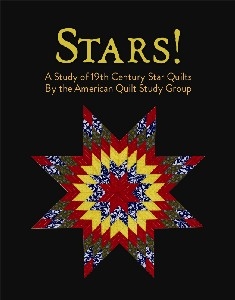
Susan's quilt is patterned in the book Stars: A Study of 19th Century Star Quilts, so if you are looking for a Civil War reproduction design consider the star made of teardrop shapes, which can be appliqued or pieced. Click here to find out more about the book.
https://www.pickledishstore.com/productDetail.php?PID=1248


Regina has published her research on the Nyack quilt at her web site:
http://www.dutchdoorgenealogy.com/quilts-rockland-county-bergen-county.html

The quilt is now in the collection of the Historical Society of the Nyacks and on display. Click here for more information about their new museum. http://nyackhistory.org/welcome.html

My favorite book this month is a history of the colony of Nieuw Amsterdam which explains how all those Dutch names came to New York and New Jersey.
See more about Russel Shorto's The Island at the Center of the World by clicking here:
http://www.randomhouse.com/features/island/american.html

The contrast between the Dutch culture and the English culture that tried to replace it and erase it is fascinating. Another book about Nieuw Amesterdam is Jean Zimmerman's The Women of the House, which focuses on one family and women's lives and rights under Dutch law.

Thursday, August 18, 2011

Northern Lily/Southern Rose Block 6

Dixie Rose by Ilyse Moore

The sixth pattern in the Northern Lily/Southern Rose pattern is a Southern rose.


Dixie Rose by Susan Stiff


Detail of Dixie Rose quilt
 made by Sarah Williams,
Anson County, North Carolina, before 1860
The North Carolina quilt project found two examples of this pattern in their search for regional quilts, both made prior to the Civil War. The name Dixie Rose had not been published until their 1988 book, but that was the name that apparently had been handed down in one of the families. Note the use of paisley shapes for the leaves in this one.
See pages 82 and 140 of the North Carolina Quilts book by Ellen Fickling Eanes, et al.

And see the full quilt at the Quilt Index here:


This block was in a North Carolina sampler dated 1855, made for Laura Brown McCallum.
See the full quilt at the Quilt Index by clicking here:


Judy Davis did a Dixie Rose for my Civil War Women book using paisleys.

The name Dixie Rose has been a part of Southern imagery since the War. Augusta Kortrecht wrote two popular girls' books Dixie Rose and A Dixie Rose in Bloom in the early 20th century, and O. Henry wrote a story called the Rose of Dixie. A websearch for the words reveals information such as one Dixie Rose Lester (born 1913) is buried in Paulding County, Georgia. You'll see a few recent birth announcements of 21st-century girls named Dixie Rose.

Dixie Rose by Barbara Brackman
I have all my applique blocks done now and I am thinking of a set.
Possibly side-by-side to make a wall hanging.


Brenda Papadakis included the Dixie Rose (at a tiny scale) in her Dear Hannah pattern several years ago.


Here's Susan's version of the finished Northern Lily/Southern Rose sampler,
 done in Civil War Reunion fabrics and Moda Bella Solids.