QUILTS & FABRIC: PAST & PRESENT


Showing posts with label William Morris. Show all posts

Saturday, March 24, 2012

Morris Quilts

Evening Star by Sheila

William Meets the Farmer's Wife
By Sheila Oaten
Sheila (The Quilting Gammy)  made blocks from the Farmer's Wife sampler in William Morris reproduction prints.

The patterns are from a book by Laurie Aaron Hird


See Sheila's Flickr page here with lots more pictures

Barbara Brackman, Craftsman Values, 2011

I found this quilt I made last year in the stack of unphotographed miniquilts. I used a package of 1-1/2" precuts, sorted them out by value into lights and darks and made a strip quilt by piecing strips along the diagonal.

The ever creative women at Common Threads in Waxahachie, Texas have kitted up the Southern Gentleman pattern by Sindy Rodenmayer in Morris & Company prints.


See more at the shop by clicking here:


Penny Pierce is teaching a class in embroidery. For her sampler she used 1 metre of the Daffodil print from my Morris Tapestry collection. She said it's a good thing she's Canadian so she got a metre instead of a yard, because she couldn't have gotten all the sashing and the border out of a yard.


I don't think I ever posted a picture of Roseanne Smith's "square in a square" quilt finished.
Here it is hanging down at Sarah's Fabrics.


She framed square in a square blocks with strips and cornerstones and then added wider strips and cornerstones.


Her inspiration was this quilt from about 1900 she saw on an online auction.

Send me pictures of stuff you make from these Morris prints and I'll post them here and on my Pinterest board.

Update on March 25th---See Shasha's quilt here


Saturday, July 2, 2011

The Next Morris Collection-Sneak Peek


Anemone
from Morris & Company


We're always working ahead in the fabric business. Here's what's happening in July that customers will see in November. The sales reps have the sample cards of the next William Morris collection I am doing with Moda. They'll be showing it to the shop owners over the next few weeks.


Morris & Company will have 40 different pieces in the collection. Eight prints in a variety of colorways. We've scheduled it for delivery in November (with precuts a little earlier.)


Eyebright will blend nicely with the larger prints


This collection highlights William Morris’s skills at translating nature into pattern.  Eyebright, above, is a tiny alpine bloom.
Anemone
One of the larger prints is the showy Anemone, a floral that reveals Morris’s close observation of his garden.  


Brother Rabbit
Brother Rabbit features visitors with whom he shared the garden---birds and rabbits.


Wandle
The large print Wandle was named by Morris “to honor our helpful stream,” the river that flowed near the dyeworks, providing water for the coloring processes as well as a lovely landscape. The diagonal with it's branches (tributaries) symbolizes the river.  


Pink & Rose
Morris called this carnation print Pink and Rose. Pink is an old-fashioned name for carnation.
The accent color in this collection is a burnt orange. The colors echo the shades of the natural dyes so important to Morris’s vision.


Grafton

Wreath intertwines across the surface

Honeysuckle
This large direction print is one of at least two honeysuckle prints by Morris and Company.We used a black background for drama.


Morris & Company will inspire all who love the Arts and Crafts look for quilts, clothing and decorating.
See more by clicking here:
 http://www.unitednotions.com/fcc_morris_and_company.pdf

Monday, December 20, 2010

The River Wey

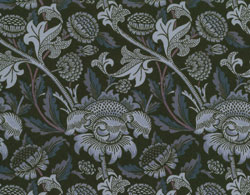
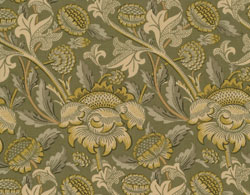
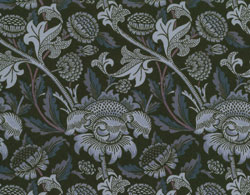
Wey, a reproduction from the Moda collection A Morris Tapestry

Nature was William Morris's muse. His careful observation of plants and birds are one reason his fabric designs remain so current today. He captured the essence of the bloom and worked it into a complex repeat of layers of curving lines.


Design for Wey by William Morris

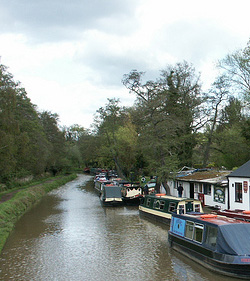
The lines in the repeat also reflected his feeling for nature with stems and branches standing for the rivers and streams of England. He created several designs named after waterways. The Wey is a river that runs through Surrey, Hampshire and West Sussex, joining the Thames River at Weybridge.


The River Wey

The interlaced lines in the pattern are thought to represent the river and its tributaries. The major line in Wey is a strong diagonal with stems interlaced behind it.


Morris's drawing for Wey,  partially colored


The Wey has long been a navigational river.


Wey was designed by William Morris about 1883, originally meant to be blockprinted on cotton broadcloth and on velveteen (the red piece above is on velveteen).
.
In recoloring Wey for A Morris Tapestry I toned down that diagonal line. Directionality that works well for upholstery and wallpaper is often too strong for patchwork.


For the border and setting triangles on my pineapple log cabin
 I'm using Wey in the damask black colorway .


Right now I am handquilting along the diagonal lines, the tributaries.

See more information about the River Wey by clicking here:

http://www.weyriver.co.uk/theriver/nav_2_%20history.htm

And see the Textile Blog for more information about Morris's other prints named for rivers---Windrush, Cray, Wandle, Medway, Evenlode and Kennet:
http://thetextileblog.blogspot.com/2009/12/william-morris-and-thames-tributaries.html

One can take a boat tour of the River Wey.  

Thursday, December 16, 2010

J.H. Dearle's Daffodil

Daffodil from my new Moda collection
A Morris Tapestry
Damask Black Colorway

As William Morris aged he turned over the supervision of Morris and Company to John Henry Dearle (1860-1932), known as Henry. Dearle had begun as a showroom assistant when he was an 18 year-old art student and graduated to designer. After Morris's death in 1896 he became Art Director. Linda Parry, the expert on Morris design, has counted 25 Dearle designs in repeating textiles (Morris did 36).*

Morris's Wey design, also in A Morris Tapestry

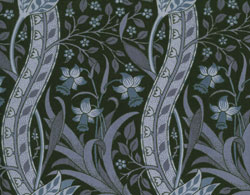
For his early designs Dearle tended to copy flowers and leaves from Morris's patterns, combining them in new repeat, not much different from Morris's characteristic designs. He gradually developed his own style, typified by Daffodil from 1891. Morris had often used a diagonal set to his florals, but Dearle alternated the flowers here with a bold vertical stripe.

We've done the Daffodil print in seven colorway,
above Wardle's Sky Blue and Fennel Green, left and center.

Morris's line is often subtle; in this piece the stripe dominates.


An original print or document print
Morris would not have used the bright pinks, blacks and bitter yellows in this version of Henry Dearle's Daffodil. As the Arts and Crafts Movement style evolved into Art Nouveau unusual color combinations obtainable with synthetic dyes became the fashion.
Dearle adapted Morris's emphasis on nature to new Art Nouveau sensibilities and color. The block print for Daffodil required ten blocks for the color combinations, which came from synthetic dyes. Dearle understood the changing direction of the Arts and Crafts movement. His Daffodil design for wallpaper and print was one of the firm's most popular sellers.


Poster by Alphonse Mucha (1860-1939).
Mucha, Henry Dearle's contemporary, 
pushed Art Nouveau principles
 and color to create a popular style. 


Prints were one facet of Henry Dearle's interests. He also designed carpets, tapestries and embroideries as well as stained glass. His son Duncan W. Dearle (1893-1954) specialized in glass and when Henry died on January 15, 1932, Duncan took over the firm. But by the 1930s modernism ruled and the Morris firm went into decline, going into liquidation in 1940.

See more of Dearle's work by searching for "Dearle" on the search page of the Victoria and Albert Museum's website. Click here:
http://collections.vam.ac.uk/

And see an earlier post about him by clicking here:
http://barbarabrackman.blogspot.com/2009/09/morris-workshop-designers.html

The Textile Blog has a post about his tapestries
http://thetextileblog.blogspot.com/2010/06/later-tapestry-work-of-john-henry.html


*Linda Parry, William Morris Textiles, Viking Press, New York, 1983. There is a picture of Henry Dearle on page 70, a sketch showing him looking exactly like an Edwardian gentleman who lived into the modern age.

Saturday, December 4, 2010

Morris Tapestry Blues


I'm thinking snow
And indigo blue.

Variable Star block from about 1850 in an indigo blue print

Wey in the Kelmscott Indigo colorway
We're offering lots of blues in my William Morris reproduction collection A Morris Tapestry---a snowstorm of blues.


Designer William Morris loved indigo. He and his dyer Thomas Wardle (right) worked hard
to produce a variety of blues with the old fashioned dye.


Although we use synthetic dyes today we've also worked hard to get a good range
 of blues from light to dark in A Morris Tapestry.

You might want to start a winter project with a traditional star and a wintery mix of blues.

The blocks in these sketches are 10 inches. See rotary cutting directions below.
In both quilt designs the stars are set next to a second pieced block and use a variety of the blue prints.

Drifting Snow
82" x 82"


The alternate block is a square pieced of 2 half-square triangles, turned in 2 directions.
For 10" finished blocks cut squares 10 7/8" and cut in half diagonally.
You need 24 of these blocks, so cut 12 light squares and 12 dark squares.

Blizzard
82" x 82"
Same star arrangement but the alternate block is pieced of 4 triangles.


For 10" finished blocks cut squares 11 1/4" and cut into 4 triangles.
You need 25 of these blocks, so cut 12 light squares and 12 dark squares.

The lovely Japanese prints are from the Library of Congress collection. They have a large collection of 19th-century woodblock prints online.
Click here:

And see other posts about indigo blue and Thomas Wardle by clicking here:


Cutting the 10" finished star blocks:
For each quilt you will need 12 light stars and 13 dark stars.
For each star....
A Cut 4 squares 3".
B Cut 1 square 6 1/4". Cut into 4 triangles with 2 diagonal cuts.
C Cut 4 squares 3 3/8". Cut into 2 triangles with 1 diagonal cut.
D Cut 1 square 5 1/2".

Cutting the 6 inch finished border:
I'd use one of the large-scale prints.


Wey has a diagonal direction;


 Daffodil runs parallel to the quilt's edge and


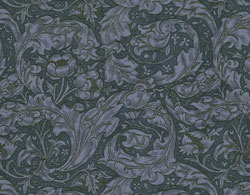
Bachelor's Button is less directional.
You'll need 2 1/3 yards. Cut the borders before the blocks and you'll have left-overs for the blocks.
Cut 4 strips 82 1/2" by 6 1/2".
Miter the border corners.