QUILTS & FABRIC: PAST & PRESENT


Showing posts with label IQSC. Show all posts

Monday, May 9, 2011

IQSC Quilt of the Month

Original design, Medallion. Frances Hawkins. Made in United Kingdom, dated 1818. Mosaic patchwork technique and appliqué. 96” x 85”. Collection of the International Quilt Study Center and Museum #2006.035.0001. Purchase made possible through James Foundation Acquisition Fund.

If you subscribe to the Quilt of the Month email from the International Quilt Study Center and Museum you were treated to a view of this quilt for May. The unquilted mosaic medallion is one of the twenty template-pieced bedcovers that will be on display at the Museum in Lincoln, Nebraska from May 28, 2011 through January 11, 2012. Elegant Geometry: American and British Mosaic Patchwork is curated by Bridget Long. Click here to see more about the show:

http://www.quiltstudy.org/exhibitions/online_exhibitions/mosaic.html

I recently got to study this quilt closely. I am always thrilled to see an early quilt and especially one with a date inscribed so I can see what kind of fabrics were in use at that date. Frances Hawkins used some very bright yellows. The yellow-ground chintz was popular here in the teens too.


Some of the prints, like the red on blue spade design, look to be block printed. The figure is very crude. Others look like the latest in roller prints. The European mills were making great strides in detail and color combinations during the first twenty years of the 19th century and Frances seems to have had all the latest fabrics.


Here's a side view of the tree that comes out of the basket in the center. Notice in the rosette below the bird are two hexagons with precisely positioned stars. I thought I'd seen that print before....


I found something very similar in my picture files. This mosaic quilt was sold online several years ago and had the same kind of strange pinstripe with a crudely printed star. The two quiltmakers each fussy cut the star (to use a new term for an old idea.) The other quilt is dated 1825 and signed with the initials L.F.


The star prints aren't exactly the same but they both look like the stars are stamped, stencilled or free-hand painted onto a roller-printed pinstripe. The similarities raise many questions.
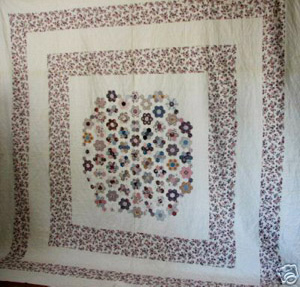
Overall view of L.F.'s quilt
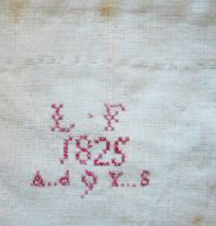

L.F
1825
A..d 9 Y...S
(Aged 9 years)

Contrast these two British quilts (I am guessing L.F.'s quilt was made in Great Britain although it is now in America) with the American made quilts in the previous post: Quite a difference between our domestic prints and the European prints in the first few decades of the 19th century.

Plan to go to Lincoln to see the Elegant Geometry show at the International Quilt Study Center and Museum. You'll have a wonderful time looking at the quilts and the prints.

If you don't get the free Quilt of the Month email you should sign up here:
http://www.quiltstudy.org/collections/quilt_of_the_month/join.html


Wednesday, May 4, 2011

Civil War Memory Quilts

Barb Vedder who is half of the blog Fun with Barb and Mary sends photos of two Civil War commemoratives. Above is a block challenge for which she adapted a pattern from my book Civil War Women.


Jeff Davis's Daughter
by Nancy Hornback, Wichita, Kansas
1996

See our inspiration, Lucinda Honstain's "Reconciliation Quilt" in the collection of the International Quilt Study Center and Museum #2001.011.0001, which has a block with Jefferson Davis and his daughter Maggie in the second row. Click here:


And here's Barb's medallion top. I thought people would want to know who printed the pictorials because they are such a great thing to add to the Civil War fabric stash, so I asked her if she recalled any names of collections.
Her answer is an impressive piece of memory work:


"Here are some of the lines that I used to create this quilt. I'm also a selvage quilter and had set aside a zip lock full off them from this project. I'll have to remember to do this in future as it worked well as a fabric reference.

Old Glory by Sara Morgan for Blue Hill
Bonnie Blue's America by Paula Barnes of Bonnie Blue Quilts
Commemorative Collection by Nancy Gere for Windham Fabrics
Civil War VII by Nancy Gere for Windham Fabrics
Fairmount Park - Industrial Revolution by Nancy Gere for Windham Fabrics
Coverlet Collection by Mary Koval for Windham Fabrics
Shirting prints by Jo Morton for Andover Fabrics
Heritage Classics by Judie Rothermel for Marcus Fabrics
Civil War Tribute Collection - 150 yr Anniversary by Judie Rothermel for Marcus Fabrics
America the Beautiful by Judie Rothermel for Marcus Brothers Textiles
Patriotic Legacies by Laurene Sinema for SSI

and more....being a scrap quilter, I use all and any motifs and colors that I feel work with the piece I'm making. I feel that any patriotic or Americana fabrics would work well for this kind of medallion quilt."

See Barb's post here:
http://funwithbarbandmary.blogspot.com/2011/04/girls-just-wanna-have-fun.html

And here's a link to a print-on-demand version of Civil War Women with the Maggie Davis pattern in it.
http://www.ctpub.com/productdetails.cfm?PC=1857

Wednesday, April 27, 2011

Snakes


It's that time of year to keep an eye out for snakes in the garden. And it's always time to look for snake quilts.


I've been collecting pictures of snake quilts for several years. Many of these are not what you would call "book patterns." They seem to have been handed around or made up by a creative and geometrically talented quilter.


You can find some of the published versions indexed in my Encyclopedia of Pieced Quilt Patterns

 Many are just fan blocks that form a trail. The one above is a regular fan block that's arranged in concentric rings.


This one's similar but the fan "handle" matches the background so it works a little better as a snake.

This is a double fan, with one fan larger than the other. This is probably the most effective pattern if the two fans are drawn with the right arc so the eye moves easily from block to block.

The quilt above was probably made from this design. It is BlockBase# 3355, called Whirling Fans by the
syndicated Laura Wheeler newspaper column in the 1930s.

The secret to the perfect snake is getting the arcs to connect visually.
The commercial patterns really didn't do that so people seem to have redrawn them.
I don't think the one below was pieced as blocks.


Here's the ultimate snake quilt, 2 arcs to a block and snake heads and tails in the border. I THINK it belongs to Emory University in Atlanta.


It's hard to believe there isn't a commercial pattern source for all these that work so well from the 1930-1960 era.

Here's a variation.


Sort of like this fan, just alternated in rows.
Again, it's hard to believe I haven't found a commercial source in the 1930s for the pattern above.

Green Snake by Susie Ponds

Surprisingly there is an Encyclopedia and BlockBase number for this one that seems so folky. It's #3350 and was in the Kansas City Star twice, once as the Rainbow quilt and once as The Drunkard's Trail.
In Alabama it's called Green Snake.

The Alabama quilters have solved the arc problem, getting the line to undulate in snake-like fashion.
See two more Alabama Green Snake quilts in the collection of the International Quilt Study Center and Museum by clicking on these two links to the Robert & Helen Cargo collection:
http://cdn.firespring.com/images/770aef18-2e1b-4dac-b8e1-3307cd6f6820.jpg
"Green Snake Quilts" (2000.004.0090) by Mary Maxtion and (2000.004.0101) by Lureca Outland

Here's another one, a black snake I guess.
Click to see a link that shows how to draft a snake:

 I made  one in the mid 1990s.
I alternated two blocks each with a different curve.

There are several new commercial snake patterns out there.
Karen Stone has a Rattle Snake and below is Denyce Schmidt's Snake Charmer

Mabry Benson is showing her snake variation popular with the East Bay Heritage Quilters in Berkeley, California, a few years ago.

Snake Trail pattern from
Raggedy Stitches in Australia
Click here for information on the pattern:
http://www.raggedystitches.com/quiltpatterns.html

Read Pepper Cory's post on her Quilt Flap blog
http://quiltflapper.blogspot.com/2008/11/wahoo-back-on-blog-again-googles.html
The snake she shows from eBay is very scary.

Sunday, December 26, 2010

Marseille: White Corded Quilting


The International Quilt Study Center and Museum in Lincoln, Nebraska, is featuring an exhibit of whitework until May 22, 2011.

The show is guest curated by Kathryn Berenson, author of Quilts of Provence and the new Marseille: The Cradle of White Corded Quilting.


Denniele took a trip to Lincoln and sent photos. Whitework is often hard to photograph but the show is so well-lit and she is so handy with her point and shoot that her photos will inspire you to make a trip.


Here's what the IQSC site has to say about the show:
Marseille: White Corded Quilting, the first major display in the world of all-white quilted and corded French needlework,  explores its development in Marseilles, the fusion of technique with design imagery, and the integration of this needlework into other cultures as it was exported, adopted and re-transformed over three centuries in three continents.


Broderie de Marseille is a form of three-dimensional textile sculpture using plain white cloth and white cotton cording, deftly manipulated with needle and thread to reveal patterns highlighted by the resulting play of light and shadow on the textile surface. Skillful execution of broderie de Marseille resulted in delicate, refined work that graced the homes and figures of aristocrats and launched an international passion for all-white corded needlework. The quilted works were filled with imagery expressing contemporary values, such as folk legends (Tristan), heraldic devices and royal monograms (on bedcovers), and floral wreaths an fruits symbolizing good fortune and fertility (on wedding quilts). Contemporary versions, today often referred to as "matelasse," are machine made and thus lack the intimate connections to the work represented by the confections of the original needleworkers-almost all of them presumably women.
Click here to read more:
http://www.quiltstudy.org/exhibitions/online_exhibitions/marseilles.html

Friday, July 30, 2010

Seneca Falls Star

Seneca Falls Star
by the Sew Whatevers
(Roseanne Smith, Georgann Eglinski, Barbara Brackman,
 Sarah Fayman, Carol Jones, Nicki Listerman, Janet Perkins, 
Wendy Turnbull, and Jerrye VanLeer)
Lawrence, Kansas, 2009
87" x 87"

The Sew Whatevers  reproduced a quilt from the International Quilt Study Center and Museum to raise funds for the Kaw Valley Quilters Guild.


Roseanne made the center star from fabrics Barbara and Terry Thompson designed years ago for Moda. The collection was called Seneca Falls. The fabrics echoed mid-19th century prints and the names honored leaders in the era's women's suffrage movement.
 
Georgann hand-appliqued the Oakleaf and Reel designs for the edge of the star. The group pieced the diamond border and Lori Kukuk machine-quilted it.


Our inspiration was a terrific mid-19th century quilt in the collection of the International Quilt Study Center and Museum in Lincoln, Nebraska. Click on the link below to see the original (#1997.007.0660). It's possibly from Pennsylvania, in the James Collection, and done about 1840-1860 in indigo prints with golden yellow figures.
 

http://www.quiltstudy.org/includes/photos/quilt_database/large/1997_007_0660.jpg?PHPSESSID=bf577b00549c9bc75d5e8453048f8943

Our reproduction quilt will go to its new owner on September 20th. That might be YOU. Email Barb L at kvqg@sunflower.com for information about tickets---$5 for six.
Click here for more information:
http://www.kawvalleyquiltersguild.org/opportunity_quilt_2.html

Saturday, February 27, 2010

The Douglas County Bank Quilt

The Douglas County Bank Quilt
The Seamsters' Union Local #500
Lawrence, Kansas
1987
Collection of the International Quilt Study Center & Museum

A member of the Seamsters' Union was scrolling through the quilts at the International Quilt Study Center & Museum website recently and came across this quilt that our sewing group made in 1987.

Developers and preservationists were at odds. The above mentioned bank, situated at the edge of a lovely Victorian neighborhood, felt they needed a giant parking lot and bulldozed a block of houses at dawn one morning before any one could protest that the historic buildings were worth saving.


We had no preservation organization and no state laws with any teeth in them to prevent such destruction. Those of us who valued the architecture in our historic town could do nothing but watch in frustration.

[These photos aren't of the neighborhood---but one crushed house looks pretty much like another crushed house.]


We did take our money out of the bank---emptying several accounts amounting to the high two figures.


The Seamsters decided we'd strike back with a quilt depicting the bank as the aesthetic villains they were.


 Our inspiration was a quilt Jean Ray Laury'd made about a California earthquake in which she silk-screened broken houses.

 One Seamster recalls:
"I remember stenciling the border caption, and I remember making and cutting up house blocks. My most vivid memory is setting it up on a quilt frame at the public library and inviting people to stitch on it until [representatives of the banking and development interests] pitched a fit and got us thrown out."

We then moved the quilting frame to a public park and spent some summer evenings quilting the bank's logo into the background. The quilt was published in Americana magazine, April 1988. We raffled it off to raise money to start a preservation organization. The lucky winner has apparently donated it to the IQSC.

The words we stencilled on the border:
Douglas County Bank Quilt. June 27, 1987, The Most Destructive Single Day in Lawrence Since Quantrill's Raid.

A depiction of Quantrill's Raid during the Civil War when the town was burned.

See our quilt at the International Quilt Study Center & Museum's website by clicking here:

Friday, September 18, 2009

Hannah Haynes Headlee

Basket of Roses Medallion by Hannah Haynes Headlee, Topeka, Kansas, 1938

A few days ago the little sister of my much-missed old friend Marie Shirer brought a great quilt to my class. Carolyn had inherited the quilt above from her parents. Her father's mother's sister (Carolyn and Marie's great-grand aunt) was Hannah Headlee, an applique quilter extraordinaire.

Hannah Haynes Headlee 1866-1943

Hannah was a painter who did watercolors and china painting. One of my favorite quilts in the whole world is her Iris Garland, which is now in the collection of the Kansas Museum of History. Click here for more information: http://www.kshs.org/cool2/coolquil.htm

Iris Garland by Hannah Haynes Headlee, Topeka, Kansas, about 1935. Collection of the Kansas Museum of History.

A few of Hannah's seven known quilts are still in the family; Carolyn's cousins inherited some.
Cranes by Hannah Haynes Headlee, Topeka, Kansas, about 1934


The Peacock by Hannah Haynes Headlee, Topeka, Kansas, about 1932. Collection of the International Quilt Study Center and Museum.

Marie, Carolyn and I had lost track of the Peacock and I told Carolyn I would look around for it. I found it in the IQSC, a good home.

See their picture of it here: http://www.quiltstudy.org/includes/photos/quilt_database/large/2005_024_0001.jpg

You'll notice Hannah's unique border style---sort of a gothic swag.