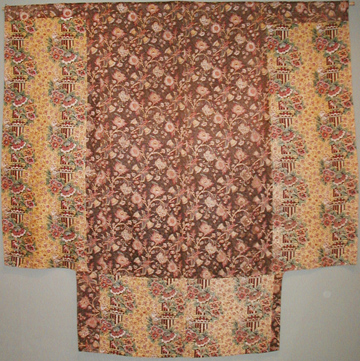
A mockup of the pillar print in my Lately Arrived From London repro collection.
Every early 19th-century reproduction collection needs a pillar print.
Pillar prints were popular in the early 19th century when new dye ideas
enabled printers to put bright color next to bright color.
The designs echo the classical architecture of ancient Greece and Rome with stripes assuming the form of fluted columns interrupted by ornate capitals and garlands of flowers.
A tea-ground chintz print from about 1815.
The reds here were probably printed by copper cylinder,
the blue, yellow and overprinted green added by blocks or hand.
Other names for the style are “architectural prints” or "columnar prints."
Monochrome patriotic print.
One indication of a roller or cylinder printed fabric is the short repeat.
Roller-printed design repeat about every 15 inches.
If this were printed with a larger copper plate
the repeat would be over twice as wide.
The term "pillar print" seems to be rather recent, a mid-twentieth-century name. The earliest reference I have found by searching Google's digitized books is in a 1956 British publication. The term is more commonly used to describe Japanese wood blocks on paper, in which a pillar print (hashira-ye) is a long, narrow print meant to hang from a wooden pillar in a house.
Detail of a whole cloth quilt.
Stripes inside a stripe.
Pillar prints were popular for decorating before 1830 or so.
Florence Montgomery noted an English printer's mention of a chintz with pillars and garlands in a 1760-62 notebook, which may be the earliest reference to the design idea in a print, but surviving examples printed with woodblocks date only to the end of the 18th century. The pillar prints we come across in American quilts tend to be from about 1800-1830 and usually printed by a roller.
Stripes pieced into strips. Two different prints in a strip quilt.
The same pillar print as above but a different colorway.
And another colorway.
English museum curator Peter Floud wrote a series of articles for The Magazine Antiques on "English Printed Textiles" in 1957. He examined four English printers' pattern books in the collection of London's Victoria and Albert Museum and the Musee de l'Impression of the Societe Industrielle at Mulhouse, France. Floud's conclusions remain the standard scholarship fifty years later.
"The pattern books show that [pillar prints] enjoyed two quite separate spells of popularity; the first between 1800 and 1808, when a very large number of polychrome block-printed pillar prints were turned out by all the leading English printers; the second between 1825 and 1830, when it was revived as a vehicle for some of the finest roller-printed designs ever produced. It appears in both cases to have remained a purely English phenomenon, without any parallel among French printed fabrics."
Architectural prints were popular with American quilters
between those two periods of production.
At top of this photo the document print for the pillar print
in the Lately Arrived from London reproduction collection.
At bottom a tea-ground and a white-ground colorway.
A utilitarian four-patch with a
pillar print in the border along the top.
For the quilt detective looking to date a quilt rather than a piece of fabric the best estimate might be range of 1800-1860. The fabric may have been unfashionable for interior decoration in the 1840s but quilters continued to salvage patches from their old drapes for decades.
One does not often come across pillar prints in borders and strips,
but look for them as scraps.
Quilt from the Spencer Museum of Art, about 1830.
Several years ago Terry Thompson and I
reproduced this print for a Moda reproduction collection.
Above is the document.
Here's the reproduction with a chocolate ground.
Buy 5 or 6 yards when you find these pillar prints as they make terrific borders for quilts copying an early 19th-century look. [I always tell you to buy 5 yards, but better to be safe than sorry.]
Kathy Ronsheimer didn't buy ENUFF,
so she had to cut the pillar in two for a border for her
version of Jeana Kimball's Old Voices New Impressions sampler
But it all worked out nicely, don't you think?
Click on the link to see Florence McConnell's reproduction quilt using a pillar print
http://www.americanquiltstudygroup.org/qs_star_study05.asp