QUILTS & FABRIC: PAST & PRESENT


Sunday, November 6, 2011

Encyclopedia of Pieced Quilt Patterns Out of Print

I had some unsettling news.
 My Encyclopedia of Pieced Quilt Patterns is out of print.
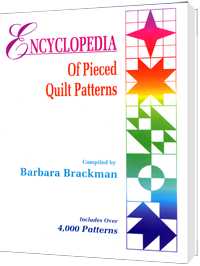

I know, I know the book is dead


An old-fashioned format for information....

But how are you going to figure out the name of an old quilt pattern?

#1493 Square and Compass
About 1890


Lost Ship by Barbara Brackman
#1362
Where are you going to get ideas for new ones?


I still have a copy. (Not in the best of shape as I use it nearly every day.)
If you don't have a copy you'd better get you one now.
The new books are twice the price they were a few months ago.
The used books are still reasonable.


It's been in print since 1979 in some form or another but people are still discovering it.
Click here to read Faith's post about it.
and LuluBloom's

It's pretty low-tech. I typed it on an IBM electric typewriter (with variable spacing)
 and drew the pictures on gridded paper.
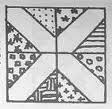

I photocopied copies for ten years and then AQS published it in hard back about 20 years ago.

I drew each one of those little blocks an inch square and tried to draw a tiny fabric pattern that the photocopy machine wouldn't blur or splotch.


I am sure that there will be some kind of higher tech version of this book in the future (and of the digital program BlockBase---also out of print.) But until then....


It's back to the used bookstore.

Wednesday, November 2, 2011

Morris And Company Anniversary Stamps


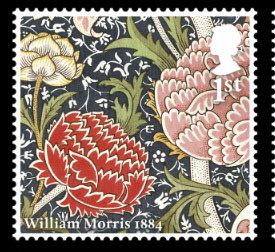
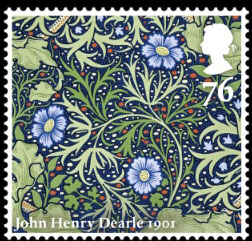
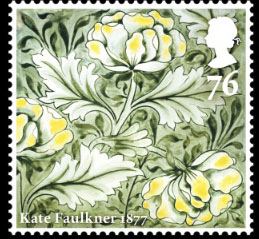
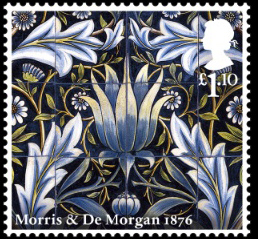
2011 is the 150th Anniversary of the founding of William Morris's firm and the United Kingdom's Royal Mail is celebrating with an issue of six stamps. The firm is described as " one of the most influential enterprises in the history of British design and manufacturing”.
The individual stamps feature designs from artists/partners who worked in the Morris & Company workshops. Each stamp has the date of the design featured on that stamp.


The print chosen for the stamp honoring Morris is Cray 1884, which is similar to the print Wandle in my new collection Morris and Company for Moda.

Wandle  Reproduction
The diagonals represent the rivers and streams in Morris's landscape.


Dearle's stamp is his Seaweed print from 1901


 Kate Faulkner 1877

 Morris & De Morgan 1876

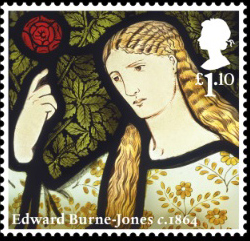
 Edward Burne-Jones c.1864
The First Day Cover
The stamps were issued in May
William Morris fans might want to own a set.


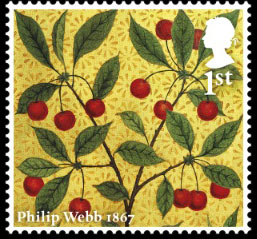
Philip Webb 1867

Friday, October 21, 2011

1862 Battle Hymn


The November/December issue of McCall's Quilting has three ads for Civil War reproduction prints!
I think mine is the best.


Click here to see more about this Christmas issue:


My fabric will be shipped to quilt shops in January, but the precuts should be out during the holiday season.
The ad has a sneak preview of the project pattern that shops can offer with the fabric.

1862 Battle Hymn
by Barbara Brackman and Susan Stiff

The pattern is a variation on a design known as Jacob's Ladder that was also called Underground Railroad by Ruth Finley in her 1929 book. We added three Bella Solids to the project in red, ivory and brown for some kick.


The block's a simple nine-patch that can be shaded and set in many ways...

Antique Quilt from about 1900
...resulting in many effects. It was most popular in the 1890-1920 years

Another antique in two colors

Here is one from Laura Fisher's online antique quilt shop.

There are always variations for sale in online auctions.

Read more about the 1862 Battle Hymn fabric here:
http://www.unitednotions.com/fcc_1862_battle_hymn.pdf

Tuesday, October 18, 2011

Chrome Yellow

Quilt in a regional design from Tennessee and Texas
Most of the yellows we see in 19th-century quilts were dyed with chrome.

Sampler block, 1840-1860
Chrome yellow and chrome orange

Chrome yellow is closely related in chemistry to chrome orange (what we call cheddar today). It's a true yellow that the dyers called canary yellow.

Pennsylvania quilt 1880-1910


Swatch glued in a 19th-century dye book
 showing chrome or canary yellow.
 The color changes when it comes in
 contact with certain chemicals---
like the acids in an old book's pages.

Observation indicates that the chrome orange shade was more popular for backgrounds and accents, but many quilters made good use of the bright, clear canary yellow.

Chrome yellow could be bought as a solid or a print.


Pennsylvania, end of the 19th century.

The color was important in Pennsylvania German design, which emphasized bright next to bright.

So we see many Pennsylvania quilts using the color.

Block about 1840-60
Quilters all over the country used it, however.

The chrome yellow process was developed early in the 19th century, but we really don't start seeing a lot of it until the 1840s when it became important for applique and piecing.

It's difficult to determine whether a print is 1860 or 1890.

The common combinations were red and black (dark brown) figures on yellow grounds.

The major difference between mid-century prints and those from the end of the 19th-century is that the later prints became more standardized. There just wasn't a lot of variety. Mills printed the same design in the same color for decades, marketing them as old-fashioned calicoes.


Top from the 1940s?

Apron from the 1960s or 1970s.

The yellow prints were almost the same for a hundred years.
But then... they stopped printing them about 1980.

Until now!

Reproduction of a classic yellow print 1860-1980

Here's a reproduction of a 1960s interpretation of the old prints---
 a repro of a repro that Moda and I are doing in a collection of
Old Fashioned Calicoes.
Start thinking canary and click here.