QUILTS & FABRIC: PAST & PRESENT


Thursday, August 12, 2010

Chris Wolf Edmonds

Chris Wolf Edmonds will be showing her textiles
at the Strecker-Nelson Gallery in Manhattan, Kansas from August 6 to September 11.
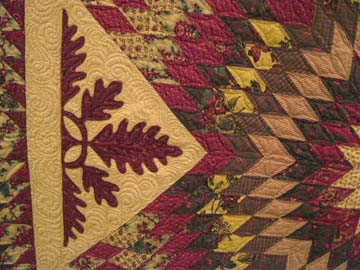
The detail above is from Dandelion Pinwheel-Journal Entry 8 May


Seasonal Shifts: Dandelion Pinwheel by Chris Wolf Edmonds
32" x 32"

Her pieces in the Seasonal Shifts series will be part of a group show.
Chris pieces textiles inspired by nature, using her own hand-printed and hand-dyed fabrics.


Seasonal Shifts: Dragonflies by Chris Wolf Edmonds
32" x 48"


Seasonal Shifts: Frost-Edged Leaves by Chris Wolf Edmonds,
 32" x 48"


Seasonal Shifts: Young White Oaks by Chris Wolf Edmonds,


32" x 32"

 
Through the Trees: Solstice Moon by Chris Wolf Edmonds, 2001

She has several pieces in the collection of the International Quilt Study Center and Museum including this one from her Through the Trees Series.

Click here to find out more about the gallery:
http://www.strecker-nelsongallery.com/index.html

See a gallery of the work she's showing there by clicking here:
http://www.strecker-nelsongallery.com/Artists_nu/Edmonds/EdmondsSlideShow/index.htm

See another of her pieces in the IQSG collection by clicking here:
http://www.quiltstudy.org/includes/photos/quilt_database/large/2005_005_0002.jpg?PHPSESSID=bf577b00549c9bc75d5e8453048f8943

Tuesday, August 10, 2010

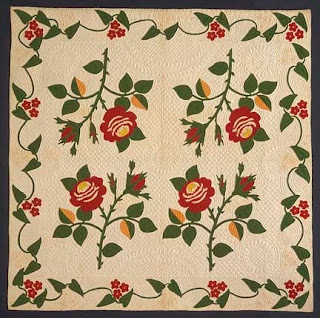
Moss Rose


Moss Rose by Susan Black Stayman
Made in 1853 according to family history.
Collection of the Spencer Museum of Art at the University of Kansas
Gift of Miss Mary Stayman

I've been collecting information about these 19th-century rose quilts for years. I volunteer as quilt curator at the Spencer Museum where this particular quilt is one of the treasures. We put it on the cover of the catalog of floral quilts published with Kansas City Star books.


The pattern is indexed in my Encyclopedia of Applique on page 119 as #37.293

Mary Stayman of Leavenworth, Kansas, donated the quilt with several other family pieces. She was an acquaintance of Carrie Hall who pictured the quilt under the family name Moss Rose in her 1935 book The Romance of the Patchwork Quilt. Mary's mother Susan Black Stayman made the quilt in Illinois in the early 1850s, according to the family story.

Distinctive as the quilt is, there are others. The one below was recorded in the Iowa Quilt Project and pictured in the Quilt Index.


I took the photo above at an American Quilt Study Group seminar in Washington several years ago.
The quilt belongs to a museum in Yakima.

And here's a detail of a similar four-block quilt from the Michigan Quilt Project, made by Elmira Kibler.


For a view of the whole quilt click here:

These quilts have so much in common we have to assume the quiltmakers passed a pattern around. Aside from the four-block format the quilts have similar details. The roses all have reverse-appliqued slashes to give them depth.

Slashed roses aren't that unusual. Here's a late 19th-century version.

Other more distinctive details: Stems on the 4-Block Roses often include thorns. The rosebuds have detailed, feathery edges. Some of the quilts feature split leaves done in yellow and green. The Michigan quilt, which hasn't the split leaves, has both green and yellow leaves.

The Stayman family called their quilt the Moss Rose. Gardeners are familiar with what we call a moss rose today, a short sun lover named Portulaca grandiflora.


But a moss rose to a 19th century American meant a variety of true rose.


Above is a Currier and Ives print, The Moss Rose, featuring two-tone leaves and detailed buds. Victorian gardeners knew the moss rose as a hybrid with sticky, aromatic "moss" on the stems and leaves.


Here's another 19th-century print of a moss rose,
and below a photo showing the "moss" growing around the bud.


We rarely get a glimpse into the names that 19th-century quilters gave their designs. With this distinctive pattern the name Moss Rose seems authentic.


Detail of Susan Stayman's Moss Rose

Read more about growing vintage Moss Roses here:

Friday, August 6, 2010

Digital Toys in Arnold's Attic

It's been fun waiting for my Arnold's Attic reproduction collection for Moda to arrive. It's scheduled to be in shops in August. I've been digitally doodling with my Electric Quilt and BlockBase programs and the swatches available on the Moda website.

The colors in the line tend to be earth colors: muted orange, brown and green with a lot of blue.

Here's a traditional Spider Web design that I found in my BlockBase digital library of patterns. The pattern was fairly popular about 1900, the time period we are recreating with the prints.


I found the pattern in BlockBase; transferred it to EQ (Electric Quilt) and recolored it with the new fabrics. 
If you have EQ you should try loading pictures of the individual prints into your color palette like I did. See the link to a tutorial below. What you want to do is save pictures of the prints as jpgs and then create your own fabric library.

An easy way to load pictures is to buy the EQ Stash program. The Spring 2010 edition includes Arnold's Attic.

After doing several mockups using BlockBase's traditional patterns I started thinking about doing a "Modern" quilt. I noticed Karrie Lyne's pattern for a quilt she calls Random Reflections on the Moda Bakeshop website. She's used 2-1/2" Jellyroll strips of Fandango fabrics plus yardage to create this strip quilt.


See her tutorial at the Moda Bake Shop by clicking here:
http://www.modabakeshop.com/2010/07/random-reflections.html#more

I drew her 10" blocks (36 of them) in EQ and filled in the strips with prints from Arnold's Attic. I turned it on it's side too.

One important part of Karrie's quilt is the solid contrast. She used plain white in hers.
Arnold's Attic doesn't have any solids.

I didn't whine, however. I realized that I don't need to have solids in every collection of fabric I design....
Because Moda has Bella Solid Basics. Above I used Rust (#9900-105)


I found some basic plains that coordinated with the prints but that were brighter or lighter to provide necessary contrast. This one is Figtree Olive (#9900-69). I love that Figtree palette and this color goes perfectly with the prints.


I tried 2 different shades of blue-green. The light one is Sage (#9900-35); the darker Dusty Jade (#9900-38). Karie designed this quilt to be made of 2-1/2" precut strips, Moda's Jelly Rolls, plus yardage.

If you are a digital doodler I suggest you do your planning by copying the Moda prints and plains into EQ. Click here to find out more about the Stash program that updates your digital drawings with the latest prints.

http://www.electricquilt.com/Shop/Stash/StashWEQ.asp

Here's an online tutorial about loading the jpgs yourself:
http://www.electricquilt.com/Support/FAQ/eq6FAQ/eq6_fabricLIB.asp#web

Here's where to find the swatches to save at the United Notions/Moda website:
For Arnold's Attic
For the Bella Solid Basics

And here's where to find information about the Electric Quilt program, the BlockBase pattern library and the Stash fabric library.

Friday, July 30, 2010

Seneca Falls Star

Seneca Falls Star
by the Sew Whatevers
(Roseanne Smith, Georgann Eglinski, Barbara Brackman,
 Sarah Fayman, Carol Jones, Nicki Listerman, Janet Perkins, 
Wendy Turnbull, and Jerrye VanLeer)
Lawrence, Kansas, 2009
87" x 87"

The Sew Whatevers  reproduced a quilt from the International Quilt Study Center and Museum to raise funds for the Kaw Valley Quilters Guild.


Roseanne made the center star from fabrics Barbara and Terry Thompson designed years ago for Moda. The collection was called Seneca Falls. The fabrics echoed mid-19th century prints and the names honored leaders in the era's women's suffrage movement.
 
Georgann hand-appliqued the Oakleaf and Reel designs for the edge of the star. The group pieced the diamond border and Lori Kukuk machine-quilted it.


Our inspiration was a terrific mid-19th century quilt in the collection of the International Quilt Study Center and Museum in Lincoln, Nebraska. Click on the link below to see the original (#1997.007.0660). It's possibly from Pennsylvania, in the James Collection, and done about 1840-1860 in indigo prints with golden yellow figures.
 

http://www.quiltstudy.org/includes/photos/quilt_database/large/1997_007_0660.jpg?PHPSESSID=bf577b00549c9bc75d5e8453048f8943

Our reproduction quilt will go to its new owner on September 20th. That might be YOU. Email Barb L at kvqg@sunflower.com for information about tickets---$5 for six.
Click here for more information:
http://www.kawvalleyquiltersguild.org/opportunity_quilt_2.html

Monday, July 26, 2010

Anna Williams and Inspiration

Quilt by Anna Williams

Occasionally an artist comes across a direction-changing inspiration for her work. Anna Williams has given that gift to many contemporary quilters. She's from Louisiana, born in 1927. Her quilts are hand-pieced of small shards, worked into powerful compositions.

The American Quilters Society showed her work in 1995 and published a catalog of the exhibit, Anna Williams: Her Quilts and their Influences by Katherine Watts with Elizabeth Walker. That catalog is now out of print, but several people are encouraging the American Quilters Society to reprint it.

Read more about Anna Williams by checking this site:
http://www.straw.com/equilters/annawilliams/index.html
Louisiana State University also gave her a show:
http://www.textilemuseum.huec.lsu.edu/joyfulimprovisationsvspg1.html

Among the artists who've been influenced: (Some are pictured---some require clicking)

Karen Griska
http://www.realwomenquilt.com/archives/KarenGriskaFeaturedQuilter.php 


Dorothy LeBoeuf

Nancy Crow
http://www.post-gazette.com/pg/08163/888833-42.stm


Deb Rowden
See her blog post about Anna

The Lazy Gal
http://lazygalquilting.blogspot.com/2010/04/love-anna-williams.html
http://lazygalquilting.blogspot.com/2010/05/still-loving-anna-williams.html


Nifty Quilts
See her blog


Cathy Tomm
http://www.exploringcreativity.com/featured_artist20_archive.html

Barbara Brackman
I'm still quilting on it


Another by Deb Rowden


Kathy at Material Obsession sent a picture and a description:
This quilt, called Madness, was inspired by one that Anna Williams did and I admired. The key to Anna's were diagonal lines crossing over the vertical and horizontal pieces... This quilt came together rather quickly from my scraps over the last six years and is one of my favorites.


And a small one Deb Rowden, Terry Thompson and I did together

See this photo set:
http://www.flickr.com/photos/whatkatiedidnext/sets/72157600011083006/

Eileen Lovett
http://www.realwomenquilt.com/archives/EileenLovett.html

Anybody else?
Send pictures or links.

Saturday, July 24, 2010

New England Road Trip

Feathered Star from the collection of the New England Quilt Museum


A parade entry from the Library of Congress collection

Pack the truck and fire up the GPS. Summer's a great time to go to New England and look at antique quilts.

You might want to plan your trip around some weekend events with shows of antique quilts. Maine Quilts 2010 will have a special exhibit I've Got the 19th Century Blues,  featuring antiques from the collection of Judy Roche, at their 3-day show at the Augusta Civic Center from  July 30th-August 1st. Click here: http://www.mainequilts.org/Quilt_Show/index.html


Sunburst with eagle border from the collection of the New England Quilt Museum

The Lowell (Massachusetts) Quilt Festival will be August 12th -14th. The theme is Images: The Best of Today's Traditional and Contemporary Quilts. There will be an exhibit of 12  blue and white antiques from the Collection of the New England Quilt Museum, which is in Lowell. See the blue and white quilts above.
http://www.lowellquiltfestival.org/specialexhibits.htm

If you miss those weekend events there is still a lot to see. In Lowell, The New England Quilt Museum's late summer exhibit is Contemporary Broderie Perse: An Elegant Revival (see my post of July 18th). Lowell is the textile history center of the U.S. with several museums. The American Textile History Museum's exhibit is Textile Revolution: An Exploration through Space.

http://www.nequiltmuseum.org/museum/current_exhibition.html
http://www.athm.org/exhibitions/current_exhibitions/


Appliqué Geometric Quilt by Nancy Simes Nutter Hoit Kaime,
Barnstead, New Hampshire about 1860. New Hampshire Historical Society.
Gift of Miriam and Deborah Page, in memory of Barbara Page Hutchins.

The New Hampshire Historical Society in Concord is hosting a year-long show. Pieced Together: New Hampshire Quilts and Their Stories features "Fifty quilts, patterns, and related quilt-making objects made during the 18th, 19th, and 20th centuries"  through January 10, 2011. Click here for information: http://www.nhhistory.org/museumexhibits/quilts/quilts_2010.html

Crazy Quilt from the Shelburne exhibit

This season's antique quilt exhibit at the Shelburne Museum in Shelburne, Vermont, is Embellishments: The Art of the Crazy Quilt, through October 24. The show features 19 examples of Victorian-era crazy quilts from the collection, including the piece shown above. They are also hosting a contemporary show: Alzheimer’s: Forgetting Piece by Piece, an exhibit of 52 quilts, many made by caregivers or family members of victims. Click here for more information: http://shelburnemuseum.org/visit/


And see blogger Ivy Long's photos of some of the crazy quilts by clicking here:

http://edera-faerie.blogspot.com/2010/06/unexpected-break.html


And view a set of photos showing conservators at work on a crazy quilt by clicking here:

http://www.flickr.com/photos/shelburnemuseum/sets/72157622542476324/

Thursday, July 22, 2010

More on Broderie Perse


Quilters are often surprised when they see Broderie Perse applique quilts up close. You can see that the blue-gray leaves are not cut close to the outline, but cut rather loosely into the white background.
Once you see that the cutting isn't quite as close as it looks in a photograph, you realize that the technique is not all that difficult.

Of course, SOME people like M.L.D, above, cut her florals and stems very closely in 1853. This makes it harder to cut, manage and sew.


The peacock's feet and perch are cut
freely from the white background.

The secret to making Broderie Perse relatively simple is to match the background color of both the chintz floral and the background fabric carefully.

That's easy when both backgrounds are white.


But it's not always easy to find matching backgrounds. See the blobby shape on the left which was a tan ground chintz. It just didn't work. If she was going to use a darker background she should have cut carefully around each rose as the quilter below did.


It looks like the backgrounds for her florals were brown so she had to snip close to the flower and do a lot more work.


Here's another antique quilt with leaves and flowers apparently cut from a dark background. The seamstress used a blanket or button-hole stitch to secure the applique, a relatively common technique.


The Sarah Morrell album quilt, which alternates pieced blocks and Broderie Perse blocks
Di Ford has done patterns for a reproduction from this mid-1840 quilt. Two bloggers from the Netherlands are posting their progress. Click on their blogs to see more of the process:


http://www.supergoof.web-log.nl/

And see this Secret Sewing Sisterhood blog:
http://secretsewingsisterhood.blogspot.com/2010/07/daughters-of-sarah-morrell.html

Traditional Broderie Perse is harder today because large-scale florals with white backgrounds are rare.
The lack of white background chintzes may be why the technique fell out of favor after the Civil War, when chintzes gained a "chintzy" reputation. But it is still possible to match backgrounds. Just forget white.


"Ohio Autumn" from my Moda collection Arnold's Attic

When planning to do Broderie Perse, pick out the large-scale floral, then find a color match for the background. Arnold's Attic has close color matches in small-scale prints for the shades in the large leaf print.


Occasionally designers do you a huge favor and give you a large-scale floral with a fancy background pattern PLUS yardage of the same fancy background pattern, as Kaye England did several years ago. Judy Severson made great use of Kaye's two prints---chintz print and matching background in this Broderie Perse quilt below.


See more about Judy's broderie perse quilts at a post I did earlier this year. Click here: http://barbarabrackman.blogspot.com/2010/01/judy-seversons-broderie-perse.html

One of the best ways to do contemporary Broderie Perse is to focus on black. Black-ground chintzes are easy to find today (although they were NEVER a traditional print style because blacks for cotton were not practical until about 1890.)


Roseanne Smith is making a Broderie Perse on black quilt. Here's a block with flowers cut out and arranged on a new background. She's ready to needleturn applique it.


Here's her leftovers. You can see she could cut general shapes because her blacks match so closely.

Here's one of her finished blocks.


This little quilt by Sujata Shah makes the most of matching blacks. That's just a strip of black-ground floral stitched above the vase. See Sujata's blog by clicking here: http://therootconnection.blogspot.com/


Logs and Leaves by Bobbi Finley
Bobby appliqued leaves cut from a dark ground print to her dark log cabin blocks.

If you've been doing Broderie Perse I'd love to see photos---in progress or finished.