QUILTS & FABRIC: PAST & PRESENT


Tuesday, August 9, 2011

Dogtooth Stars

 
We love regularity (some of us.)

But some of us love spontaneity.
A favorite find for me is a wacky star in a 19th-century quilt.

No templates involved here.

An eagle with a load of odd-shaped arrows and stars (late 19th c.?)

Reproduction eagle and star by me
These appliqued stars seem to be related to the dogtooth border technique where seamstresses slashed a strip and tucked under the points as they appliqued.


Appliqued dogtooth border


The stars were especially popular with eagles.
The stars could have 8 points, 6, 5 or 4.

Quilt dated 1898

4 points.

In the next post in a few days I'll show you how they did these free-cut stars.
Below are the allover views of some of these quilts.


See more about the dogtooth border at this post
http://barbarabrackman.blogspot.com/2010/12/dogtooth-borders.html

And more about the eagle design here last year.
http://barbarabrackman.blogspot.com/2010/07/eagles-and-eccentricities.html


Quilt dated 1848 with a scallop border and a many free-cut five-pointed stars.

Saturday, August 6, 2011

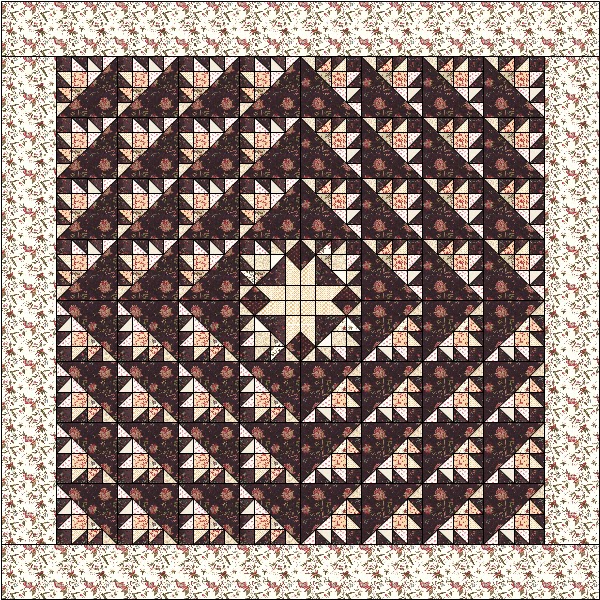
Delectable Mountains: 1812 Reproduction


Lately Arrived from London
Designed by Susan Stiff and Barbara Brackman
10" finished blocks; 76" Square

Above is the project quilt from my Moda reproduction collection called Lately Arrived From London.

Our inspiration was the pattern today called Delectable Mountains, a sort of medallion made from blocks.
The version above is from an online auction where blocks on point frame a chintz panel, probably finished about 1840. Examples date as early as the teens so it would seem to be an excellent design to recall the War of 1812 for the anniversary next year.


The basic block is a two patch cut in half diagonally.
 It can have any number of mountain peaks.


For our project Susan redrew the old block to make it scrappier.
With the medium-sized triangle broken up into three pieces it looks like a basket.
In all of her blocks the big triangle is medium or dark and the background is light as in the picture above.


I've been playing around with the block in EQ7.
Here the big triangle is light to match the background and it becomes the background.


To make the medallion set work you have to use an even number like 4 x 4, 6 x 6 or 8 x 8 block grids.This set leaves you with an empty area in the center but if you use the large chintz like the Seaflower the space  will not really be empty. It would be rather dramatic.


Quilters often filled that center area with a star. This antique has the blocks on point, the typical 19th century  set.


Here's a star in center with the blocks on the square. The easiest way to do this is probably to leave the big triangles off the four center blocks. Piece them to the sides of a star. With 10" finished blocks that center star should measure about  14-3/4" with the seams.

Above are the finished measurements. Add seams.

At the bottom of this page are instructions
 for cutting a star finishing to 14 1/4".


Quilters also put the blocks side by side, set on point.
Here's a detail of one from the 1840s or '50s with that buff and blue combination so popular then.

You could increase the complexity in the all-over on-point set by making half the blocks dark on light and half the blocks light on dark. You get a strip effect if you alternate them.


Dark on Light


Light on Dark


You could also set them on point in strips.
 The block really looks like a basket here.


Sawtooth Strip
I made this quilt 15 years ago or so. I was going to make a Delectable Mountains medallion but I got distracted. I turned the blocks into rectangles and stacked them up.


Part of the appeal in these patterns is the name.

The Delectable Mountains

The image comes from a Christian parable, an 18th-century book by John Bunyan called Pilgrim's Progress. Pilgrims named Christian and Hope came upon the Delectable Mountains from which they got a view of the Celestial City.
Click here to see the project pattern for Lately Arrived From London

The International Quilt Study Center and Museum owns several great examples of the Delectable Mountains pattern. Click here:
And here are examples from the Quilt Index
Cutting a variable star finishing to 14-1/4"
Corner squares - Cut 4 squares 4-1/8"
Large triuangles - Cut 1 square 8-3/8". Cut into 4 triangles with 2 diagonal cuts.
Small triangles. Cut 4 squares 4-3/8". Cut each into 2 triangles with one diagonal cut.
Center Square - Cut 1 square 7-4/8"
For these odd measurements you may have to do a little easing to get the star to fit the diagonal of the mountain blocks.

Wednesday, August 3, 2011

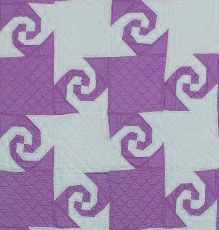
Snail's Trail

I've been thinking about challenging pieced blocks lately and I remembered what a challenge this Snail's Trail pattern is. Many years ago I made one for a niece born in Indiana. Indiana Puzzle is another name for it and I liked the negative/positive aspects of the design. Mine was red and green as I recall.
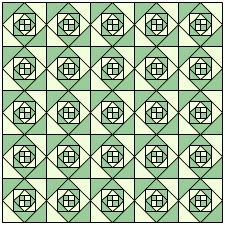

The block has several names and variations.
Ruby McKim called it Monkey Wrench or Snail's Trail in the 1920s.
Quilter's Newsletter called it Indiana Puzzle in 1976, which must be where I got the idea. Other names are Journey to California, and Whirligig Quilt.


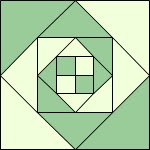
#2398 in BlockBase
It's not that hard to make---especially if you put a four-patch in the center and piece it on a paper foundation. Variations include more squares inside of squares inside of squares.

#2398 with shading
It's not that hard to make. It's hard to set it right and get the illusion.
Following that shading around in a circle gets confusing if you have a little spatial relations problem.


Note errors at left and on bottom.

This one's folded but that top left corner has a problem.


You can't just set the blocks side by side


You have to rotate every other block.

McKim and others suggested an alternate plain block and that makes it even harder to set---if faster to piece.

This is NOT the way to do it. It looks like lizards.


You have to rotate the rows and alternate the colors.
That requires a lot of heavy concentration for me.

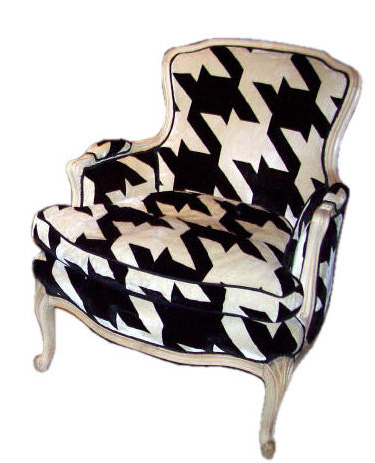
The illusion is based on what we call a hound's tooth check, an old weaving pattern.


A pattern that is still popular.
Here's an outfit by the late Alexander McQueen.

Carol Gilham Jones played with the pattern to great effect.
 I think this one is from the 1980s.

If you are interested in making the design there are many new patterns and how-tos available. Do a web search for the three words quilt snail trail or quilt monkey wrench. Here's a challenge from Electric Quilt.

And links to a few examples.
See Susan's very first quilt!
http://susanscloches.blogspot.com/2011/05/very-first-quilt-i-made.html

A great black and white example from the 1920s in the Quilt Index
http://www.quiltindex.org/fulldisplay.php?kid=57-90-2D0

I should loosen up and just go with it as Mary Maxtion has done. Click here and scroll down to see her pink and black version
http://antiquesandthearts.com/2009-08-25__14-12-28.html&page=2
and one in red and black at the International Quilt Study Center and Museum
http://cdn.firespring.com/images/8bf318c6-2229-44fc-a04b-cf02851a5688.jpg

Monday, August 1, 2011

Obsessive Circle Making


You would think this was a one-of-a-kind applique design.
 I recently saw this antique quilt on MrsSewnSew's blog.

Click here to see more:


But it's not the only one out there.

Here's another from my file of online auction pictures.
The green leaves have faded to pale gray but it's the same idea.
And whether it's a good idea or a bad idea is up to the viewer.


Wait, there are more


Georgann Eglinski's version of the above pattern.


I think that's enough.


Like many other applique ideas, this one probably originated in embroidered samplers. Piles of round fruit in bowls and baskets are often found. The details above are from 19th century samplers.

I've been cutting circles with the Go!Baby cutter. They could be fruit.