Wednesday, November 30, 2011

Pinweel Passion

Cheater cloth pinwheel quilt from about 1960-1980

I'm spending my time thinking about quilt pattern in two periods---1812 and 1970.


One would guess that these eras have little in common but they are remarkably alike in the popularity of  the Pinwheel/ Broken Dishes design.

Penn's Treaty Quilt in the collection of the
Mount Vernon Ladies' Association

For her late 18th-century medallion The Penn's Treaty Quilt Martha Washington pieced some giant pinwheels in the final border.

Quilt dated 1965


AQSG Medallion by Georgann Eglinski,
Bobbi Finley, Carol Jones and Judy Severson, 2009.
A collaborative early-19th century reproduction to benefit the
American Quilt Study Group

Pinwheels are a good choice for a reproduction whether it's early-19th century you are looking to recall or the early 1970s

The pinwheel was so popular in the 1960s-70s that it was a standard cheater cloth print.

Made into clothing


And quilts!
When I taught quilting in the 1970s students eager to learn the basics of patchwork would often bring a piece of this print to the first class, hoping to cut it up and piece a block.

See some more pinwheel quilts from the mid-20th century at these links.
Willy Wonky's been buying antiques from the era.
http://willywonkyquilts.blogspot.com/2011/10/two-70s-pinwheel-quilts.html

This one's for sale on Etsy from Cranes Quilts

And see some reproductions here:

http://pursuitofquilts.blogspot.com/2011/10/concord-cranston-and-peter-pan.html

A Happy 70s Baby Quilt made from the Sand Pebbles pattern
http://www.flickr.com/photos/bellgirl/galleries/72157625249934888

The Sand Pebbles from Cherry House Quilts would look great in my Old Fashioned Calicoes fabrics.
http://lizzyhouse.typepad.com/cherry_house_quilts/2010/07/sand-pebbles-quilt-pattern-now-available.html

And read more about Martha Washington's quilt at this post
http://quilt1812warandpiecing.blogspot.com/2011/10/martha-washingtons-penns-treaty-quilt.html

Here's a rayon pinwheel comforter

with a cheater cloth backing.

Sunday, November 27, 2011

Morris & Company Brother Rabbit

Brother Rabbit from my Moda collection
Morris & Company

"Brother Rabbit" was designed by William Morris in 1882. It's a monochrome print, quite small in scale (especially for a Morris print) but also finely detailed. This is one Morris pattern that was actually designed to be a cotton print.

Here's a magnified shot so you can see the detail although it's fuzzier in the photo than it is in the fabric.
Like many of Morris's designs, it's based on his observations in his garden. Birds and  rabbits hide in the vegetation.

For Morris & Company we colored it five ways. It reads as a neutral and will provide some light contrast to the darker, larger-scale prints.

Like many of Morris's designs the inspiration is the intricacy of medieval tapestry.


Rabbits are often seen hiding in the garden as in this detail from one of the Unicorn tapestries.


Br'er Rabbit from Joel Chandler Harris's Uncle Remus stories

There are references to this print as "Br'er Rabbit" and the idea that William Morris was inspired by the Uncle Remus stories in American folklore, yet a talking rabbit seems the antithesis of what he was trying to do with his emphasis on European medieval design.

So I am sticking with the name Brother Rabbit, it's patent registration name in 1882. I think it reflects the same kind of empathy for the garden's residents that inspired the "Strawberry Thief."


Plant enough in the garden so the birds and animals can share.

Friday, November 25, 2011

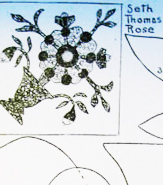
Seth Thomas Rose Quilt in Oregon


I was looking at WillyWonky's blog the other day and came across this picture---which immediately caught my eye as I myself had  just blogged about the pattern. The quilt is in a show in Salem, Oregon.
See my post here:
http://barbarabrackman.blogspot.com/2011/10/northern-lilysouthern-rose-block-8.html

The Oregon quilt is very close to the newspaper pattern published by Ruby McKim in 1929, showing a quilt made in the 1860s by Araminta Daniel Kreeger (1830-1875) who lived near Independence, Missouri in the middle of the 19th century.


The major difference is in the lower florals coming out of the vase.

The Oregon quilt is attributed to Adeline Brown Crawford (1821-1879) who traveled in one of the earliest Oregon-bound parties in 1842. She was one of six daughters of Gabriel and Elizabeth Robinson Brown, described in this post by Jim Tompkins: 

"Five of them of marriageable age when [they left] Arkansas. Known as the “Belles of Oregon” not for their beauty, but for their availability, three of them were the first emigrants to marry in Oregon (Adeline age 23, Polly age 16, and Cynthia age 14, each married men who were in the same emigration party as the Browns). They were said to be fair haired if not endowed with titian tresses. Is it any wonder that they were passionately courted, in an almost Eveless Eden."

Adeline may have brought the quilt with her from Arkansas but the style indicates it was probably made after 1842 and thus is an Oregon quilt. So it's unlikely to be the actual quilt that inspired Ruby McKim's "Seth Thomas Rose" in Independence, Missouri.  However, interesting details emerge in Adeline's story. The Brown family joined that 1842 overland party near Independence in Jackson County, where 13-year-old Araminta Daniel Kreeger lived. 

Adeline's quilt does cast doubt upon Ruby McKim's story that Araminta drew her pattern from a picture on a Seth Thomas clock. Could it be that she and Adeline Brown Crawford shared a pattern for a quilt with circles edging a central flower? Or is this pattern more common than I thought.

My version of the Seth Thomas Rose sewn by Susan Stiff

Treasures from the Trunk: Quilts and Their Makers After the Oregon Trail Journey, curated by Mary Bywater Cross is up until December 24, 2011 at the Wilamette Heritage Center in Salem, Oregon.


An important Oregon quilt on exhibit there is Elizabeth Ann Clark Kelly's ribbon quilt made from souvenir ribbons gathered at reunions of the pioneers who traveled to Oregon on the overland trails. It's on loan from the American Folk Art Museum.

See the WillyWonky blog post here with more pictures of the show:

http://archiver.rootsweb.ancestry.com/th/read/OREGON-TRAIL/2000-08/0967214820
Adeline met her husband Medorem Crawford on that 1842 trip. Read his journal of the trip here at Google Books:
And Jim Tomkins' web page here:
http://www.oregonpioneers.com/MotivationQuotes.htm

Wednesday, November 23, 2011

Raffle Quilts

Country School Quilters's raffle quilt to
benefit the Virginia Quilt Museum.
See next year's here

Here's a work-avoidance scheme. Do a web search for images by typing in these three words: Raffle Quilt 2011
I found quite a few. Here are some based on antique quilts.

Boise Basin's quilt is autographed by many famous quiltmakers. Click here to read more:


The Charlottesville Area guild's quilt titled Trailing Vines was designed by Martha Calderwood and Ann Robertson, adapted from a quilt by Susan McCord.
http://quilts.avenue.org/rafquilt.html


Maple Grove guild's quilt is called Land of  10,000 Fabrics
 http://maplegrovequilters.org/
 
The Newtown Quilters guild's quilt is another classic star.


Northwest Quilters Summer Garden was designed by June Bradley and Carol Schaefer, inspired by Rose Kretsinger's Paradise Garden


Quilters Guild of Plano's Tequila Sunrise with a Gaggle was inspired by Judy Neimeyer's Glacier Pines pattern.


The Tri-cities guild's is based on Sue Garman's pattern Stars for a New Day.
You could try the words Opportunity Quilt too. And then there's 2012. It could keep you entertained for quite a while.

Brownstone Quilters' Friendship Garden was inspired by Florence Peto's Calico Garden.
http://www.brownstonequilters.com/Quilt_show.html

Sunday, November 20, 2011

Morris & Company Fabric is IN

The newest collection of William Morris reproduction prints from Moda is in a few shops already.
Click here on Moda's home page and see this lovely introduction slide.

This line uses shades echoing the natural dyes that were so important to William Morris's vision.

Blues from indigo


Burnt oranges from madder


And we also have some updated color schemes,
gray green with gray, shades of taupe for today's taste.


And a true black


Some shops already have the yardage.
Berrima Patchwork was the first to blog about it.

Click here to see the whole range at Moda:
Morris and Company

And click here to get the free project designed by Susan Stiff, a period fan block in an arts and crafts frame. http://www.unitednotions.com/fp_morris-and-company.pdf

Friday, November 18, 2011

Fancy Machine Grounds

Every early 19th-century reproduction line needs a print with a fancy machine ground.
For my Lately Arrived From London collection for Moda I had a rather large piece of fabric with a floral trail figure atop a detailed "fancy machine ground." The document print above is the larger piece, the reproduction is the smaller square. It may date to about 1820-1840.


In the englargement you can see the finely detailed dots behind the florals. They not only add a background, they form part of the floral figures. These backgrounds were not engraved on the roller by hand; they were applied in a machining process.


Above:  the tan reproduction in the top left and the larger brown document print for the Meryfield print from my Hartfield collection, an early-19th-century line I did a few years ago. The green leaves in the original were probably done with a wood block, the brown ground printed with a roller. Notice the streak in the fancy machine ground, indicating it crimped in the roller.


Once printers figured out how to apply detailed machining to copper rollers the designers came up with many outrageous combinations as in the print from an old quilt above. The insect-like figure and the striped machined ground have very little in common. And then there are those green sticks.... People loved the variety and the layers of detail.


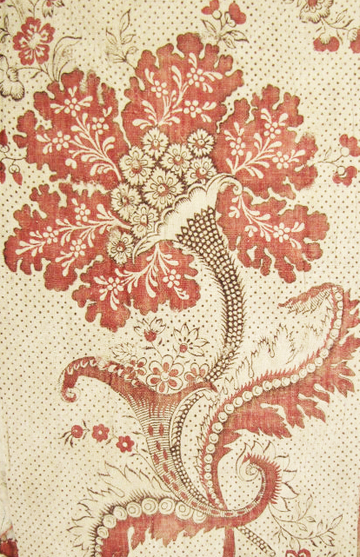
Designers and customers welcomed the new look about 1810 because older wood-block printing limited the types of backgrounds. One typical wood block ground was a solid color hand applied around the figures with a wood block, as in the chintz above. The technology wasn't perfect and printers often left haloes of white between the figure and ground---the registration was off.

For more detail the block printer could add a patterned ground behind the figure, in this case a regularly spaced dot, probably applied with a wood block fitted with pins in a regular pattern. In England these dotted grounds were called Stormont grounds, in France picotage.

But the fancy machine grounds were ---well much fancier---than the old Stormont grounds. Once the roller printed grounds were possible the designers and the printers showed their skills in many combinations of figure and ground. The detail is impressive, the registration is perfect---the only flaw (if one were being picky) is that the design combinations were sometimes strange.

So if you are looking for an authentic 1810-1840 look buy prints with detailed grounds---fancy machine grounds. You wouldn't see them any earlier than 1800 because the technology wasn't there yet. And they fell out of favor about 1840 as new styles developed.
Above is the Little Molly print in the muslin colorway that shows the fancy machine ground off the best.

In the tea colorway the shading dominates the florals, creating a rainbow look.

In the plum colorway the ground is more subtle and the figure stands out.