QUILTS & FABRIC: PAST & PRESENT


Monday, June 17, 2013

How I Use BlockBase: Redrawing Old Blocks

I have kept this photo of some fairly sad blocks from an online auction for a while. They look to be from the 1930-1950 era.

It's an interesting block, if badly made, and I thought it might make a good pattern to use Moda JellyRolls, the precut 2-1/2" strips. But I had to figure out how to draft it. The photo isn't too clear. I was hoping to find it in BlockBase, my digital Encyclopedia, but where? was the question. There are not a lot of patterns that are constructed like this. It's kind of a log cabin....

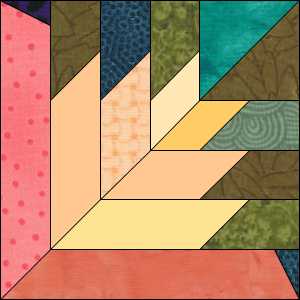
I saw it as a grid of 7 for proportion and drew it up from scratch in Electric Quilt.
I liked the cactus look and thought about Echeveria, the succulent, when I colored it.


Once I drew it up though I realized it had a diagonal seam, which encouraged me to look in BlockBase again in the rather small category of Two-Patch quilts.

Blocks divided in half diagonally.


And here is something very close to those original blocks.
A rather obscure pattern, #3177.
Modern Flame, published twice.
Once in Woman's Day magazine in September, 1942
And also by the Spool Cotton probably around the same time.
It is very modern looking.


The old blocks may have been made from one of those patterns, but unfinished without the last strips.
And when you look at the original pattern design you can see why.
There are those tiny corner pieces in the longest strips.


Well this would make an excellent block for 2-1/2" strips---a 12" block.
Except for those little corner strips which would drive you crazy. You can see why no ever one made it.
So back to my point, which is how I use BlockBase with EQ...


To fix BAD DESIGN. I imported the BlockBase block #3177 to my EQ file.


Then while I am in the EasyDraw mode I go up to the top left and highlight that little arrow which is called The Pick. When I am in that mode I click on a line and it highlights the offending line. And I can delete it.
Here's Block #3177 with an easier to piece outer strip.


It's probably a better design (based on a grid of 6) than my Echeveria based on 7.


But the Echeveria is so cactus-like I kind of like it.

In EQ I rotated the blocks around.


It's quite directional with a lot of possibilities.


Here's a free pattern with templates  for a 7" version based on 1" finished strips. Click on the picture and print out at 8-1/2" x 11"
Or click for a PDF:

If you wanted to use 2-1/2" strips cut the square 8-7/8" and cut diagonally in half  for the large triangles. You don't really need templates.  I'd just join dark and light strips with a 45 degree seam and line them up to look spiky.

After I wrote this post I was looking through some pictures and found this version of Modern Flame. At least one quilter made it mid-20th-century.


Thursday, June 13, 2013

Run-On Borders


I've been thinking about border style and how it can be used as a weak clue to help date antique quilts.
In this post I talked about what we call the Spacer Border and how it was popular at the end of the 19th century, particularly with quilters of the Anabaptist religions.

Women in all kinds of quilting communities used multiple strip borders to frame their designs---here four strips and a contrasting binding.

But, as all beginning quiltmakers have to learn, there are design problems with multiple strip borders.

You can't piece the strips together and add them...unless you miter the corners. If you plan on a mitered corner you can piece plain strips and pieced strips first and then attach the whole thing to the blocks.

Which is how you get a neat framed corner.


This quadruple strip border looks to be mitered.

But mitering takes more fabric and it's a little tricky to stitch, so when you look at antique quilts you usually see that the seamstress added one border at a time as probably happened in this one.

Adding one border at a time means you can butt the 
rectangles against one another, which is the common method.

At least, those quilters who liked a neat framed corner did it that way.

Not everyone valued that look in the corners.

Many, many quiltmakers pieced the strips together and butted the corners.
Perhaps not getting an "A+" in home ec.


But creating some pretty great compositions.


These run-on corners do seem to be more common after 1880 than before
so once again the border style can be a weak clue to date.

As in this one where you get the feeling that the blocks and the paisley sashing might be before 1880 but the 3-strip border of solid fabrics (with a red fading to khaki) was added after 1880.


If you are making reproduction quilts you sometimes face a dilemma.
Our aesthetic or theirs?


Monday, June 10, 2013

Paisley in Civil War Jubilee

Here's the paisley in my latest reproduction collection
Civil War Jubilee

This pack of Layer Cake precuts 10" square gives you an idea of the scale.
You can fussy cut borders and blocks


Here's the original document print, a cotton stripe...
We made it a little more red, a little less orange.


It also comes in browns

And blues

And here's our nod to today's bedrooms---grays.
NOT an authentic Civil War color, but a lovely shade of gray.

Paisleys with their cone-shaped figures have been quite popular since the early 19th-century when the west began importing cashmere or Kasimir shawls from India, and then knocking them off in Paisley, Scotland.

There were many variations on the design.

The 1840s and '50s were a bad hair era, but a great dress era.
This dress drapes like a wool or wool combination fabric.

The dress may be a cotton paisley print; the larger sunshade a fussy-cut wool.

Shawls remained quite popular throughout the century.


I asked my sister Dr. Barkman to identify the dog and she says---more bad hair---hard to say.


Aside from shawls, paisleys by the 1860s were considered most appropriate for at-home wear in intimate settings rather than as prints for street wear.

Two wrappers (dressing gowns)---
woman's on the left, man's on the right.


Men's dressing gowns were called banyans.

Posing in one indicated a kind of casualness.

And here a silliness that is quite contemporary.

Marie Clerc 1875

See some fantastic portraits from the Louvre at this post:

Check out this Pinterest page on wrappers. She has the topic wrapped up.
Links to other posts I've done about paisleys:


And a post on a show at Allentown Art Museum: