QUILTS & FABRIC: PAST & PRESENT


Friday, June 7, 2013

Fancy Borders: A Dating Clue


Mid-19th century
quilt from an online auction.

 I've been doing posts about borders and how the changes in style can help in dating antique quilts. What seems to be important in dating is the elaborateness of the border. Quilters working between 1880 and 1930 were not as likely to make complicated applique borders like these mid-century examples.


When you find an antique quilt with a fancy appliqued border think: Before 1880. Like most other border clues this is a weak clue.


It's always fun to find someone who took parts of the block design and made a border like the quilts above and below. 


I  like the idea of throwing in some dots.


Often the border has NOTHING to do with the block, but the clue to a mid-19th-century quilt is that it's a 
fancy border.


NOTHING to do with the block...


The clues you can count on here: Red and green applique quilts tend to date from 1840 to 1890 (that's a strong clue.) The fancy border is a weak clue that helps you narrow the date to before 1870 or so.


Above is an applique from Tennessee with a plain border date-inscribed 1885. Plain borders are more typical of what you see in red and green later in the century. There are exceptions to the rule about fancy borders---which is why it's only a weak clue, but it can still help you narrow the date a bit.

One more thing: Here's a style characteristic that is NO HELP in dating:


The lack of a border is no clue to date.You see it in the star quilt above dated 1854...


and in this sampler dated 1894. No border means nothing---a double negative.


Tuesday, June 4, 2013

Drunk Tank Pink

Double pink prints were popular fabric in 19th century quilts
 particularly towards the end of the century.

I saw an interesting piece on CBS's Sunday Morning recently
about how color influences mood.
We all know that blue is soothing but who knew that
bubble gum pink is too?

Drunk Tank Pink is a familiar shade that prison officials are using
because it calms aggression.


Who'd a thunk it?

I guess it also has a calming effect on quilters too.

Quilt by Genoa Rox Hunter
Freeman, North Carolina


Quilt by Sarah Stein Dietrich,
Berks County, Pennsylvania

The reverse of that quilt

Already I am calmer.


Saturday, June 1, 2013

What We Are Working On: Morris Modernized


Bird & Tulip
Reproduction print


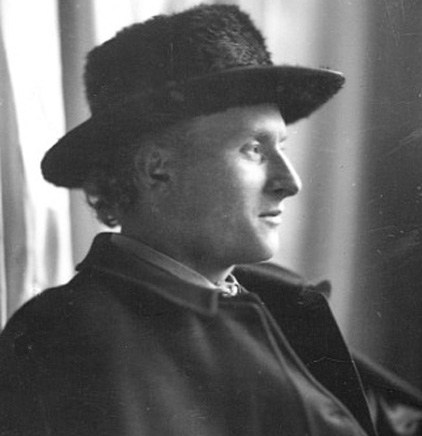
C.F.A. Voysey is one extremely influential pattern designer you may not know.

Voysey (1857-1941) 


"Never look at an ugly thing twice. 
It is fatally easy to get accustomed to corrupting influences."

C.F.A. Voysey


I agree, but what about that hat?

Voysey was very clever and very opinionated. I love his work and his writing about design.


He was an informal successor to William Morris, a next generation designer who took Morris tradition well into the twentieth century. My next Arts & Crafts reproduction line, in shops in October, features seven Voysey prints.


The Poppy Garden
by CFA Voysey

Like Morris, Voysey found inspiration in his English garden.

His Bookplate

He also had special affection for birds.

Metalwork by Voysey


Because he was "modern" he often pared down the bird image to its basics and used the same abstracted bird in many different ways.

Pyracantha
Reproduction Print

Saladin
Reproduction Print
There's a pair of birds (doves?) hiding in the greenery.

He loved to play nature against a flat surface in wallpapers, rugs and textile design. While modernism dictated simple geometries, Voysey balanced likeness and abstraction. 

Birds & Berries
Reproduction Print

He often paired his birds.
Hearts are another recurring motif. 


See my virtual booth for last month's Quilt Market where Mr. Voysey looks a lot like the above bird:


This collection won't be in shops until the fall but you can see a preview at Moda>Fabrics>Future Groups>October: 

London's Victoria & Albert Museum has an extensive collection of Voysey design. Click here and type Voysey into the search box.

I'll show you more and tell you more about Voysey as the yardage is ready to ship in the fall. I've been working on quilts large and small, pieced and applique.


Wednesday, May 29, 2013

Twins Separated at Birth

Oriental Poppy Quilt
by an unknown maker---
Sold at auction a few years ago.

When I saw this quilt online I thought---a quilt by Rose Kretsinger of Emporia, Kansas. She made a twin quilt that is in the Spencer Museum of Art at the University of Kansas.

Here I have layered the two quilts.
They are almost identical, with the major difference being that the Kretsinger quilt has rounded corners, the auction quilt square. The rounded corner is a minor characteristic of the Kretsinger quilts.

The question. How could two quilts be so much alike?
Possible answers:
1) Made by the same person.
2) Made from the same pattern---one designer plus the second quilt a copy by another.
3) Made from the same pattern, one designer but both copies.


Another pair of quilts almost identical, one a top, one a quilt. The major differences seem to be precisely how the striped background fabric is placed and how the stars are angled.
Because it is a contemporary quilt the answer seems obvious: It's a published pattern:
Jan Patek's Birdsong. The one on the right is the model, the one on the left the copy.

Buy the pattern here at Jan's website:

I'd guess the copy was made from a kit but I don't see that Jan has them for sale on her website.

In the case of the Oriental Poppy design we could be seeing the same situation.
The Oriental Poppy was published in the magazine Farm Journal in 1949, where you could buy a pattern for a quarter.


In her book Soft Covers for Hard Times: Quiltmaking and the Great Depression, Merikay Waldvogel published a picture of Bernice Schultz Mackeys' version.


Bernice remembered buying the pattern from Farm Journal.
She scalloped her edge.

The quilt at the top of the page may have been made from that published pattern too.
But Rose Kretsinger also sold and gave away hand-drawn patterns. Before digital, xerographic and mimeographic copying, people traced patterns onto vellum, a heavy tracing paper. I am lucky enough to own a tracing paper pattern for an Oriental Poppy quilt that is labeled on the envelope "Mrs. Kretsinger's Gift" and "Mrs. Kretsinger's Quilt."


I don't know who drew it but I guess it was Rose Kretsinger.
Her daughter told me years ago that Rose sold hand-drawn patterns. The woman who sold the pattern to me came from Emporia and told me it was a Kretsinger pattern. The hand writing is similar to Rose's.


It has just about everything you'd need to create a copy of Rose's quilt: color suggestions, swatches showing fabrics and quilting instructions.

Here's the word green from the pattern (on the left) and from a list she kept of her quilts.

So my guess is the auction quilt at top is a copy of Rose Kretsinger's quilt, made from one of her hand-drawn patterns or from the Farm Journal pattern---although Rose could have made the same quilt twice.