QUILTS & FABRIC: PAST & PRESENT


Tuesday, October 18, 2011

Chrome Yellow

Quilt in a regional design from Tennessee and Texas
Most of the yellows we see in 19th-century quilts were dyed with chrome.

Sampler block, 1840-1860
Chrome yellow and chrome orange

Chrome yellow is closely related in chemistry to chrome orange (what we call cheddar today). It's a true yellow that the dyers called canary yellow.

Pennsylvania quilt 1880-1910


Swatch glued in a 19th-century dye book
 showing chrome or canary yellow.
 The color changes when it comes in
 contact with certain chemicals---
like the acids in an old book's pages.

Observation indicates that the chrome orange shade was more popular for backgrounds and accents, but many quilters made good use of the bright, clear canary yellow.

Chrome yellow could be bought as a solid or a print.


Pennsylvania, end of the 19th century.

The color was important in Pennsylvania German design, which emphasized bright next to bright.

So we see many Pennsylvania quilts using the color.

Block about 1840-60
Quilters all over the country used it, however.

The chrome yellow process was developed early in the 19th century, but we really don't start seeing a lot of it until the 1840s when it became important for applique and piecing.

It's difficult to determine whether a print is 1860 or 1890.

The common combinations were red and black (dark brown) figures on yellow grounds.

The major difference between mid-century prints and those from the end of the 19th-century is that the later prints became more standardized. There just wasn't a lot of variety. Mills printed the same design in the same color for decades, marketing them as old-fashioned calicoes.


Top from the 1940s?

Apron from the 1960s or 1970s.

The yellow prints were almost the same for a hundred years.
But then... they stopped printing them about 1980.

Until now!

Reproduction of a classic yellow print 1860-1980

Here's a reproduction of a 1960s interpretation of the old prints---
 a repro of a repro that Moda and I are doing in a collection of
Old Fashioned Calicoes.
Start thinking canary and click here.


Saturday, October 15, 2011

Northern Lily/Southern Rose Block 8

Seth Thomas Rose from the kit illustration.

Block number 8 in this sampler of regional applique is a Southern rose.


Seth Thomas Rose by
Barbara Brackman

 Seth Thomas clock
In 1929 Ruby McKim featured the Seth Thomas Rose design in the Kansas City Star saying that Araminta Daniel Kreeger drew the pattern for the original quilt in 1862. Daughter Fannie told McKim that Araminta copied the design from the face of a Seth Thomas clock brought to Missouri from North Carolina. Shelf clocks often were decorated with hand-painted scenes and florals.

Seth Thomas Rose by Ilyse Moore

The clocks were made in New England but Araminta and Fannie Kreeger were Southerners---Missouri Confederates. Another of Araminta's quilts was stolen from the bed by Jayhawking Yankees during the Civil War. (See a post about that quilt here: http://civilwarquilts.blogspot.com/2011/10/40-order-number-eleven.html

Seth Thomas Rose by
debi schrader
It's an unusual pattern with the circles dotting the central flower.


 For my book
 Borderland in Butternut and Blue.
I made one like McKim's pattern, which had a vase.

Araminta's quilt has disappeared. Any quilts in the design seem to have been made in the 1930s after the pattern appeared in the newspaper. The one above is much like the newspaper pattern.

Here's one among a set of blocks for sale.
But I am always hoping to find Araminta's original.

Maybe this is it.
A big central rose, a footed urn, mid-19th-century---
recorded in the Iowa Quilt Project, purchased by a collector,
so no information about the maker.
See the whole quilt here at the Quilt Index


debi's

Back to the Northern Lily/Southern Rose Sampler.

Everyone is getting their blocks together. Ilyse used a triple strip border.

Jerri McReynolds used a green calico, a single strip.

debi set hers with alternating log cabin blocks. She started with a package of Layer Cakes from Civil War Reunion and added a few yards of a tan solid. She kept pulling leftovers out of her scrapbag, enough for a pieced striped border.

Susan Stiff used a print stripe for her inner border.
Next month the last applique block.

Wednesday, October 12, 2011

Excentrics in Nebraska


Elegant Geometry Curated by Bridget Long

You absolutely must see the exhibit at the International Quilt Study Center and Museum in Lincoln, Nebraska---if you like old fabric. I'm lucky enough that I can drive there in four hours so I plan to go back before it comes down in early January.


Hexagon mosaic, maker unknown
Probably made in United Kingdom, 1810-1830
108" x 106" IQSC 2006.056.0002
Gift of Clyde E. and Joan B. Shorey

On this trip my favorite thing was the quilt above. You can enjoy it at a distance as an interesting composition.


But it's the closeup view that makes it's spectacular. The maker sorted her fabrics carefully, creating areas of dark prints framing areas of light. She had an exceptionally diverse scrapbag, but diverse in a narrow category of prints---monochrome prints in blue, pink and brown.


These finely detailed florals and geometrics 
are calicoes printed with the latest roller printing technology---
up to date  in 1820.


The top was full of  excentric prints.


A proud printer testifying to the British Parliament in 1840 described these prints as "a particular style of design known by the name of 'excentrics,' in the production of which England surpasses every other nation in the world." Excentric prints (eccentric in American spelling) are fine geometric figures with jagged or wavy distortions.


Detail of the classic eccentric Lane's Net
from an American quilt about 1870


 Lane's Net is a specific eccentric print style with many variations.


 This top has more variations of Lane's Net than any I've seen.


The calico printer in 1840 described the invention of excentrics as an accident that occurred when a parallel stripe creased in the roller, "producing a new and unexpected effect. " Rather than discarding the misprint, he said, the enterprising mill owner (Mr. Lane?) was inspired to create a new fad for jagged stripes.

(Click on this photo and it will enlarge)

This version of accidental invention tends to be the origin story today (I've published it in my books). But the more I learn the more I doubt the tale. Eccentric prints were probably based less on accident and more on technological advances in lathes and other metal tools.

Drawing using excentric line

 The word excentric means odd or erratic (off-center) but it also refers to geometric ellipses and circles with centers at different points (as opposed to concentric circles.)

Bank note engraving making use of excentric curved lines

 
Toolmakers developed metal lathes with so-called excentric chucks that could create mechanical drawings of endless intricate line pattern, first used to engrave unforgeable bank note backgrounds. The English calico printers co-opted the technology as well as the name "excentric." 

Three eccentric prints making use of curves and straight lines
The name eccentric came to mean any geometric print with intricate line pattern.

Late-19th-century scraps of Lane's Net, named for the mill owner

 
Look for variations on Lane's Net throughout the 19th century. It makes a great print collection focus. As far as the earliest date: The calico printer said in 1840 that the design originated 30 years ago, so 1810 is a good starting point. I've seen Lane's Net into the 20th century and variations have been reproduced in the last 20 years.

Here's another excuse to visit Lincoln. There will be a lecture at IQSC on Tuesday October 25 at noon.
“The Art and Science of Patchwork Tessellations”,
Dr. Barbara Caron, IQSCM Assistant Director.
See more about the exhibit here:
And buy the catalog online here (It's sold only through the museum.)
The catalog is great, full of wonderful details, but if you want to see all the closeups you have to see the show. Photography without flash is permitted.

Read an 1841 essay on copyright in design that mentions Lane's Net by clicking here


Thursday, October 6, 2011

A Passion for Quilts


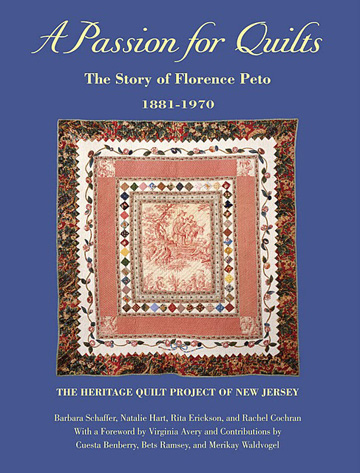
One of the best things at the American Quilt Study Group seminar is the book sale where you can find out-of-print books from the authors' warehouses [garages] and some brand new books that you might not hear about elsewhere. I was pleased to pick up A Passion for Quilts: The Story of Florence Peto.
Co-authors Barbara Schaffer, Natalie Hart, Rita Erickson, & Rachel Cochran have been working on this sequel to the New Jersey Quilts book for years. Rachel on her blog Notes From the Basement describes Florence Peto and the book.

Where Liberty Dwells
by Florence Peto
She used antique fabrics to make small
medallion quilts in the 1950s and '60s
"Florence Peto (1881-1970) was a quilt collector, quilt historian, and quiltmaker. The quilts she collected and those she made were of such high quality that they became significant parts of museum collections. Florence's enthusiasm for life, thirst for knowledge, and love of quilts led her on a path she might not have expected as a young woman at the end of the nineteenth century. Through books, magazines, lectures, and exhibits, she shared the stories she found in quilts and created a legacy that endures from the twentieth century into the twenty-first century.


The book is 174 pages with more than 150 illustrations, including family photos and previously unpublished quilts. In addition, we are very lucky to have a foreword by Virginia Avery and contributions by Cuesta Benberry, Bets Ramsey, and Merikay Waldvogel.

If you'd like to order a copy, send a check payable to The Heritage Quilt Project of New Jersey in the amount of $32.95 plus $5.00 for shipping and handling to: The Heritage Quilt Project of New Jersey, P.O. Box 341,
Livingston, NJ 07039. Or you can go to the website http://www.newjerseyquilts.org/."


Where Liberty Dwells by Barbara D. Schaffer
Barbara's just finished this top,
 a copy of Florence's quilt above.
And Barbara's here:
These are two blogs to keep an eye on--- if you like antique quilts.

See some posts I've done about Florence Peto
http://barbarabrackman.blogspot.com/2010/06/persian-pears-florence-peto.html 
http://barbarabrackman.blogspot.com/2010/05/lafayette-or-jackson.html

 Old Toile and Chintz by Florence Peto
1950-51
44 x 48"
The cover quilt.

Monday, October 3, 2011

"Quilt Code" Persists


When I was in Philadelphia last week I gave some thought to the idea of false myths set in stone. The city's built a historical identity around the tale of Betsy Ross sewing (and designing) the "first flag" for George Washington.

The Betsy Ross Bridge

There are three bridges across the Delaware River there, one named for First President George Washington, one for poet Walt Whitman and the third for Betsy Ross. There it sits---a giant metal monument to a woman who did nothing heroic or even monumental. She stitched flags---not the first flag, not the most flags, not the last flag.  UPDATE: I shoulda fact checked. The first bridge is Benjamin Franklin not George Washington. Thanks Judi.
One of the better Betsy Ross marketing schemes,
 a child's sewing machine.

So when a reporter for the Nashville City Paper called the other day and asked me questions about the Quilt Code---the idea that escaping slaves used quilt patterns as code to help make their way north on the Underground Railroad, Betsy's name came to mind immediately. Let's not create a public image around a historical innacuracy.


Mixing marketing metaphors:
The cowboy's favorite Revolutionary grape juice.

Apparently Nashville was planning to use the Quilt Code/Underground Railroad story as the basis for public art. I was surprised to hear the Commission was unaware of the lack of historical evidence supporting the tale derived from a twenty-year-old children's fiction book. 


Deborah Hopkinson's  charming 1993 book told of a
quilt used as a map to freedom.

We haven't heard much about the Quilt Code lately. Most schools no longer use it in their Black History curriculum.
The Sail Boat pattern is about 80 years old.
 No quilts in this design were made in the 19th century,
although quilt code advocates believe it was a signal.

Few quilt lecturers go around anymore with a stack of Double Wedding Ring and Sail Boat quilts to discuss the deep historical meanings of these 20th-century patterns in mid-19th-century"history."


Several members of the American Quilt Study Group advised Nashville against using the UGRR Quilt Code idea. Jen Cole, the art commission’s director, listened and responded that the project would continue to have a quilt theme, but would no longer commemorate the Underground Railroad. 'We were unaware of the historical inaccuracies when we acted,' Cole said. 'We basically are going to move forward with the artist, but any relationship to the Underground Railroad, or the quilt code, will be taken out.' "

Shouldn't this be tea?


A false myth made permanent in steel and concrete? Bad idea. A quilt theme for the public art. An excellent idea. Any thoughts? 

 I'd go to the book of Tennessee quilt history---The Quilts of Tennessee: Images of Domestic Life Prior to 1930, published in 1986 by Bets Ramsey and Merikay Waldvogel. They mention several regional Tennessee patterns and I can think of more they've found since they conducted their original research in the 1980s.

You may think of this as a New York Beauty
but the association with New York was a 1930s marketing idea.
 It's actually a regional Southern design,
popularly known in Tennessee as
Crown of Thorns or Rocky Mountain.

Read more about Tennessee quilt history by clicking here:
http://www.decorativeartstrust.org/tennessee_quilts.htm

An unusual pattern found in Tennessee and Texas


Betsy Ross Danish Butterhorns.
 I'd eat them with Philadelphia cream cheese.