QUILTS & FABRIC: PAST & PRESENT


Monday, June 14, 2010

Pickle Dish

Pickle Dish from Margaret Cavigga's collection, about 1860

The Pickle Dish pattern has been in the air around here lately.


It's a lot like a Double Wedding Ring, based on arcs and a squeezed square, but the arcs are full of points.
The name Pickle Dish seems to have first been published in the Kansas City Star in 1931
(Note: they liked the name so much their quilt web page is named http://www.pickledish.com/)


A wedding ring has four-sided patches in the arcs rather than triangular pieces.
Double Wedding Rings don't appear till about 1920.


The idea of an arc and an ogee (a squeezed square) is an old pattern structure based on overlapping circles.
The Rob Peter to Pay Paul or Compass top above is from Donna Stickovich's collection.


In 1932 the Grandmother Clark pattern company called the version with pointy shapes in the arcs Indian Wedding Ring, according to my Encyclopedia of Pieced Quilt Patterns.

The Pickle Dish pattern is older than the Double Wedding Ring, dating back to the last half of the 19th century. It was quite popular in the Southern U.S. about 1880-1910. I wonder what the Southern quilters called it before the name Pickle Dish was in print.


Karen Alexander found a print in an old quilt that looks just like a Pickle Dish. By the colors---Turkey red background with blue and brown figures---I'd guess the fabric could be pre-Civil War, as could the mossy stripe next to it.


See more about this quilt at Karen's blog by clicking here:
http://karenquilt.blogspot.com/2010/05/excitement-of-excavating-quilt.html

Here are some other Pickle Dish variations from online auctions:

This one has an X in the squeezed square.

The green is fading the way synthetic green dyes did after 1880 or so.


Here's a quirky version with two kinds of green dyes one fading, one fast, again probably 1880-1920.


Notice the arcs can have diamonds or triangles.

See some more examples by going to the Quilt Index. Click here:
http://www.quiltindex.org/
At the top left in the search box type the word pickle.
Several quilts will come up, mostly from the South.

Saturday, June 12, 2010

"OLDEST KNOWN QUILT" REDUCED BY MILLIONS

 Ginger Rogers in an outfit made of money from Gold Diggers of 1933
 Several readers have written concerning an outrageous eBay posting, high in hyperbole.


The quilt, advertised as the Oldest Known Quilt in Western World, went unbid upon last month in an online auction with a starting bid of $2,900,000. One could have bought it directly for $3,200,000.


It's back up there in another auction this week. At the beginning of the week you could  "Buy It Now" for $500,000. A price reduction of nearly 3 million dollars. But then the listing was dropped.
Click here: http://cgi.ebay.com/Oldest-Known-Quilt-Western-World-1650s-/170485551759?cmd=ViewItem&pt=Quilts&hash=item27b1bb128f
or maybe click here:
http://cgi.ebay.com/ws/eBayISAPI.dll?ViewItem&item=170490141669


It was advertised as dating possibly to the 1650s, attributed to Hester Hosmer (1641-1702) who was later the wife of Rev. Thomas Buckingham (1646-1709). If the quilt is indeed the 1650s Hester would have made it between the ages of 9 and 19.

When asked last month for any documentation the seller replied:
 The problem has been that every quilt appraiser who has looked at this has admitted that they are under qualified because of the obvious age and materials used. And they do not know of anyone who is qualified (I have been searching for years.)


The reverse seems to be patched of large pieces.
Here's a blue and white woven striped cotton

 Were I looking for assistance in dating a quilt from that era  I would take the quilt to an expert in colonial costumes, textiles and fabrics. There are many museums, here and in Europe, that specialize in the 17th century period. There are many people who would be glad to take on the job of identifying and dating the piece.


Detail of a patchwork coverlet dated 1718
From the collection of the Quilters' Guild of the British Isles

Even a novice appraiser should be able to identify the fibers in the fabrics. Anyone with any experience could find costumes and household textiles with similar weaves and dyes.


Patchwork attributed to early 18th century.
Collection of Colonial Williamsburg.
This quilt is on display through October, 2010.

If you are looking for a quilt appraiser the first place to check is The Association of Professional Quilt Appraisers/Quilted Textiles. Click Here: http://www.quiltappraisers.org/

But that is not the real point. The point is that the quilt is WAY OVERPRICED and WAY OVERHYPED.

 Let us say this wholecloth (or minimally pieced) quilt is indeed the work of Hester Buckingham who is said to have died in 1702. It is thus a 17th-century quilt. This may very well be true.

What is the monetary value of a quilted bedcover attributed to the end of the 17th-century? I'm not an appraiser and I don't keep up with the current auctions, but I do know that a quilt is worth the price agreed upon between an honest seller and a knowledgeable buyer. We can look at the history of quilt sales, which have been dropping in this recession.


 About 20 years ago people were paying premium prices for Baltimore album quilts, way over $100,000 and into the $200,000's. Baltimore albums now sell at auction for maybe $10,000 to $60,000.

See a link to a recent sale:
http://antiquesandthearts.com/Antiques/AntiquesShows/2010-01-19__11-01-40.html

Album quilt by  Lucinda Ward Honstain

This quilt, now called the Reconciliation  Quilt, sold in 1991 at a Sotheby's auction for $264,000. It's now in the collection of the International Quilt Study Center and Museum and "considered the most valuable quilt by many experts," according to the IQSC.


Lancaster County center diamond from the Brown Collection

 The other consistently expensive quilts, rare Lancaster County Amish quilts, tend to go for $10,000 to $30,000.

These are posted auction prices and there may well be private transactions going on where prices are higher.
 So the Buy It Now price of $500,000 this week was nearly twice the record price for a quilt.

Adding to the impression of an outrageous price is that early wholecloth quilts without patchwork tend to be of far less interest to collectors that folk art classics with pictorial applique or Amish quilts with good sales histories.

Back to the claim, this is the "Oldest Known Quilt in Western World." Could it be? First we have to define the Western World---the Western Hemisphere, the North American Continent, Any place that's not the Eastern World???


There are many European textiles dating to the late 17th century, and several American pieces considered as old. Colonial Williamsburg right now is hosting an exhibit named Quilted Fashions, which "explores the use of quilting to decorate bed coverings, clothing, and accessories of the 17th and 18th centuries."


What can we learn from this?
  • Hyperbole like "Oldest Known Quilt in Western World" muddles the whole quilt dating field. Don't believe it.
  • Avoid claims like "oldest" and "first." There is no way to prove this.
  • Statements such as "There are no qualified appraisers are ridiculous." One can find an extremely qualified appraiser for a fee.
  • Don't ever pay over $300,000 for a quilt without a lot of expert advice. It's hard to find a greater fool to sell it to. 
 PS
The six fabrics in the quilt were described as:

  • Center is Damask fabric, blue floral on brown ground
  • Border fabric is a brown & tan stripe
  • Back is 2 main pieces of a blue & white striped fabric
  • Border of a dark brown wool
  •  Binding mostly a green jacquard
  •  With a piece or two of a lavender fabric


Tuesday, June 8, 2010

The Perkiomen Valley Patch

South 40, designed by Lynne Hagmeier
83" x 83"

A few weeks ago (April 25) I showed Lynne Hagmeier's design for a reproduction quilt in the split nine patch pattern.


Above and Below:
Split Nine Patch variations, about 1910 from online auctions
The example below is a Barn Raising set.
[and, as Veridian pointed out in the Comments: It's a 16-patch not a 9-patch!]
This pattern traditionally was a regional pattern, found from about 1880 to 1940 in Southeastern Pennsylvania and New Jersey. In Pennsylvania they called it the Perkiomen Valley Patch. (The Perkiomen Valley runs through the northern corner of Montgomery County and portions of Berks, Lehigh, and Bucks Counties.)


It's a clever version of a simple nine patch that is shaded half light and half dark and can then be set in any of the log cabin variations like Straight Furrow, Barn Raising or Sunshine and Shadow like Lynn's. Notice how the antique quilt above has a row of three yellow triangles---an interesting variation.

Fire and Ice by Nicki Listerman, 2009
Like Nicki,  you can go way beyond a simple Barn Raising set.
Both Nicki and I asked our sewing group, the Sew Whatevers, to make us 9-inch split nine-patch blocks from white shirting prints and red and black. Nicki kept on going, making her own blocks.

I made a miniquilt out of mine and appliqued in the white area.


Red Bird, White Snow by Barbara Brackman, 2005


Nancy and Donald Roan of the Goschenhoppen Historians are the experts on the pattern in Pennsylvania. Read more about the Perkiomen Valley Patch in their book Lest I Shall Be Forgotten: Anecdotes and Traditions of Quilts.


Here's another version from an online auction. It looks to be about 1900-1925.

See several antique quilts in the International Quilt Study Center and Museum collection by clicking here on the search page:
Go down to Advanced Search and then below that Primary Pattern.
Pull down the menu and click on Split Nine Patch. Five examples from Jonathan Holstein's collection will come up.
Hope all these scrap quilts inspire you.

[They changed the link at IQSC last week. The one in the post right now works.]

Sunday, June 6, 2010

Quilts and Fairs


Kathy sent pictures of a wonderful cased photo she recently inherited.

My Aunt recently gave me a diploma that one of my ancestors received. It is in a miniature vulcanized rubber frame with the diploma on one side and what looks like a photo of a fairground on the other side.


It says: DIPLOMA AWARDED BY THE SHAWNEE COUNTY Agricultural Society to
Mrs Sarah Ives
for Cotton patched quilt
Topeka Sept 28, 1875.
A J Huntoon sp Pres.
S H Downs Sec'y.
I became a quilter 3 years ago. So, I am thrilled that I was the one to inherit this.

 My guess is Kathy's photo case contains a prize won at the Shawnee County Fair (Topeka) in 1875 for a patchwork quilt. A diploma like the one in the case was an award---less than a medal but higher than honorable mention.


We are used to ribbons as fair prizes but in the past judges awarded a variety of prizes.

I consulted two friends at the Kansas Museum of History, curators Nancy Sherbert and Rebecca Martin, who believe that the cased photo was a homemade souvenir of the quilt prize. Someone took an old deguerreotype holder and cut Sarah's diploma to fit. On the other side they put a photograph of a drawing of the fairgrounds by Henry Worrall, a Topeka artist.

I found out a little more about Sarah Ives. In 1873 she won an award at the state fair. The annual records for that year list "Mrs. Sarah Ives, Topeka. Best Plain Knitting by a lady over 60."


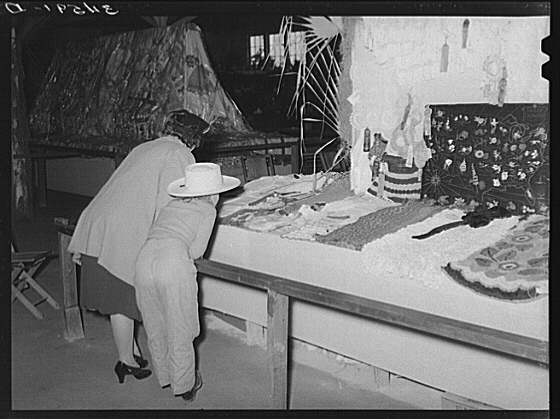
This is not Sarah Ives, but a great picture
from the Farm Security Photos at the Library of Congress


Certainly wish we knew what Sarah Ives's quilt looked like!


Gonzales County, Texas fair, 1939. Photos by Russell Lee.
I found these pictures of fairs, mainly in the 1930s, by searching for the words County Fair at the Library of Congress website: http://www.loc.gov/pictures/


Grapefruit display at the Imperial County fair, California


Why did white anklets and spectator pumps go out of fashion?


Friday, June 4, 2010

Persian Pears & Florence Peto

Miscellaneous thoughts about paisley:

Magazine cover featuring a boteh or shawl print


Found this picture of a baby nurse wearing a terrific ruffled cape made of a paisley print, maybe in the 1870s.
It's from a blog called 19th-century American Women: A Museum in a Blog
http://b-womeninamericanhistory19.blogspot.com/


Wool/cotton blend printed in a paisley, about 1880

I wrote about the lack of historic sources for the term "Persian Pickle" recently. Click here to see that post:
http://barbarabrackman.blogspot.com/2010/04/persian-pickles-and-shawl-prints.html


Indigo paisley border about 1890.
The jagged edges imitate the woven shawl designs.

I'm still working on sources for various names for the design. I was surprised to NOT find the word paisley in the Oxford English Dictionary---is the word not used in England? (ouch! there are a lot of negatives in that thought.)

12 hours later: I went to the library and read their edition in regular-size print of the O.E.D. Paisley is in there as "a garment or material made [in Paisley] or having the curvilinear design characterstic of cloth made there, or the pattern itself." The earliest use of the term Paisley shawl they cite is 1834; the earliest possible use of the word for a boteh pattern is 1898---"trimmed with paisleys."
While reading my notes about Florence Peto, who was a textile dealer and historian in the 1930-1960 years, I came across her reference to a paisley design as a "Persian Pear" in the Magazine Antiques in July, 1942, giving us another visual metaphor for the paisley cone shape or boteh.


The idea of a Persian Pear may come from oriental rug dealers. I found an article in a 1918 magazine criticizing all the imagined myths published about rug motifs.


As for the so-called Persian pear pattern, concerning which the rug books evolve so many fanciful theories, I know no more about it than they. But I do know that the Persians call it the bute, meaning twig or bush, by which they further designate the camel-thorn of their bare plains. And I have seen the same design on old Indian silks…
"About Rug Books" by H.G. Dwight in The Bookman Volume 46, 1918

Read more about Florence Peto by clicking here:

http://www.quiltershalloffame.net/index_files/Page854.html

http://mendofleur.com/2009/11/04/florence-peto-part-i/

http://mendofleur.com/2009/11/06/florence-peto-part-ii/


And here's a small stamped piece by Linda Frost.

She sees birds in everything, including butah, boteh and bute shapes.


Check her blog 13th Street Studio


Wednesday, June 2, 2010

Nancy Halpern

Flight from Bergamo 1998

Life’s Work: The Quilts of Nancy Halpern

June 25-27
Vermont Quilt Festival 2010

From the Vermont Quilt Festival Website:
In continuing its retrospective exhibits of the work of well-known quilt artists, VQF is proud to feature approximately 40 quilts made by Nancy Halpern of Natick, MA, one of New England’s best-known and most talented quiltmakers and a leading light of the contemporary quilt world for more than 30 years. Here, in Ms. Halpern’s own words, is a description of her exhibit:
"From the beginning (the early ‘70s) my quilts have been inspired by the people, places and things I care about, plus the happy coincidences found in the colors and patterns of a heap of fabric. Their designs are essences, stripped down and distilled from more complex realities. Their fabrics (begged, bought and stolen) embody and embellish these essences. Their quilting is the calligraphy that tells their stories."


Archipelago 1983, 96" x 74.5"


Where There's One There's Another


Hopper 1992, 57" x 76"


Hilltown 1980, 71" x 73"

Hilltown, made 30 years ago, changed our view of what quilts could be. A reviewer in the New York Times described it as "an intricate Cubistic landscape of facets denoting a warren of houses below and a pale sky above."

See more about Nancy's lectures and classes by clicking here:
http://www.sheinstein.addr.com/Nancy.html

Read more about the Vermont Quilt Festival by clicking here:
http://www.vqf.org/index.php?option=com_content&view=article&id=12&Itemid=7