QUILTS & FABRIC: PAST & PRESENT


Wednesday, June 26, 2024

Indigo Blue Resist #1: Florence Harvey Pettit's View


About 25 years ago premiere textile dealer Titi Halle of Cora Ginsburg, Inc. published a pretty little catalog of their inventory...

Featuring this double-sided whole cloth coverlet with cut-out corners.


Their information told us that these indigo print bedcovers were found in Connecticut and New York and at that time were called "Hudson Valley Blue resists," with the assumption that since so many  examples were found along the Hudson the fabric must have originated there. Their source cited is Florence Harvey Pettit's 1974 book America's Indigo Blues.

Florence Harvey Pettit (1909 - 1995)


Pettit had published an earlier book with an indigo resist print on the cover in 1952. America's Printed & Painted Fabrics, 1600-1900: all the ways there are to print upon textiles, a most complete history of world fabrics, all about the printers and patterns of America, & other things that went on from 1600 to 1900 

She lived in Stamford, Connecticut. As a fan of antiques and vernacular crafts she saw many examples of these out-sized blue prints in early bedcovers such as the one above about 40" square from the Buttolph/Williams house in Wethersfield, Connecticut.

Florence, born in Iowa, graduated from the Art Institute of Chicago and spent her art career as a sculptor specializing in cast metals and also as a fiber artist designing fabric, this resume tells us. Her textile specialty was block printing. She was also a critic, reviewing books and exhibits for Craft Horizons magazine (later American Craft) and an advisor to the Cooper-Hewitt's Friends of Textiles organization.


By 1979 she'd published 7 books on folk art and textiles, several
with husband Robert's photos.


She seems to have been good at capturing the look of crafts for Americans who were eager to make traditional decorative items in the 1970s. She taught children's workshops, e.g. this one at the Metropolitan Museum of Art in 1983.


From America's Indigo Blues


Pettit's dust jacket introduction addresses the mysteries surrounding the indigo resist prints. Her connection to the Cooper-Hewitt as a textile advisor places her in the midst of their continuing discussion of geographical sources for the blue resist bedcovers in so many local museums.

Next Post: More on the Cooper-Union/Cooper-Hewitt's history with the topic.

The Smithsonian's National Museum of American History has this blue resist bedcover
attributed to Clara Harrison of Middlebury, Connecticut.

Friday, June 21, 2024

The Moses Sisters' Gift to Cuesta Benberry


In the Cuesta Benberry collection at Michigan State University is
this traditional looking applique quilt made by Lena and Olivia Moses
as a birthday gift for her in 1975.

Cuesta's notes:
"Made by the sisters, Lena and Livia Moses, Roanoke, VA. as a birthday gift for me. I had sent the pattern to them and they liked it very much. They made several quilts of this design. A boutique owner in Atlanta just snapped up these quilts for sale in her shop and wanted more. I met Lena and Livia back in the early 1960s, early on in my career, and we remained friends until their deaths."


Cuesta about the time of that birthday 

Cuesta is best recalled as a scholar studying African-American quiltmakers but she was also a prodigious quilt pattern collector. She may have met the Moses sisters through her pattern collecting and trading network as Lena and Livia were white women who lived far from Cuesta and made quilts to sell to supplement their income from their jobs in Roanoke's rayon factory.


In the 1930 census just as the Great Depression began Lena and Livia were recorded living with mother Lillie Alma Sowers Moses in Roanoke. All three worked at the "Rayon Mill," American Viscose Corporation, jobs they seem to have held all their working lives.


Roanoke's viscose silk mill (rayon)

A float in a 1928 parade.

The Moses women:
Lillie Alma 1867-1961
Lena May 1895- 1980
Olivia Alma 1901 -1987

Always looking for references to women in the textile industries, particularly those who made quilts to sell, I was glad to find this connection to jobs in a textile mill and side income making and selling quilts.

Roanoke Public Libraries
Woman working in the rayon mill during the time
the Moses sisters did.

The Moses's later home at 1236 Pechin Avenue. Photo from perhaps 20 years ago.

Mother Lillie died at 94 in 1961 so Cuesta
may never have known her.

The sisters share a tombstone

Lena's 1980 obituary in the Roanoke Times

Hearts & Pomegranates
12"

The pattern, as the Moses sisters noticed, was unusual. It's not in my Encyclopedia of Applique and the set with a second applique block in the center makes it more unusual. And then there's the border.


Sunday, June 16, 2024

Temperance Notes


Rochester Historical Society Collection. Gift of Mary & Joe Koval.
Fundraiser by members of the Rochester Independent Order of Good Templars,
a temperance organization, about 1900.


Quilts were part of the widespread temperance movement's fundraising and consciousness raising efforts. A few quilts and accounts....

Missouri

The Women's Christian Temperance Union was the largest of
the organizations.


WCTU quilt with names from Liverpool, Ohio

1909 Harper, Kansas
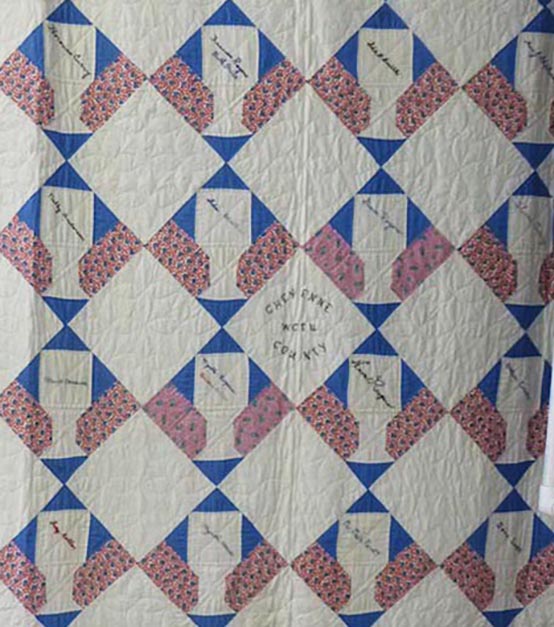
The W.C.T.U. encouraged fundraising quilts covered with names. One paid a dime or more to have one's name embroidered on the piece, which then might be raffled to raise more money.

Two New York quilts


Raffles were an affront to antigambling sensibilities but they went on despite
 laws prohibiting any kind of gambling. (I believe still on the books in Kansas.)

1901

The Water Glass, a temperance symbol

Tennessee State Museum Collection

Chester, Pennsylvanians with a WCTU quilt. The white ribbon
in the center was one of the group's symbols.


New York project & the Quilt Index. West Groton, New York

UPDATE: Louise sent a 1903 reference to raising $ with quilts. Same design but in red.


It's a good time to recall the WCTU and its goal of prohibiting alcohol in the U.S. They succeeded in their crusade only to watch Prohibition encourage a new attitude that increased acceptance of drinking alcohol with new cocktail recipes to hide the taste of bootleg liquor.

Post-prohibition bar with my mother and Aunt having a
Manhattan with the boys. Their generation learned to drink
during Prohibition.

Legislating morality, particularly religious morals, is a foolhardy goal. The 18th Amendment was a "failed experiment,” says Samuel Freeman, a professor of philosophy and law at the University of Pennsylvania in an Atlantic article. “They did make an amendment that had to do with a matter of private morality, and it didn’t work.”

Collection of the New York State Museum

Protestant religious sentiments in a WCTU quilt
made in Schenectedy in 1904.