QUILTS & FABRIC: PAST & PRESENT


Friday, February 19, 2021

1881 #2: National Fads


Log Cabin dated May 15th 1881
by Catherine Bush Gwin (?-1914) Iowa.
Collection of the Eastern Washington State Historical Society

Yesterday's post looked at regional styles in quilts dated 1881.
Other new ideas were popular all around the country

Log Cabins in silk and calico dated back about
15 years and became increasingly popular in the 1880s.

The date is on a piece of needlework so the quilt
might be later.


From Mother
August 15, 1881


A related innovation was the pineapple or Maltese cross variation.


It says "Frances C.W. Rauch from Ma Matoon," 1881.

A silk crib quilt for C.L.S. dated 1881, perhaps
to take the baby to church.


Silk was an expensive fabric, often imported, but in the 1880s American mills began weaving silk cloth, which reduced the price and increased the availability. Ready-made silk clothing factories also
proliferated and marketed scraps from the cutting tables in clever ways. We see the explosion of silk quilts made from these scraps after 1884 or so.

In 1881 Knight's Dry Goods sold imported silk yardage
for $1 to $2 in Montpelier, Vermont.


People made silk quilts in 1881 but they remained a rather luxurious hobby for a few more years.


As early as 1881 Mary Goff told you how to make a "crazy quilt." Not many needleworkers took her advice until 1884.


Once the crazy quilt fad hit it crowded out other styles
and a divide between crazy quilts and other quilts appeared.

Tomorrow we'll look at cotton quilts dated 1881

Thursday, February 18, 2021

1881 #1: Style & Dated Quilts


I picked a rather arbitrary year in the late 19th century to examine quilt style
and consider economic factors behind the look.
A look at 34 quilts date inscribed 1881 over the next few posts...
beginning with a whole cloth quilt from Joe & Mary Koval's collection
featuring a calendar and printed patchwork. Mary says she has no idea
why 1881 would be thought important enough to memorialize in a print.
Calendar prints are probably a bad sales idea---obsolete after a few months.

Here's a piece used in patchwork from an Illinois/Indiana 
Quilt Study Group meeting.

Not much was happening of note in 1881. It was a good year and yet a very bad one for James Garfield who was sworn in as president at the beginning of the year and assassinated at the end. Kansas became the first state to prohibit all alcohol. Whistler's Mother died and Florence Peto and Cecil B. DeMille were born.

People made quilts, although not in any great numbers if we compare the 34 dated examples say to the 1850s or the 1930s when we'd have dozens more to examine. But the quilts from 1881 can tell us something about a year that is relatively important in dating quilts by style and fabric.

We are grateful to Melissa for signing the center block of her quilt.

We see a few fashionable designs like the Double Irish Chain...


 this one dated 1881 from the North Carolina Project

& this one signed R Mc


I'm glad her red cottons were more reliable than her thread.
The fabric was probably Turkey red.

Signed MGB 1881 at the right bottom corner by
Martha Benedict (1850-1889) of Eaton County, Michigan.
From the Michigan Project and the Quilt Index

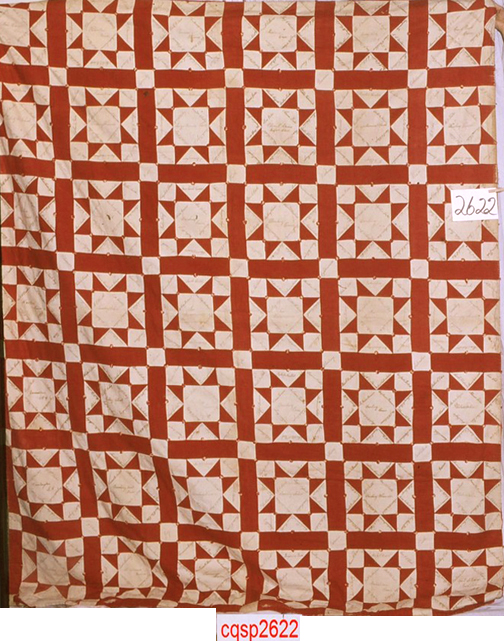
Turkey red and white quilts were in fashion. Most of us use a date of post-1880 for these red and white quilts (there are earlier exceptions.)

Star name quilt from the Danbury Universalist Church 1881 
Connecticut Project and the Quilt Index

We also see the beginnings of the fashion for name quilts in which
one paid a dime or a quarter to be remembered on a fundraising quilt.

Star name quilt, 1880 - 1881, by Sarah F. Gallup, 
Leominster, Massachusetts to benefit the G.A.R. veteran's group. 
Massachusetts project & the Quilt Index. 

Turkey red was a reliable old dye (if expensive) but the price of Turkey red cottons was dropping as chemists synthesized the natural dye. Genuine Turkey red was worth a little more if one had the money because those new synthetic dyes that were beginning to flood the market were fugitive. The gray sashing in the quilt above was probably once blue, likely a new coloring agent that just was not color fast. Here's another clue then to "after 1880"---synthetic dyes fading to tan, dun and gray.

We hope E.S. who initialed and dated this 1881 applique
never saw what happened to her green fabrics colored with the new
dyes.

The date is quilted in this one so E.S. may have done the applique
earlier (some natural dye combinations could fade like this with harsh
washing) but as I said, fading greens, blues and reds are a good clue to
after 1880.

The New Yorkers who made this sampler for their minister J.F. Jones and his wife had no problems with fading (at least by the time the photo was taken in 1985 for Jane Kolter's Forget Me Not.)

The appliqued album was old-fashioned by 1880 but New Yorkers
continued to make them in their own style with bold words and cats.
Scroll down to see a quirky New Jersey sampler from 1881.


Moossie whose name is on this quilt wasn't so lucky in her fabrics.

The ebay seller interpreted this as Moosie.
Could be Apossie???

This photo probably reflects the color better. It looks like the triple sashing was once red and chrome orange with a wider green strip in between.We don't know a thing about this quilt from an online auction except for the inscription but we can guess by style characteristics Moosie lived in the South.
1) Triple strip sashing
2) Half blocks on the edge
3) Solid colors that are fading
4) Run on border (strips not mitered)
At the QuiltHistorySouth Facebook group we've been looking at Southern quilts for over a year and we've noticed a real change in style about 1880. Southern quiltmakers seem to have created a regional style about that date.

Here's the QuiltHistorySouth Facebook page link. Ask to join.

Quilt dated 1881 by Angelica Justina Schultz Petree (1842-1919)
Winston Salem North Carolina
The North Carolina project

Here's her grave:

Angelica's quilt looks to be oxblood red-brown and dark blue with the standard white for a neutral. She used the run-on strip border that was done often in the late 19th and early 20th centuries. The pattern is also a Southernism---we might call it Pickle Dish---but Angelica added a small floral, a creative addition. Angelica's descendant mentioned she was a Moravian, a German-American, a group of whom came to Forsythe County before the Revolution.

Star quilt dated 1881 once in the collection of  Rita & Paul Flack

At the same time Southern quilters were going off in a regional direction Pennsylvanians who lived in the southeastern counties began following their own distinctive style. One characteristic was their use of brighter fabrics for neutrals - brighter than most American quilters would have chosen at the time. The above blue print as background is so linked with Lancaster County quilters people call it Lancaster blue today.

Detail of an undated quilt showing the double blue prints
so popular for backgrounds with Pennsylvanians.

Another Mennonite quilt from Lancaster County dated 1881,
with pattern, coloring and double strip border---a Pennsylvania look.

The distinctive Pennsylvania-German style (not confined to quilters from the Anabaptist sects but favored by them) seems to have developed about the same time that the regional Southern style did. Both regional styles continued strong into the teens and 1920s.

Tomorrow we'll look at more general styles that were fashionable around the U.S. in 1881.


Monday, February 15, 2021

Flora Delanica #5: Sunflower

Flora Delanica #5: Sunflower (Helianthus Annuus) by Becky Brown

The common sunflowers are native to the Americas.

Mary Delany's work reflects her lifelong interest in natural history. Collecting specimens whether botany or seas shells was a fashionable hobby at which she excelled. 

One of Mary's mosaic grottoes

Friends paid many compliments to Mary Granville Pendarves Delany, among them that she liked to keep busy. Throughout her life she had energy and enthusiasm for several large-scale artistic projects including the encyclopedic paper mosaick albums she began in her seventies---her Flora Delanica. In her thirties the young widow took up grotto building on a rather grand scale.

Mary Pendarves spent summer, 1732 with
the Donnellen sisters in Killala along the North Atlantic shore.

Her inspiration was a seaside vacation she and longtime friend Anne Donnellen took while visiting Anne's sister Catherine in Ireland. Catherine was married to Robert Clayton, Protestant Bishop of Killala on the North Atlantic coast.

Anne Donnellen (ca.1700-1762) suggested
 the extended visit trip to Ireland, perhaps to divert 
Mary after an unhappy romance.

Shell-mosaic, Margrave Grotto, England

Collecting shells was a mania of the time. Gathering natural history along the shore combined with a Christian tradition of decorating a cave or grotto with shells to symbolize a pilgrimage to St. James's shrine in Spain. 

For centuries pilgrims collected
scallop shells to commemorate their visit to 
Santiago de Compostela.

Not far from the Clayton's home was a hill on which Mary and friends were "erecting a grotto":
"On the summit of the hill is a natural grotto, with seats in it that will hold four people. We go every morning at seven o’clock to that place to adorn it with shells – the Bishop has a large collection of very fine ones; [Anne] and I are the engineers, the men fetch and carry for us what we want, and think themselves highly honoured."
Mary closed this letter to her sister:
"I am now going to build a pyramid for the grotto."

St. James, the patron of shell collectors, in Pope's Grotto, Twickenham

Back in England a few years later Mary visited the famous grotto built by poet Alexander Pope, gathering inspiration we can assume. She spent many of her summers as guest of her close friend Margaret Duchess of Portland at Bulstrode in Buckinghamshire, where she worked on a grotto.

The Grotto in the Park at Bulstrode 
 1781 by S.H. Grimm, British Museum


After she married Patrick Delany and returned to Ireland, Mary decorated their house in Dublin with shell work, creating a mosaic in the building's chapel.
"I go on making shell flowers for the ceiling of the chapel. I have made 86 large flowers and about 30 small ones." Mary in 1750

In her 1953 book Follies and Grottoes, Barbara Jones gives Mary Delany just a paragraph or two.

"She also designed and made or advised on a number of grottoes, notably a famous one at Bulstrode (now demolished) [pictured above] and her amusing letters often refer to follies: all the folly and grotto builders knew one another, and constantly visited and assessed one another's works----the references are innumerable.....In 1752 she gave a ball with one room decorated as a wood with a grotto...." 

Mary helped her sister Anne Dewes with shellwork interior decoration at her home Wellesbourne Hall. In the mid 1750s she advised Anne's neighbors the Mordaunt sisters at Walton, Warwickshire on the mosaics in their octagonal bathhouse.

The shell work in the Mordaunts' octagonal bathhouse has been restored.


Mary's vision for the room was shell stalactites or icicles looking as if they'd been placed there by "an invisible sea nymph."

You can stay in the octagonal room.
 The Bath House near Stratford on Avon is now a Landmark Trust site.

Sunflower by Barbara Brackman

Mary in her thirties, forties and fifties apparently spent many hours on scaffolds cementing shells to windows and ceilings. Looking at this mid-life work we can see the roots of the paper mosaics she created in her old age.

"Imagine starting your life's work at 72," begins Molly Peacock's book on Mary Delany, a common view of one aspect of Mary's work as an artist that diminishes all that went before.

To see the original Helianthus annus go to the blog Late Bloomer and scroll down:

The Block
#5 Sunflower


Applique on the diagonal to an square cut 10-1/2" or on the vertical center of a rectangle cut 9-1/2" x 12-1/2".


One Way to Print the Pattern:
Create a word file or a new empty JPG file that is 8-1/2" x 11".
Click on the image above.
Right click on it and save it to your file.
Print that file out 8-1/2" x 11". Note the inch square block for reference.
Adjust the printed page size if necessary.

Sunflower (Helianthus Annuus) by Nan Phillips in wool applique.


A Little More Mary Delany
A bearded iris---hybrid.
Iris Squalens Dingy flower de Luce. Tall Bearded Iris

In 1732 on her first trip to Ireland Mary wrote about her pleasure in shell collecting with four friends:
"We took off in a boat and went to a shore about a mile off to gather shells, where we found a vast variety of beauties. We were very merry in our work...."

Sunflower by Ilyse Moore, wool on linen 

Further Reading & Viewing

Lucy Worsley is portraying Mary Pendarves Delany here
in her new British series A Very British Romance. That's Mr.
Pendarves back there, I believe. Streaming now on PBS stations:

Poet Molly Peacock wrote a reflection on Mary Delany's life in 2011: The Paper Garden: Mrs. Delany Begins Her Life's Work at 72. See a preview:
https://www.google.com/books/edition/The_Paper_Garden/4sgI9qkBuBAC?hl=en&gbpv=1&dq=molly+peacock+mary+delany&printsec=frontcover

More about Irish grottoes and Mary Delany's role in the gardening fashion in James Howley & Roberto D'Ussy's The Follies and Garden Buildings of Ireland
https://www.google.com/books/edition/The_Follies_and_Garden_Buildings_of_Irel/xrwOGidTbKgC?hl=en&gbpv=1&bsq=delany

Mary's close friend Margaret Cavendish Bentinck Duchess of Portland was the queen of shell collecting.
Read Beth Fowkes Tobin's 2014 book: The Duchess's Shells: Natural History Collecting in the Age of Cook's Discoveries.

Barbara Jones, Follies and Grottoes, (1953 & 1974).