Saturday, February 26, 2011

Dot Cutters

News From Dotland


Those of us enrolled in the Karla Menaugh school of applique have long used removable office dots for the templates for our circles.


Stick the dot on the back of the fabric.
Cut out the fabric with a small seam allowance.
Glue the fabric over the dot, getting a nice round circle.
Applique by machine or hand.
Cut out back of dot.
Remove paper.
Uh OH!
Office dots, even the removable kind are too sticky.

I've been thinking. What is going on in the scrapbooking world that could help? I went shopping.

Here's what I found.

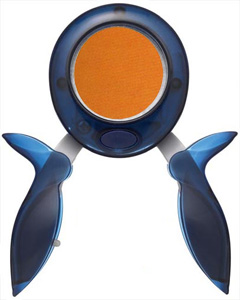
A Fiskars Squeeze Punch that cuts 1" circles.
There are plenty of other circle cutters out there, but this one seems to be easier on the hands.

Woo!
Multiple dots cut out of freezer paper.
Now I can iron them on the back of the fabric and remove them easier.

I have to confess that my major hopes were dashed, however. I thought this might cut fabric but--- No Way. I tried fused fabric, I tried fabric with freezer paper on it. It just isn't sharp enough.


But I'm happy with freezer paper dots. There is no stopping me now.

The next shopping expedition:
A paper cutter to cut out 1-1/2" hexagons.

And if you got a ginormous dot cutter you could do snowglobes


Or anything....


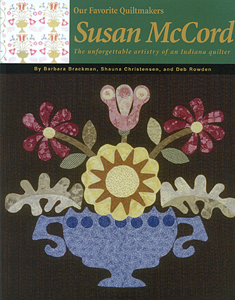
Read more about Karla's machine applique techniques in our book
Susan McCord, which you can buy from the Pickledish store at the Kansas City Star website.


Thursday, February 24, 2011

Stars Out of Control Part 2

These stars that cover the whole quilt top often work really well.
Even when the sewing is a bit problematic the graphic impact saves the quilt.


You can see why everybody wants to make one---at least one.


When the graphics work they are impressive.
But sometimes stitchers bite off more than they can chew.


I showed seven-pointed stars in an earlier post.
Click here:


It's surprising how common seven-pointed stars are.


The six-pointed stars seem to have been planned,
as there's a long tradition of six-pointed stars.


Here's one from about 1840.
She might have planned it as a seven pointed star.
And here's the extra point.


The one-pointed star?

There's so much that can go wrong.


Gravity
From the collection of the American Folk Art Museum.
See information about their current exhibits here:


This one belongs to Deb Rowden.
 It's the star (so to speak) of her collection of
Thrift Shop Quilts.
See her blog Thrift Shop Quilts by clicking here:

Monday, February 21, 2011

Civil War Reproduction Prints

Ann Kimble showed me her paper pieced medallion top
made with precuts of my Civil War Crossing prints for Moda.

I love how she fussy cut the stripes.


This collection of reproduction prints came out in 2009. 
We know it takes a while to do these hexagon quilts.


See more of Ann's patterns for paper piecing by clicking here:


Annette Chavez has just finished her version of the vase and flowers from the "Frost on the Fern" quilt in Barb Adams's and Alma Allen's When The Cold Wind Blows. The toile background is fabulous. The whole thing is fabulous. She says she is going to call it "Toil on Toile".


My favorite part: She used a reproduction red from Civil War Homefront for the vase.


I do a Civil War reproduction collection every year or so. There are common shades between them so you can build a stash of tans, reds, blues, browns, etc with print styles such as paisleys, stripes, foulards and patriotic prints.


The star print and others are from the
 last three Civil War reproduction collections I've done
with the Union print in Civil War Reunion.

The precuts for the 2011 line Civil War Reunion are in the shops now and the yardage should be out in February with more reds, browns, blues and a great eggplant purple.
One more reason to be glad that February only has 28 days.

And see this Jacks quilt top from the 2010 collection Civil War Homefront at the Quilt Hollow blog.
http://www.quilthollow.com/2010/08/jacksthe-schnibble-kind.html

Saturday, February 19, 2011

The Name on the Quilt


A few months ago the editors at The Quilt Life Magazine asked me:
What was the most surprising thing I've found out in quilt research?
I had to think for a while and I decided the answer:  
I've been most surpised by the differences between what we call a 19th-century quilt design and what the quiltmakers called it back then.

What would you call the pattern pictured above?


This quilt from the collection of the Shelburne Museum confirms a name I probably would use for this pattern. Another name I'd use would be Democrat Rose.

We don't know much about pattern names before 1890 when magazines and quilt pattern companies really began to publish them as a way to sell patterns. But some earlier quiltmakers like Charlotte A. Raynor actually recorded the name on the quilt.


Most of the examples I've seen over the years, however, do not confirm my idea of what the pattern is called. The Arizona Quilt Project found a similar quilt to the one above. The maker Sarah Gear appliqued her name and the words "Odd Fellows Rose" in the border. (See their book Grand Endeavors, page 187 for a photo of the quilt.)


How about an indigo star like the block above?
The Illinois Quilt Research Project 
found a quilt assembled  from old blocks
 like this one. In the border is appliqued:
Jackson*Star*Quilt*Made*1849
I don't know of any other patterns named for Andrew Jackson. This might be the only one.

For a picture, see page 60 in the Illinois project book: History From the Heart

I might call this pattern Missouri Rose or Love Apple or Pomegranate.
On the reverse of this one is inked:
Mississippi Beauty
Judith Connor's Quilt. Presented by Jane Shelby,
Feb the 10, 1855

The quilt is now in the Winedale Collection at the University of Texas.
Click here to see the file in the Quilt Index with a photo of the quilt.


And here's
"The Peony and Prairie Flower"
by Parnell Grumley, dated 1847,
in the Shelburne collection.
The block might be the peony,
the border the prairie flowers.


How about this pattern?
I really don't have a name for it
because I don't think I've ever seen it before.


Clarissa Strong did us a favor when she created the border in 1854, telling us it's "The Indiania Fancy Quilt." The quilt is in the collection of the Indiana State Museum. Read more about their collection at the WomenFolk webpage by clicking here:


Years ago I saw an unpublished quilt in this pattern. Badly burned, it's fortunate that it survived at all. The applique pattern is one we'd call Prince's Feather---or is it Princess Feather? It really doesn't matter, because on the face of the quilt it says: Kossuth's Feather

Lajos Kossuth was an extremely popular figure in the 1850s, a Hungarian political activist intent upon overthrowing the rule of the Austrian Emperor in his homeland. In exile, Kossuth traveled the world raising funds for his revolution. A magnetic speaker and handsome man, he toured America 1851 and 1852.

Like all publicity-conscious revolutionaries, Kossuth wore a dramatic costume. His was topped with a large hat and a larger feather. The Kossuth feather became a fashion statement. I've never seen another reference to the revolutionary name for a pattern we identify with royalty.


Read more about the history of the pattern at Karen's blog posting:
http://karenquilt.blogspot.com/2010/12/red-and-green-part-1.html

And click here to see a pieced quilt with the pattern name "Ladies Ramble" on it at the Bergen County (N.J.) Historical Society:
http://www.bergencountyhistory.org/collections/LadiesRamble1876.2.jpg
Read more about it here by scrolling down:
http://www.bergencountyhistory.org/Pages/BCHScollectionsRV.html


So when people ask me what is the "correct" name for a quilt pattern I just have to say: "There is no correct name for a quilt pattern." That surprised me when I figured it out years ago. Now I just shrug and say, "Whatever you want to call it."

Thursday, February 17, 2011

PILLOW TALK!

Today's my day for a Pillow Talk blog post.
All the Moda designers are supposed to make a pillow and blog about it.


Click here to read the overview of the blog hop.

No where does it say we were supposed to SEW a pillow.
So I Photoshopped the pillow above.
Moda Lissa said I might tell you when pillows were invented....

The first decorator pillow---a spotted rock

But I think I'll just tell you when pillows were hot.
About 100 years ago when the picture postcard was THE thing, people sent picture postcards of pillows.

Women showing off pillows


Showing off doll and pillows


Showing off baby and pillow


Showing off pajamas and pillows


And a Kansas fiftieth anniversary pillow, 100 years ago.


Here's the postcard I altered for the top of the page.
I bet their mothers didn't know they were photographed in their nightgowns. Things like that go on in Chicago.


The fad for pillows in the early 20th century was encouraged by the arts and crafts design movement. Gustav Stickley's magazine The Craftsman often featured pillow designs.
 
Above is my sister's living room with Stickley furniture and pillows of antique textiles or reproductions.


Many of her reproductions are from Dianne Ayres Textile Studio.
The appliqued and embroidered ginko leaf is a Stickley design on linen.


See Dianne's web page Textile Studio:

And the book she wrote with several co-authors:
American Arts and Crafts Textiles.
It's everything you need to know about decorating with Craftsman textiles.

But wait--- this is supposed to be about my fabric---not Dianne.
So I've photoshopped another pillow.

Above is an appliqued adaptation of William Morris's Strawberry Thief, done in my William Morris reproduction prints, stitched by Georgann Eglinski and photoshopped into my reproduction Morris chair.

Buy the pattern for the applique here:


And here's the pillow I should have sewed. You can download a free pillow case pattern from American Patchwork and Quilting's All People Quilt web site by clicking here. They've used fabrics from my Morris Tapestry collection for their Million Pillow Cases project.

Tomorrow Deb Strain entertains on the Pillow Talk Blog Hop. Click here on Feb 18th.