Thursday, December 30, 2010

AQSG Star Study Opens In Oregon

Eagle Medallion by Carol Godreau and Maureen Gregoire
49-1/2" square

The traveling exhibit of quilts from the American Quilt Study Group's 2010 quilt study opens at the Latimer Quilt and Textile Center, Tillamook, Oregon on January 3. A selection of the reproduction quilts will be up until February 6, 2011. Every other year members can participate in a themed reproduction project. This year's theme was stars.


Some of the AQSG members interpreted quilts from books. The Eagle Medallion at the top of the page is on the cover of Quilts and Quiltmakers: Covering Connecticut.
 
Silk Star of the Bluegrass by Marti Phelps
35" x 35"

Others went to museums and saw the quilts in person. Marti's inspiration was a quilt in the collection of the National Museum of American History by Mary Norton Hise.

Quilt by Mary Hise Norton,
National Museum of American History,
 Smithsonian Institution

See more about the National Museum of American History's quilt by clicking here:

And others looked to quilts in their own collections.
Stars and Shamrocks 2 by Xenia Cord
43" x 49"
Xenia owns the original very odd quilt from the mid-9th century with the lower corners cut out for the bed posts. She did a wonderful job of reproducing it.

The original quilt with blue and buff striped fabric
1830-1860?
Although she said she hated making it, she was glad she did it. This one isn't in the traveling show.

Detail of the original in Xenia's collection

See my blog post on December 6th for more pictures of exhibit quilts:
http://barbarabrackman.blogspot.com/2010/12/aqsg-star-study.html


And click here to see all 39 on the American Quilt Study Group webpage:
http://www.americanquiltstudygroup.org/qs_star_study01.asp

Sunburst by Janet Locey, quilted by Holly Casey 
35" x 35"
 Janet's inspiration is a 20th-century quilt she saw at the 2009 American Quilt Study Group Seminar. The stars appliqued to stripes is from the collection of  Julie Silber's and Jean Demeter's Quilt Complex.


Here's a photo of it when it was sold at an on-line auction a few years ago.

At the end of February the show will open at the Monroe County Historical Center in Bloomington, Indiana, where it will be up from February 25 to June 5, 2011.


:

Tuesday, December 28, 2010

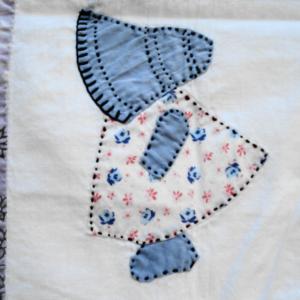
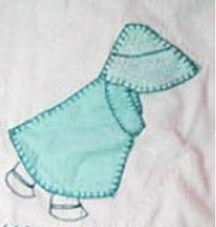
Sunbonnet Sue Wrecks


I'm not a fan of Sunbonnet Sue. I've seen too many, and she's too darn cute.

But I do enjoy collecting photos of Sues gone wrong.

Not Sues gone bad as in my post in July. Click here:
http://barbarabrackman.blogspot.com/2010/07/sunbonnet-sues-dark-side.html


But Sues gone wrong, terribly wrong.
The major problem seems to be the appendages, arms, hands and feet. Everybody knows that nobody can draw hands.


So a lot of Sues are left without their hands, which is a pretty good solution.


When in doubt just leave them out

Everybody knows Sue has only one hand, but some people just can't leave it at one.


I think the problem with the feet in the two blocks above is trying to portray both feet.
I have no idea what happened with the arm and hand in the yellow block above.


Two feet is probably never a good idea.
She seems to be walking away from the whole idea.


What?!?


What?!? Part 2


Sometimes it's just a matter of proportion.

For more about the history of Sunbonnet Sue see this Sunbonnet Sue web page:

http://www.sunbonnetsue.com/suehistory.html

Sunday, December 26, 2010

Marseille: White Corded Quilting


The International Quilt Study Center and Museum in Lincoln, Nebraska, is featuring an exhibit of whitework until May 22, 2011.

The show is guest curated by Kathryn Berenson, author of Quilts of Provence and the new Marseille: The Cradle of White Corded Quilting.


Denniele took a trip to Lincoln and sent photos. Whitework is often hard to photograph but the show is so well-lit and she is so handy with her point and shoot that her photos will inspire you to make a trip.


Here's what the IQSC site has to say about the show:
Marseille: White Corded Quilting, the first major display in the world of all-white quilted and corded French needlework,  explores its development in Marseilles, the fusion of technique with design imagery, and the integration of this needlework into other cultures as it was exported, adopted and re-transformed over three centuries in three continents.


Broderie de Marseille is a form of three-dimensional textile sculpture using plain white cloth and white cotton cording, deftly manipulated with needle and thread to reveal patterns highlighted by the resulting play of light and shadow on the textile surface. Skillful execution of broderie de Marseille resulted in delicate, refined work that graced the homes and figures of aristocrats and launched an international passion for all-white corded needlework. The quilted works were filled with imagery expressing contemporary values, such as folk legends (Tristan), heraldic devices and royal monograms (on bedcovers), and floral wreaths an fruits symbolizing good fortune and fertility (on wedding quilts). Contemporary versions, today often referred to as "matelasse," are machine made and thus lack the intimate connections to the work represented by the confections of the original needleworkers-almost all of them presumably women.
Click here to read more:
http://www.quiltstudy.org/exhibitions/online_exhibitions/marseilles.html

Friday, December 24, 2010

Dotland for the Holidays


Those of us who grew up as Catholics learned that there's a patron saint for every cause. For my Book of the Saints I wanted a Patron Saint for Dotland.

St. Dorothy was a good option.

St. Dorothy
She is the patroness of brewers, brides, florists, gardeners, midwives, and newly wedded couples. We could call her St. Dot and add polka dots to her watch.

Or it could be St. Casimir, the patron saint of Poland, inspiration for the polka and thus polka dots ---although why these dots should be named for a popular dance nobody knows.


St. Casimir

St. Quirinus is the patron of the obssessive compulsive.
I've already done him once as a digital card for a friend who has a dot problem.


I decided on St. Dot for the patron saint of Dotland, pictured here with St. Barbara on the left.


St. Dorothy is on the right, dispensing dots to the needy.
Click on the photo and it should be large enough to print for framing.

And click here to see a preview of the Book of the Saints for Quilters.


Wednesday, December 22, 2010

Christmas Cuteness Alert

You may want to avert your eyes....
Every December I get to go to San Francisco before Christmas. I do my rounds of design, décor and darn cute. The first cute stop is the windows at Macy’s on Union Square. They build fanciful habitats that are populated with adoptable critters by the San Francisco SPCA.

The crowds line up at night to watch them snooze. Inside Macy’s they have a room with available pets. The woman in charge told me they’d been doing it for 24 years.


A friend adopted a puppy years ago when the SPCA put puppies in the windows at Gump’s Department Store. Gumps the dog is gone, but the tradition lives on. I managed to leave Macy’s with only some socks.


And a picture of three sisters in matching polka-dotted tulle outfits writing letters to Santa in the Holiday Lane area.


Then down Maiden Lane to Britex Fabrics, four floors of fiber.

I was glad to find that All Saints, a London boutique, has opened a San Francisco branch right next door to Britex. Just as in London, their façade is covered with old sewing machines.


Inside the store is clothing for chromophobics who think gray is the new black.


But the sewing machines were shiny.

Anthropologie always has the wackiest decorations. Here's a tree of yarn balls with a tree of mittens on the left. I can see I need some giant stryofoam cones.


 This year the feature is a patchwork of sweater parts on
 a) Trees
b) A miniature house

c) Taxidermy deer armatures


Bloomingdale's

I usually walk around glitter-dazed, making unintelligible notes for next year’s tree. Every November my friend Georgann and I decorate a tree to be auctioned for a local children’s charity. This year our theme was pink and white and Japanese cherry blossoms.


with kimono-clad bunnies from Urban Outfitters.

I’m thinking red Chinese fans for next year,

Sort of like this tree at Bloomingdale's. Unless Georgann wants to knit a lot of patterned squares to cover a deer head.

Monday, December 20, 2010

The River Wey

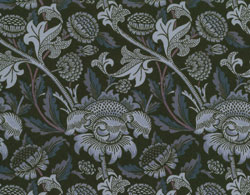
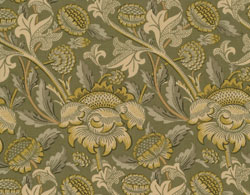
Wey, a reproduction from the Moda collection A Morris Tapestry

Nature was William Morris's muse. His careful observation of plants and birds are one reason his fabric designs remain so current today. He captured the essence of the bloom and worked it into a complex repeat of layers of curving lines.


Design for Wey by William Morris

The lines in the repeat also reflected his feeling for nature with stems and branches standing for the rivers and streams of England. He created several designs named after waterways. The Wey is a river that runs through Surrey, Hampshire and West Sussex, joining the Thames River at Weybridge.


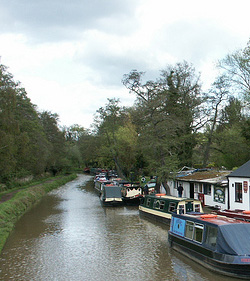
The River Wey

The interlaced lines in the pattern are thought to represent the river and its tributaries. The major line in Wey is a strong diagonal with stems interlaced behind it.


Morris's drawing for Wey,  partially colored


The Wey has long been a navigational river.


Wey was designed by William Morris about 1883, originally meant to be blockprinted on cotton broadcloth and on velveteen (the red piece above is on velveteen).
.
In recoloring Wey for A Morris Tapestry I toned down that diagonal line. Directionality that works well for upholstery and wallpaper is often too strong for patchwork.


For the border and setting triangles on my pineapple log cabin
 I'm using Wey in the damask black colorway .


Right now I am handquilting along the diagonal lines, the tributaries.

See more information about the River Wey by clicking here:

http://www.weyriver.co.uk/theriver/nav_2_%20history.htm

And see the Textile Blog for more information about Morris's other prints named for rivers---Windrush, Cray, Wandle, Medway, Evenlode and Kennet:
http://thetextileblog.blogspot.com/2009/12/william-morris-and-thames-tributaries.html

One can take a boat tour of the River Wey.